Friday’s Library Snapshot
To celebrate the recent 224th birthday of William Swainson (1789-1855) who was a British ornithologist, malacologist, conchologist, entomologist and artist.
I searched our collections for some images. Unfortunately we don’t have many of his works but I think you will agree these images are very lovely


Images from
Birds of Western Africa by William J. Swainson
Flycatchers by William J Swainson
Alphabe Thursday … U is for Utensils.


U is for Utensil; an implement, tool or container for practical use.
Coming from the Latin uti (to use), Utensilia (useful things), utensilis (available to use).
I didn’t have to look far for a U word today! I am a collector of useful things and containers to put them in!
I have given up trying to de-clutter. But, instead of throwing away I remember why I bought the item in the first place and rather than chuck it; I bring it back into use!!
Or another ploy to keep the item is to ‘raise its profile’ while it is no longer useful; I discover its aesthetic splendour give it a place beyond the Marmite jar and on the ‘nice to look at shelf.’
I do try and slim down my containers and this does work for a while; Until I find a new interest and a new set of useful items.
Another saving grace is that one’s partner doesn’t have the habits of a magpie.

Wednesday, women, gifts and Diego Rivera


It was my brother’s birthday last week and he told his friends on Facebook that he had asked [his wife] for a sitting room carpet and it was being fitted that day. I was puzzled and wondered why even in a joke, one would ask for floor covering as a gift?
I love to give gifts, and often give something to a friend that I would like myself. So perhaps my sister-in-law was calling his bluff and was thinking in this way too.
I not caring too much for a new carpet; prefering a good book; receieved a delightful backhanded gift this week
As you know I went to the Royal Academy to see Mexico ; the revolution in art 1910-1940. It featured among others the work of Diego Rivera. I had not realised that not only was he a painter of murals but also a prolific illustrator. Since then my daughter in Brazil, aware of my passion for books and fine illustrations came across a ‘just the thing’ called Diego Rivera ; great illustrator by Raquel Tibol and ‘thought of me,’ Sadly, it was more than she could afford.
So I bought the book for myself! It is a truly wonderful gift; it has already been well thumbed and will be enjoyed for a long time.
So to celebrate women and my kind thoughtful daughter I have picked out some illustrations of women and their place in society as seen by Diego Rivera.
Weekly Photo Challenge … Good Morning


My good morning begins at 5am and continues until noon when of course the good afternoon begins. I often wonder if I am a little obsessive or perhaps addicted to tea. Nonetheless my good morning begins with a pot of white tea; Silver Needle is my favourite. Sometimes, with a tit-bit; at times tea can be a little too wet! As the morning progresses and the household comes alive so the need for tea and breakfast comes; around 7 or 8; green tea (Dragon Well) is my preference then.
So refreshed; I cycle to work (this too is a vital part of a good morning) but not more than the tea break at 11 am when I take some oolong (Ti guan yin) that I can sip until noon.
However, at the weekend the good morning will end with coffee and cake! Funny, that coffee too can be a little wet without a chunk of cake.
So for me a good morning is not without a cup of tea and/or coffee and a tit-bit.

After a fine Summer the Autumn continues fair …


The walk yesterday was a joy; although I didn’t expect it to be so. I was even tempted to stay in bed, as I remembered last week while it was quite pleasant the clouds hung low and remained all week. Yesterday, although it was colder; the sky was clear blue, with pink clouds that soon disappeared [to where clouds go?]
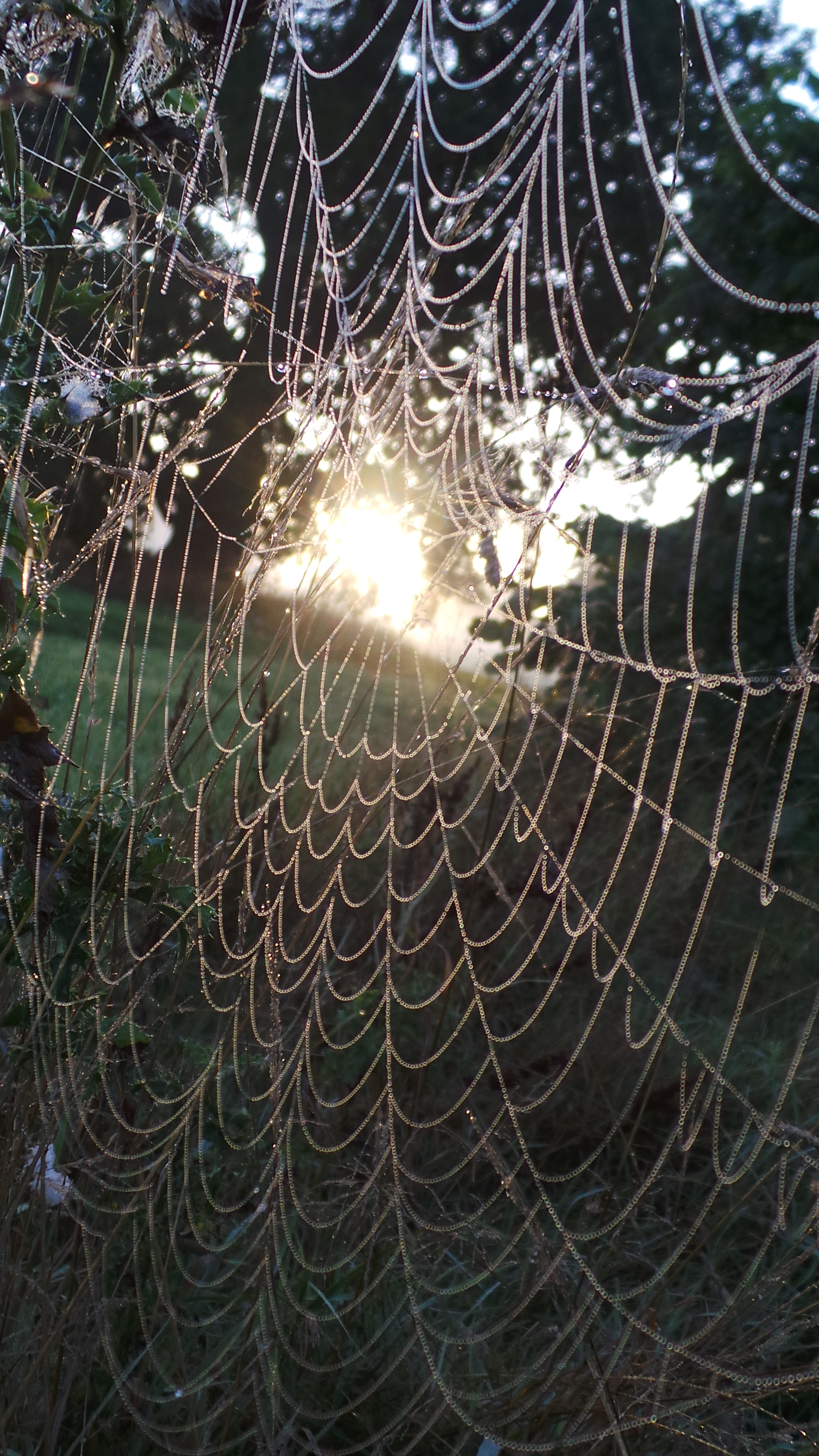
So the autumn colours were glorious; even the spiders had been busy for my delight.
Silent Sunday

Its Saturday; but last week …


It has been Fresher’s Week at the University; while it has been quiet without the students all summer; the library comes alive again. Since the end of term the library has buzzed with contractors giving us the WOW factor. The result is very lovely; I don’t know whether the students agree or not. For me it has been business as usual and not sure whether a library needs a WOW factor. I prefer a gentle ‘Tis OK’ but then I am a grumpy old lady!
So, in a bid to remove myself from the flurry of library tours, welcome desks and the general milieu of fresh faces; I took myself of to do some painting. I say paint it was more a reconnaissance mission. I have of late been inclined to take my camera to record the change of scenery or rather capture scene that will of course change at some point. Since I have taken up recording daily life (or some of it within reason) by hand; I thought I might try and paint life!
So I gathered up my tools and packed them in my handbag; remembering my ‘handbag’ resembles no such thing.
I managed to take a box of paints, pencils, paper, water and my lunch; all I needed now was a quiet spot. I was not wishing to draw attention to myself at this stage. I wasn’t yet at the point of no return; still in a secret state. I could still give up the idea and spend my break gazing at the Hello magazine and no one any the wiser.
With my trusty bag and the ploy ‘Off the the bank!’ nod nod wink wink to myself!
Well! I hadn’t reckoned on a cloud burst; students running, hither and thither to find shelter.
I was now at a place of no return and hurried to find a place to at least to eat my lunch; and fulfil a little dream.
Well I did ; and it was OK! It wasn’t so bad that I had to share the only dry space out of the rain with a group of smokers who too perhaps had a guilty secret or simply excluded for indulging in a nasty smelly and anti-social habit! At least my habit won’t kill me.
Friday’s Library Snapshot …


I am a fool for children’s reference books; and have a small collection that has fed my butterfly brain over the years. I have books and pamphlets that cover subjects from weather and clouds to the life and times of Colonel Custer! So when I found this little book while cataloguing a collection here at the library, I immediately bought myself a copy. It is of course very out of date. Nonetheless, for me it tells the story of books from their earliest beginnings nearly 6000 years ago, including clay tablets, papyrus scrolls, codices, parchment and vellum manuscripts, the coming of paper to Europe, the invention and development of printing.
It surveys the book world in Britain today, (1960) authorship, publishing, book, design, printing, binding and bookshops. .
There is a chapter on development of libraries and a practical guide to enable readers to enjoy books more fully and use them skillfully whether for fun, general knowledge or as a tool in education or in the workplace. I did say it is out of date!.
The authors are well versed in the subject matter Esther S Harley was at the time a librarian and bibliographer, with experience in libraries of various types and a special interest in the art and techniques of book production. John Hampden has written, designed, produced and published many books relating to the book world.
While this book is no longer valid as a representation of todays book world and not on the shelves at the public library. It is a lovely little history book and a sound reference book.
Alphabe Thursday … T is for Tunnicliffe and Tarka


I don’t know why I haven’t written about Charles Tunnicliffe before; he is celebrated as the greatest wildlife artist of all time. He was a hardworking, modest countryman who inspired countless naturalists of all ages; if only from his illustrations in Ladybird and Puffin Books alone.
Charles Frederick Tunnicliffe (1901-1979) grew up on a small farm in Cheshire, where he helped out with day-to-day tasks enabling him to observe animals and birds closely and at the local village school he learned to draw and become interested in art. When he was 14 he enrolled at Macclesfield School of Art and was awarded a scholarship at the Royal College of Art in London. Where he met the likes of William Rothenstein, Barbara Hepworth, Henry Moore and Edward Burra. Tunnicliffe studied engraving and went on to teach illustration and graphic design.
After graduating Tunnicliffe continued to live in London making a living from selling etchings and engravings of rural scenes. Meanwhile, he married a fellow student Winifred Wonnacott who it is said was the mainstay of Charles’s life and an essential contributor to his remarkable success. He then moved back to Macclesfield. With the onset of the economic depression in 1930s the market in prints declined. So Tunnicliffe had to find other sources of income.
Winifred encouraged her husband to submit illustrations for the new edition of Henry Williamson’s best-selling novel Tarka the Otter.
It was this series of wood engravings that bought the artist widespread recognition when the book was published in 1932.
‘Tarka … threw me into closer and closer contact with animals and birds’
Images from Tarka the Otter by Henry Williamson ; illustrated by C.F. Tunnicliffe 1932
What to look for in Autumn ; a ladybird nature book by E.L. Grant Watson with illustrations by C.F. Tunnicliffe
Birds of the estuary by C.F. Tunnicliffe
Wednesday’s wise woman … Tina Modotti


Recently I visited the Royal Academy and saw the exhibition Mexico: A revolution in art 1910-1940
I was drawn to some photographs by Tina Modotti (1896-1942) who was an Italian photographer, model, actress and revolutionary political activist. In 1913, at the age of 16, she emigrated to the United States to join her father. As an actress she appeared in several plays and silent movies. She also worked as an artist’s model.
In 1918 she met Roubaix ‘Robo’ de l’Abrie Richey, an artist and poet; they moved together to Los Angeles so that Modotti could pursue her career in the motion picture industry.
Modotti had already been introduced to photography as child, by her father and uncle who ran photography studios. So when she met Ricardo Gómez Robelo (and become lovers) and the the photographer Edward Weston and his creative partner Margrethe Mather; she quickly developed as a journalistic photographer. By 1921 Modotti was Weston’s favourite model and lover.
Meanwhile Ricardo Gómez Robelo became the head of Mexico’s Ministry of Education’s Fine Arts Department and invited Robo to join him in Mexico City with a promise of a job and studio.
Robo left for Mexico, and Modotti followed him later but sadly he died before she arrived. Soon after her father too died so she returned to San Francisco.
In 1923 Modotti with Weston and his son returned to Mexico; where Modotti ran Weston’s studio in return for his photographic tutoring.
During this time Modotti met Mexican photographer Manuel Alvarez Bravo who was impressed by her style both ‘romantic’ and ‘revolutionary’; together they set up a portrait studio; and were commissioned to take photographs for the book Idols behind bars by Anita Brenner.
(amendments) I have since learned that Tina and Alvarez Bravo did not had a studio. He and Tina did not met until Weston had returned to his family.
While Weston was attracted by the landscape and folk art of Mexico; Modotti was captivated by the people and their environment. She found a community of cultural and political ‘avant-gardists and she soon became the favoured photographer of the Mexican mural movement; documenting the works of Clemento Orozco and Diego Rivera. Here she matured and made a name for herself culminating in a one-woman retrospective exhibition at the National Library in December 1929; advertised as “The First Revolutionary Photographic Exhibition In Mexico“.
Modotti and Weston were now living in the capital’s bohemian scene and had created a growing portrait business. During this time Modotti had become involved in the Mexican Communist Party; her work now more politically motivated. Around that period, her photographs began appearing in publications such as El Machete.
When Weston returned to his family in the US; Modotti become more committed to the political agenda. However, she was not to spend much longer in Mexico. Her public profile and outspoken views as a communist at a time when the Communist Party was banned was not considered desirable. Her new companion the Cuban Leader Julio Antonio Mella was killed. Modotti was linked to the assassination attempt against Pascal Ortiz Rubio soon after he had assumed the presidency. Although Modotti was supported by Rivera, she was deported in 1929, and lived in Germany, the Soviet Union. She returned to Mexico under an assumed name; one of many seeking asylum there from Spain where she had been fighting for the Republican cause in the Spanish Civil War. Three year later in 1942 she died of a heart attack. This was not before she had successfully restored her reputation and been pardoned. Sadly she never took another photograph of the country that so fascinated her.
 Coat Hanger Doll's House