Last week …
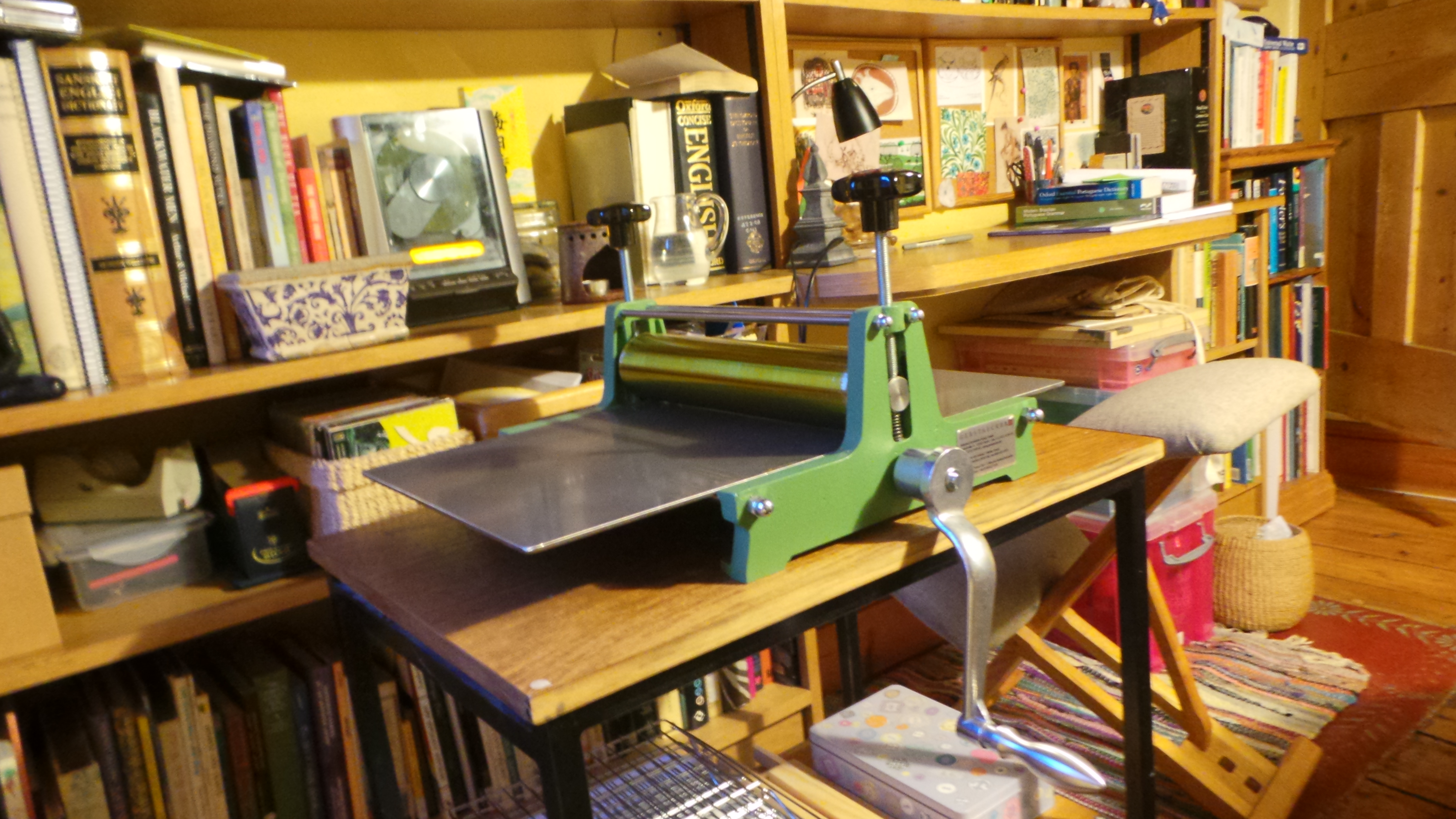
I bought a printing press on Ebay! I have been wanting one for a long time, but have been put off by the price and size. Then, there are the other difficulties I had as beginner, I began by asking the advice of other printers and then in my mind even that was almost dangerously conflicting. However, as I began to get familiar with the subject matter, language and terms and worked out my own requirements I soon discovered that there is not a pres that ‘fits all’ Then, I could seen how I had become confused, each person I asked had different, needs and was in position to tweak the beast or able to have the use of another press of other requirements. I don’t have these skills, space or money for a super-duper hybrid (even if there is one) Size, remained paramount, cost become secondary. Making the decision later in the game I began to see the opportunities but even then I had to be careful.
Then I came across this one, a good size but without the facility to print wood engraving ; however this was not such a serious issue as I can press those by hand if needed.
Even so, this is was still a few quid more than I hoped to pay for a luxury ; it was a mere tool. I would not hope or pretend that I could recoup the cost on sales. So, even considering the almost perfect press,I still had serious doubts.
I began bidding, half of me wanting it to be snapped up for the ‘buy’ price and the other half eager to have it in my little studio!
As the bidding crept up ; I zapped ‘buy’ and went to collect yesterday.
Today I will bolt it to the table for extra stability … as regards any thing else I am hoping it will be all intuitive ! However,I will value words of encouragement or advice …
Silent Sunday

Saturday and the advent of Christmas
After my first Christmas party of the season I am a little hung over and not feeling so comfortable about the next couple of weeks. We made a decision during the summer, that because of the lack of funds this Christmas would not happen. By this I mean in our household ; first we would not arrange for my daughter and her partner to come home from Brazil, then, therefore not entering into the game of swapping expensive presents or getting embroiled in the rounds of entertaining.
The later half of the plan will not be difficult, we have enjoyed the extravagance of Christmas less and less over the years, so for us it has become more simple, more pleasant and easier on the pocket.
It is the lack of the visitation of the Brazilian kind that hurts much more … so today with my sore head and smile, I send thoughts and good wishes to Mums separated or not from children, who find reasons at Christmas not to enjoy the so called festivities.
Friday’s library snapshot …
This week I came across Mary Azarian an illustrator and print-maker who has produced many books yet I found only one about Wilson Bentley in the library not in Special Collections has I hoped but on the open shelves at the Main Library. Then, I went on to think about what makes a book special. There are of course a myriad of good reasons and many more when considering a book to be kept in ‘special’ conditions; even without the economic and space issues.
For this one, I would make a case, not only is it illustrated by a notable woman wood engraver and therefore complimentary to our collections of works by wood engravers in our Printing and Publishing Collections, its subject matter is significant. Wilson Bentley, (1865-1931) was the first man to photograph snowflakes. As a small boy he was fascinated by snow; its structure and beauty. When he was given a camera in the late 19th century he was able to develop his passion fully. It is a lovely story while the images are beautiful the message to a young reader is special.


Alphabe Thursday C is for Ffyona Campbell

As described last week Basho walked to speak with his god. Others do it to test their body and soul. Ffyona Campbell, for instance in the 1980s, a daughter of a harsh military man wanted to prove herself to him and herself. She was on a quest to walk, not only the length of Britain but also around the world.
The first trip in 1983 at the age of 16 she walked 1000 miles, sponsored by London’s Evening Standard to raise money for a hospital. Then, she set out to walk around the world; this was not a continuous venture. First she walked across the United States of America, two years later Australia and then the length of Africa eight years later. Finishing up in 1994 with a trek from Spain to the English Channel. During this time she returned to Africa and the US to complete parts she had missed out earlier.
These extensive walks were documented in several books in particular the Whole story ; a walk around the world. Not literary masterpieces, as written by previous walkers such as Wordsworth. Without the delight of landscape in her narrative her writing appears as the ideals of a determined young woman with resolute goals. Campbell is a practiced sponsored walker; remarkably she walked 50 miles each day without let up, along the side of roads in all weather conditions. She walked across Australia, 3200 miles in 95 days. Her legs strong and relentless in their pursuit, but without scenery, pleasure or encounters human or otherwise.
So while Campbell tells us about walking and how it should be done with its fundraising and personal betterment, she was very successful. However, without the views, thoughts, (poetic or not) and the other human experiences (good or bad), it really doesn’t seem so worthwhile after all.
Wednesday’s wood cutter …


I like these images by Mary Azarian, they are wood cuts while they are bigger than wood engravings they tell a story. They are also from A farmer’s alphabet ; ABC books are a passion of mine and these little motifs are a delight. I will look out for her books.
Meanwhile I will share the little information I have about the artist.
Mary Azarian (1940) is an American wood engraver and illustrator, in 1999 she won the Caldecott Medal for her illustrations in Snowflake Bentley by Jacqueline Briggs Martin; the story of Wilson Bentley ; the first known photographer of snowflakes. She has produced many original prints and published more than 50 books. Before become a full-time artist Mary taught for 3 years in a one room school house. At first she printed black and white images by hand, later she added colour. When she found an old Vandercook proofing press she was able to increase her out put considerably. In the 1970s she began illustrating children’s books.
Weekly photo challenge … Converge
We women boast our ability to multitask; but I am not sure this is such a good thing. I like the idea that we are able to assume different roles throughout our working days. I enjoy beginning my day with yoga being calm and peaceful devoting 30 minutes or so to my breath and my body before I become something else. Before, I leave the house for work I am already a blogger, cook, cleaner and household executive. I commute as a cyclist; destined for the Tour de France. At work I take on many guises, Reading Room assistance, high tech wizard, bottle washer, remover of rubbish, investigator, motivator; in my bread winner mode I leave no stone unturned.
But we cannot maintain these roles or do a good job unless we isolate them; we cannot successfully do them at the some time. For instance while zooming down the cycle track in my yellow shirt I cannot launder the clothes or while I am washing the dishes I cannot become a electrician and change a plug on the iron that has blown. These are extreme examples but nonetheless things are not going to get done properly while multitasking.
Best we celebrate our ability to change roles and immerse ourselves wholly in the job at hand.
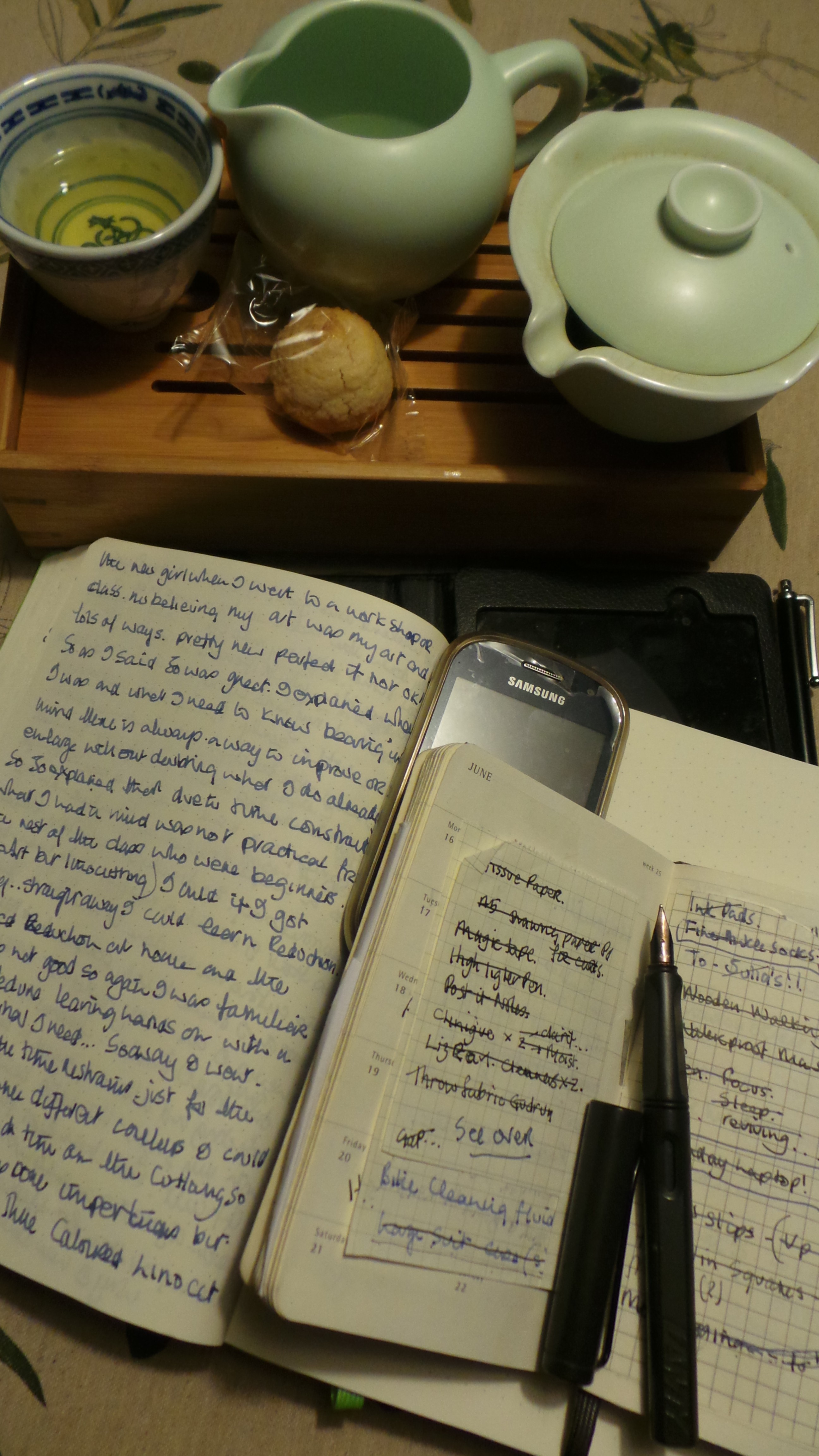
However, there comes a point in the day when these roles converge and one wonders who and what we are and then I enjoy being the maker of tea.
This weekend …
… was good! I drove to Badger Press for a day lino-cut workshop, only down the motor-way in real terms, but in my mind ‘mission impossible’. Of course it was fine, I arrived save and sound, and early which was a bonus. I was able to chat with Jo, the teacher and feel at home. This was not difficult, as Jo was very welcoming and kind. Also, I have been to Badger Press before a couple of times, so I was familiar with the surroundings. Already I was happy, and also I was not the new girl. I know about lino cutting, having done it for a year or so I am pretty competent at the basics.
However, I am more than ready for the next stage which is threefold, I think: being more creative, perfecting the basics and allowing myself to be at home with my style. The later being the most difficult. Over the last few months I have been agonising over my works and looking at the those of the professionals and then wondering why I am at odds and feeling always like the new girl!
So Saturday, I arrived feeling OK, explained to Jo where I was and what I need to know; bearing in mind there is always a way to improve or enlarge without doubting what I know already. ( I don’t know where that little lesson was learned)
Jo kindly said that due to the time constraints, what I had in mind was not practical for the rest of the class who were beginners in lino cutting. But, I could if I got cracking straightaway … learn Reduction, a method of lino cutting that would result is a 3 colour image.
I have tried this method at home with mixed results, So, while I am familiar with the procedure, having a hands on expert at my side (and she was thankfully all the way) ; off I went.
Considering the time allowed, even waiting for the ink to dry between each print, meant that I could not spend much time on the image and the cutting. So the little image has some imperfections but its reduction and three coloured -ness is lovely!


Silent Sunday

Saturday’s journey

I post daily as you know and usually do not write the post until the day required; particularly on a Saturday, Sunday and Monday when I have more time.
I am writing Saturday’s on Friday; I am going to an Art Class and have to leave early in the morning. This has not been a problem on previous weeks but this workshop is not reachable by public transport so I am driving myself. I like driving, familiar with the route but it is a longish way and I am not keen to drive alone. So already I am anxious! This is a shame as I have spent the last months in various places, alone and a stranger, even in Newcastle and the fear has not been so great.
Last year as an artist I managed to produce a small exhibition of works for a couple of exhibitions. I was able mix with like minded people, make comparisons and get feedback.
Although, I was happy with my work and sold some pieces; there was room for improvement. If I wanted to show my work in other venues and thinking that the standard required might be higher; then perhaps I should ‘go back to the drawing board.’ For the past year I have been studying hard and practicing new found skills.
Tomorrow, I am attending the last workshop of the year at Badger Press with Jo Morley and Linocuts. After many months of learning to be a better artist; if it works this heartache will a little price to pay!
I have used a Badger Press banner; I hope on Monday I will have a display of my own to show; after my journey afar!
 Coat Hanger Doll's House