Sunday stitching …

During my studies I was lucky to get a bursary from the Textile Society that allowed me to buy a new mobile phone, with a Dragon Frame tether and software for my laptop that enabled me to make improved stop motion films. A little later I attended a Textile Society Vintage fabric event at Chelsea Town Hill where I bought some scraps of lace and other beautiful elderly fabrics to make costumes for my ‘dolls and an antique Kantha bedspread. It may be as much as 100 years old and has some signs of wear. I have learned kantha embroidery and while my feeble attempts will not match the original stitch work and later repairs I am enjoying my endeavours to prolong its life a bit more.
A cart and a chair …

The light in my house has been poor since October and will not improve, I think, until the spring comes at the end of March. This typical seasonal discomfort is not insurmountable, while I cannot successfully film, this inclemency and confinement to home has allowed me to focus on other things. Such as making dolls, sets, and props, I have been able to stitch some more complex backdrops. It has prompted me to commit fully to writing and drawing. The chair was the result of one of these exercises. Presently I am making a chaise longue which I will share soon.
More vital and relevant I have begun writing a book, or rather illustrating a story book about my beloved dolls. The chair will feature in it along with the cart made by my brother and has appeared in other films that can be seen on YouTube, both have the potential to star in other dramas.
Poem to my ‘dolls …

I love textiles – fabric – fashion
and
Making – doing
I love to stitch! Mend and repair
also
Knit – darn – wrap
From this grew a passion for dolls
and
furthermore
Coat Hanger Dolls
Even the beginning attempts
at worst lifeless
at best – Neanderthal!
I fell in love with these ugly creatures
I studied puppets – wire sculptures
An array of the absurd cruel weird
downright horrible
yet tantalising
I grabbed the boorish and ran
I ran
They stood
Enjoying a frock
a nod to fashion
Coat hanger dolls
Became
Unlike ventriloquist dummies
My dolls were bashful
and
mute
No idle chatter – small talk
Empty kettles ached to step from graceful statue pose
In elegant ensemble they yearned to dance.
Stop motion animation
beckoned
alluring but
not love at first sight
For a while a slippery costly slope
technical equipment marshalled
Otherness
It felt the honeymoon was over
Yet my ugly children rallied their delights
and
With learning
good fortunes came to the fore
We animated illuminated danced and smiled
Much at one another
The Chair …

This was not my first attempt at an upholstered seat. With some foam left over from previous project I made a settee and while it was very lovely it was not in proportion to the dolls. They are 1:6 I think, with disproportionately long legs. The first settee was possibly 1:5 or 1:55 is useful in my films to set a scene or give comedic effect, neither is a bad thing, but a bigger/ better chair was required. I did not have adequate foam, so the result is rather ungainly … so what’s new? I cut the foam with a breadknife and covered with off white cotton stockinette and needed a more pleasing cover. I chose brown felt and stitched it coloured threads and is acceptable and suits my appreciation to the common objects.
Inspired by a book by Pablo Neruda called ‘Odes to common things’ and my aversion fancy pants technology and life style, I wish to celebrate the ordinary. During lock down my familiar objects like my comfortable chair afforded me such comfort and joy.

Not like Cindy or Barbie
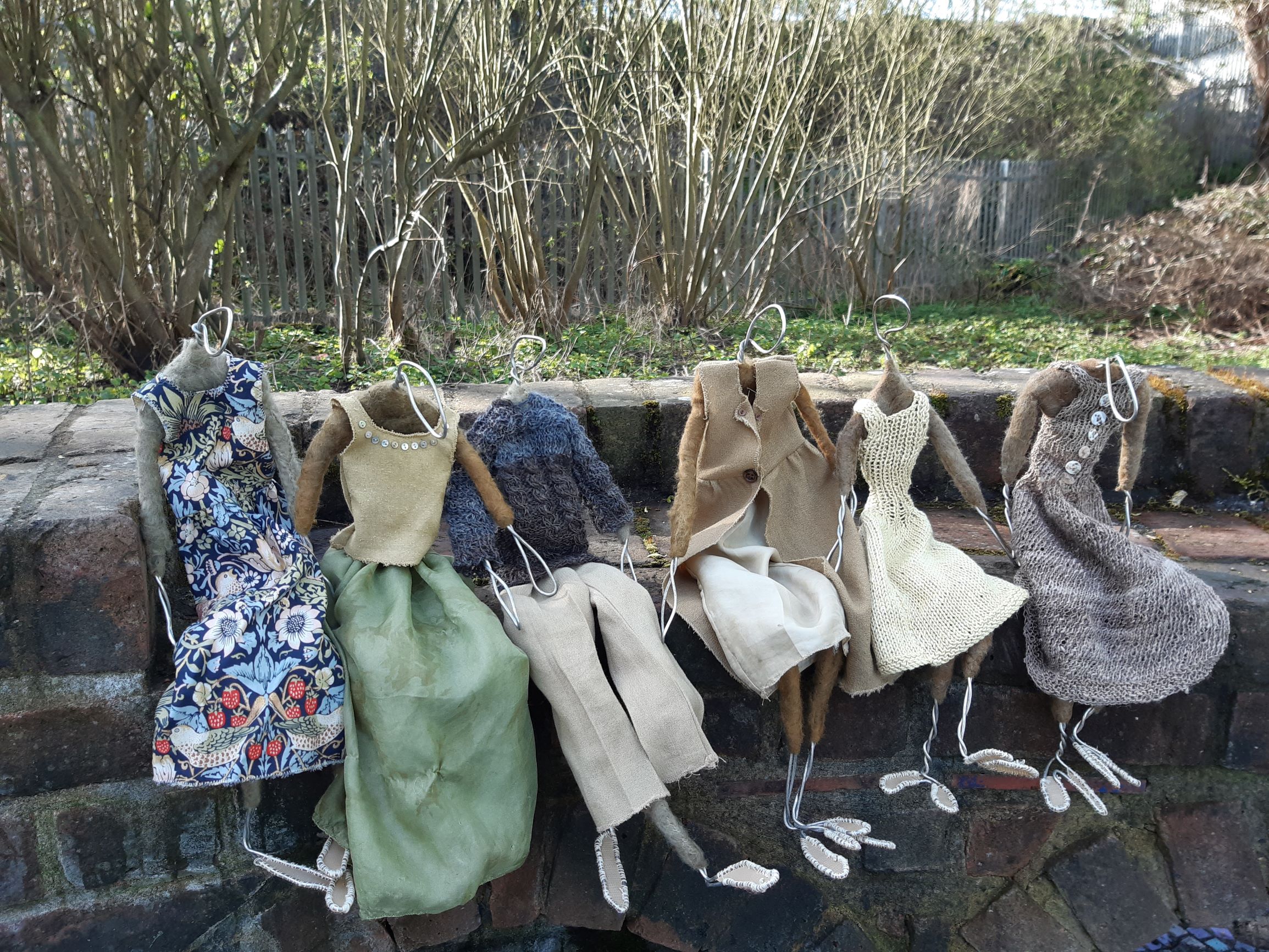
When I was a child, we rarely had new bought clothes. I was the eldest and biggest so, I did get seasonal new items from time to time when my outgrown garments were passed down to my little sisters. Mostly our wardrobe was filled by donations from friends and family. We enjoyed little new delights like socks and underwear when income allowed. My mum went to great lengths and much care to repair, restyle, and make our clothes as required. She spent many hours machine and hand stitching and knitting; her singer sewing machine was a permanent feature near or on the dining table. Socks and knitwear were darned, dresses, blouses, and skirts, and trousers were lengthened or shortened accordingly. She would unravel cardigans and jumpers to make others. I never found this practice less than wholesome until perhaps I learned that my cousins and friends at school had a different experience.
In time I learned to make my own outfits and took delight in making some fashionable additions to my utilitarian wardrobe.
When my own family came along my mother continued to create for her beloved grandchildren. Who enjoyed to open parcels when they said, ‘smelt of Nana’ and it was true! The bundle had the sweetest perfume, the items were pulled over their heads and proudly paraded and worn daily.
It was strange and remains dear to my heart that the clothes my mother made and even those made from scratch with new yarn and fabric never had a newness! It seemed that her stitching, knitting or crochet had worn away the harshness of the industrial new. Her warm energy and love to make for a growing family was imbued in the fabric.
It is this feeling I find when I make my ‘dolls they seem to have a warm and weathered look unlike the look of Barbie and Cindy.
‘dolls take the stage …

I have been making my coat hanger dolls for over a year and they remain little changed since. They still represent the child’s view on the world. The six-year-old has matured but she is easily transported to the old world and particularly since the pandemic. With enriched resources and some interesting technical advances, the ‘dolls now enjoy a play life away from weather hardship and passing of time … in a wonderful theatre of magic in a space imagination.
While my ‘dolls are called coat hanger dolls for expediency I will use the word ‘dolls. The ‘dolls are carefully made, sculpted with wire, then felted, it is a complex and lengthy task but can be done in a pleasing and orderly fashion. Even after an industrial episode to make a dozen or so, no two are alike, even without clothes they have their own delightful character. They are without gender and their colour has no relation to nationality. They have heads but facial features or hair, with looplike hands with no fingers and very large feet. As they are at the mercy of gravity, they have Velcro hook soles so they can stand on the Velcro loop stage. While having disarming characters it was not until they were animated, with the magic of stop motion that they came alive and able to inhabit a 1:6 world on a workmate stage.
What ever the weather …

From a lonely, isolated place as a 6-year-old girl, I was able create beauty, fashion and even theatre with waste materials. Fast forward … In isolation due to COVID and away from university life I also had to find ways to be creative. My home now far more comfortable and materials and tools were readily available. Yet, my mind went back to the dark and lonely a default situation, where the weather, tide and seasons were a constant back drop. My mother was a hard master, I was responsible for collecting driftwood for the fire from the foreshore when the tide turned. After that there was fresh water to fetch from the standpipe a mile or so away and the weekly shop in the village much further away. I was exposed to harshness, reality, and weather. My clothes were functional, seasonal, handmade, and hand me down. I learned to knit, stitch, darn, and repair. My home life was not about be a boy or a girl, I was taught survival, doing what needed to be done, being what I needed to be. I had to be aware of the weather and the condition at present, I did not imagine the future beyond my immediate environment. My glossy magazines and comics did give me a glimmer of something else and a hope that things might get better. Long before saving the environment became norm my parents warned me of materialism and capitalism, so there was always a sense of environmental care, making do and manding was instilled and remains my method and the core of my practice.
Sunday Stitching …
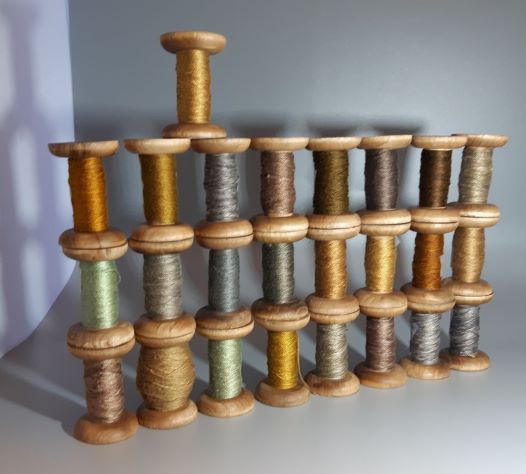
Long before I considered going to university to study the art of textiles, I was stitching coffee sacks, floor cloths and window cleaning scrim. I was also dyeing yarn and fabric. When I began my research and considering my professional practice with the help of experienced technicians in the studio and dye lab, I was able to develop these skills more fully. As a result, I accumulated a vast collection of dyed threads, with printed and dyed fabric and have been able to use them for continued embroidery on my backdrops and ‘dolls clothes.
All about the ‘dolls …
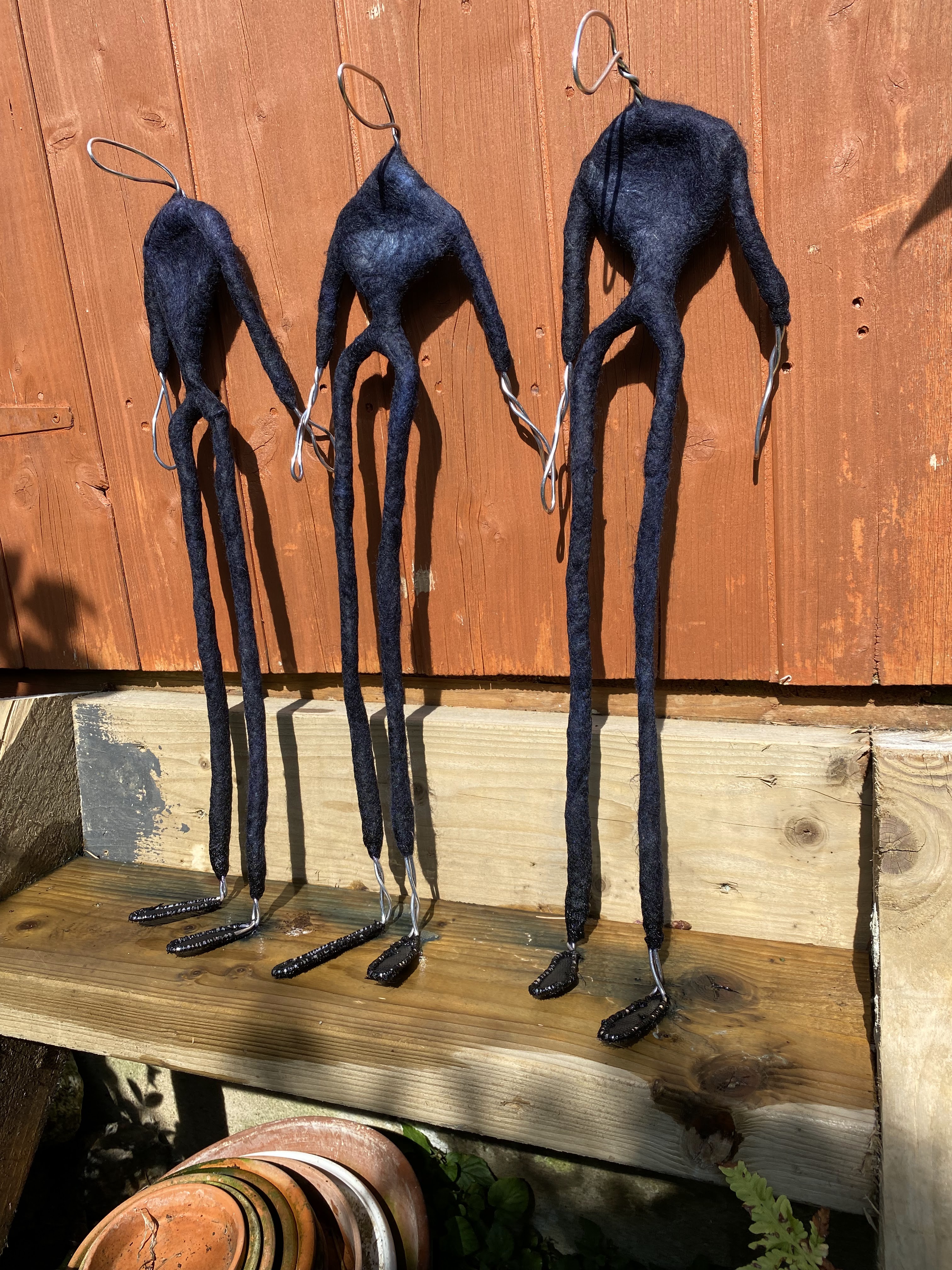
I was born and raised on and beside a dirty old tidal river on the south coast of England. I have written much about the experience. It was difficult, uncomfortable, cold, and often traumatic, sometimes bearable and occasionally joyful. I will not dwell on it here unless required. Nonetheless these memories do have influence on my Coat Hanger Dolls (‘dolls) and their creation. I am not sure where the idea come from, they seemed to arrive as if from nowhere. They have never been made from discarded coat hangers; this is just artistic balderdash and a fake nod to recycling and make do and mend. Yes, they are made with 2mm wire, a little softer that the wire used to make coat hangers. The ‘dolls merely look like coat hangers. A little before Covid and the subsequent lockdown I did learn a little about needle felting and the making of 3 dimensional figures, but it was a very painful venture, also the dolls looked a little neanderthal. When I learned and mastered wet felting, I was able to develop a consistent and pleasing result, in time I devised a cunning way with Velcro to make them stand.
As a child I made and dressed dolls using discarded mail order catalogues and card from the back of writing pads. My mother and I were active letter writers so there was always a supply to hand. The card from cornflakes packets was not robust enough for a standing doll.
Last but not least …

Before I considered myself an outsider artist, I saw an exhibition of Black art from the South, at the Turner Gallery in Margate. I saw some Gee’s Bend Quilts and work of Thornton Dial; and read more about them in a book called the Creation story; Gee’s Bend quilts and the art of Thornton Dial. Susan H. Edwards discusses this vernacular art and artists and how since with the support of William Arnett and his sons have become known as outsider artists alongside Henri Rousseau, Adolf Wolfli, and Bill Taylor and receiving much attention. Edwards goes on to say that self-taught does not mean lacking in worldliness. Also, that ‘Dial remained an independent spirit despite increasing recognition of his voice among the establishment’. Furthermore, Edwards refers to extraordinary burst of creativity such as the Italian and Harlem Renaissance and there being no apparent reason for either. Going on to suggest how some artists flourish in comfort and security and others like Anne Frank who created a lasting piece of work from horror, and Virginia Woolf preferred a room of one’s own. While the women of Gee’s Bend and Thornton Dial’s creativity came from the African American experience in Alabama; that of poverty, racism, personal struggle, and lack of formal education. (Scala, M. 2012)
It seems from the Creation Story and from the work I have seen ‘the quilts soar in beauty and the provocative symbolic codes, and the visual power of Dial’s work can be appreciated both for their aesthetic qualities and subjugated knowledge’.
For this investigation there remains many unanswered questions; while I am self-taught, I have not been marginalised or oppressed and remain an unlikely outsider.
I did not foresee doing my MA during a pandemic; my schoolgirl dream it seemed was dashed within weeks of my enrolment. While I am a part time student, I had time on my hands there was no opportunity for grief or self-pity; and transported back to being a 6-year-old girl. In days with limited resources, I was making dolls and taking them on a journey. First establishing their needs and then placing them in an artful and creative place. Then going on to look at ways on which other artists have achieved this. Like the blind, illiterate poet and performer, the soldier who met monsters on his way home from a war, puppets that spoke to troubled children or oppressed citizens. Explored the value of silence and sound with world renowned composer and music theorist and other scholars. Discovered gardeners who while planning their plots might help me make a stage in my own garden making use of plants but more important colour, light, and shade. Considered artists who looked deeply into bleak situations and exposed astonishingly dark work. Going further to discover outsider artists who while enduring very harsh conditions, using found items, still were able to celebrate colour and form to make art that looked at home in the back yard yet found its way to global recognition. Quite by accident I came across a Russian ballet dancer who invented stop motion animation to teach his pupils. Furthermore, more recently but still early in the development of stop motion animation and again from across the world filmmakers that still amaze and entertain.
None of these artists or creatives had an education in art; all self-taught skills using tools and materials at hand; often in isolation and or in hardship. Yet their work and stories are showcased and referenced by scholars and other notorious artists. This rather arbitrary story goes a long way to say that while the pandemic was not always a comfortable or easy situation it did play an important part in the progress of my journey to Russia and back and along the road to my MA.
 Coat Hanger Doll's House