Silent Sunday
Saturday …
For sometime now I have been without an art teacher. The ‘withoutness’ was planned; I had known for a few months that my teacher would be moving out of the area. For the most part I looked forward to beginning a new phase and I still do. I had lots of things planned and those continue joyfully. The summer is still here and there opportunities to come, I hope.
However, the loss of my teacher and friend has left a gulf that is still a bit sour, not soothed by the above mentioned activities. I will never replace my buddy, she was an angel when I needed her most. Now, perhaps I don’t ‘need’ anyone quite so much. Nonetheless, on a day as I try to be an artist and it doesn’t seem so attainable I celebrate the space to begin again.

A snapshot from my Library
I bought this book in Rio last year; drawn particularly by the woodcut; by Gauguin. It tells the story of Paul Gauguin, the forty-three -year old ex-stockbroker who left France for Tahiti where he was to make his home. Here, he is disappointed to find even this South Sea island Tahiti is spoiled by the inroads of Europe and he compelled to move further and further into the back country in order to attain some primitive ideal of naturalness and peace.
Paul Gauguin (1848-1903) was one of the great initiators of Post-impressionism and thus one of the fathers of modern art. Misunderstood and neglected in his lifetime, he is now regarded as a pathfinder and pioneer and his works are among the prized possessions of museums and galleries in Europe and America. … I just love this little book.

Alphabe Thursday O is for O brasileiro


O brasileiro deplora
O interesse de amar
Seus costumes, sua música
Quer os outros imitar
Povo assim e muito fácil
Doutro país dominar
The Brazilian deplores the interest of love; and that others want to try its customs and music; people like this will easily dominate …
For many years I studied and translated Greek, Latin, and later Sanskrit poetry The poets wrote of love, despair, war and peace, and their country. They sang of the glorious past and the doom of the day; other dreamed of the magnificent future.
To understand a dead language it is vital to be aware of the culture and background of the poets. Not so easy when we are 2 millennium apart.
Sometimes, the poem was incomplete; only a line or two; from these words and much background knowledge (gained not by me, I might add, but by centuries of scholarship) I might decipher a word or two.
Here I am with a fragment of a poem in a modern language and still I struggle to understand the poet; who in turn seems to battle himself with Brazil, her people and their culture … it seems we, worldwide and for centuries have difficulties unraveling life, let alone one verse of poetry …
A woman I happened upon …
These two books were on my desk yesterday; among others but they took my attention with such lovely covers. They were designed by Ethel Larcombe (1897- 1965) I know little about her except that she was influenced by the illustrations of Walter Cranes and Kate Greenaway. However, it was sometime later when introduced to the publications of William Morris that she dropped her medieval style and adopted that of the arts and crafts movement and influenced by Burne Jones and Rossetti.
Her art nouveau designs won many competitions and brought her to the atttention of Talwin Morris who commissioned her to design bookbindings for Gresham one is seen here. The other one I thought was by Talwin Morris ; but her style is considered a little busier.


Although the books were on my desk … I gleaned this information from Treasures of the GSA Library
Weekly Photo Challenge … A good day
 What a difficult prompt. On a good day I can look back and reflect on many fine examples to entertain you. Then, if the mood is different then my recollections are tainted and less attractive. So the result is dependent on the fullness of the cup.
Then there are the days not captured on film and why should they be, even taking the snapshot spoils the moment.
I love my work, so a good day for me is just being at work. Likewise, a perfect day might be spent ‘spring cleaning’ not anything worth documenting, the joy is felt, it is not measurable in a picture. I love spending a day with my family catching up with the news, eating drinking all makes a fine image ; I have albums full of them going back to the last millennium ; for me and my siblings who are in their 60s and 70s, family snaps don’t have the same appeal. My grandchildren with whom I spend many happy days are like a bucket of frogs when the camera comes out. Yes, I know the best images are those captured as the frogs are leaping!
So you will have to take my word for it I do have had my fair share of good days.
I suppose holiday photos taken during my recent stay in Rio are a fine example of a good times. And one such day was one I spent with my daughter climbing on my hand and knees up Sugar Loaf. It was very steep and to bring out a camera would not have been sensible and worse as we slid back down. Nonetheless the view from the top was worth the climb but again it was feeling that was better. We were sweaty adventurers beside those who had come up by cable car.
So the image is a bit of a cop out and the story compared to others a bit of a damp squib!
Monday and a couple of questions …


Having completed the sketches and first drawing, on the lino for my latest assignment , I have begun printing. Today, I will reduce the lino again. Not wishing to upset my son-in-law, he will understand I hope, but already I am having difficulties. As artists, we work to please ourselves when the work pleases others then it is a big bonus. So when we are asked to make a piece of art for another person then our responsibility to another person’s pleasure increases the pressure to please.
I am a self taught printmaker, my work is usually the result of many happy accidents. Over the last couple of years I have learned to smooth out the errors or incorporate them. In other cases I have sought advice and begun again. Pretty much a normal learning curve, no gain without a bit of pain.
So when I began this last project, there were certain complications, because I could not decide between reduction, multi-print or screen print, but that could only be solved by doing. Here, I am with reduction, as I said earlier, even that requires some thought; with that sorted, What else could go wrong?’ I hear you ask.
Sadly, the most fundamental and the ones most silly to admit. First, why don’t I remember that a Sharpie is not permanent and very ugly on a print?
Secondly, little flecks of dust in the ink are a nuisance; no matter how careful one is to protect the ink they ruin a print.
For a reduction print we always make provision for error but yesterday I did more than a dozen, not one was perfect.
This is frustrating, wasteful and worse, takes away the joy of happy accidents!
So, I feel the need to incorporate a couple more routines to protect myself next time.
How do I mark the lino permanently or is it enough to remove the sharpie with spirit?
Keeping the inking area free of dust seems obvious but easier said than done. How do you do it?
Silent Sunday …
Its Saturday …
 I am going on an outing first to St Barbe Museum and Art Gallery at Lymington in the New Forest. Here, I will see the exhibition of the Royal Society of Painter Printmakers and I quote ” is the UK’s premier printmaking organisation, which exhibits at the Bankside Gallery in London. For a limited time only, we are honoured to welcome them to St. Barbe” I am very excited to see this; although Bankside is not so far away from Reading Lymington, is very near my home town of Southampton where some of my family live. So so having seen the exhibition I can spend some time with my family not seen since less cheerful times. So I celebrate sun, family and welcome opportunity.
Friday and an image from my library …
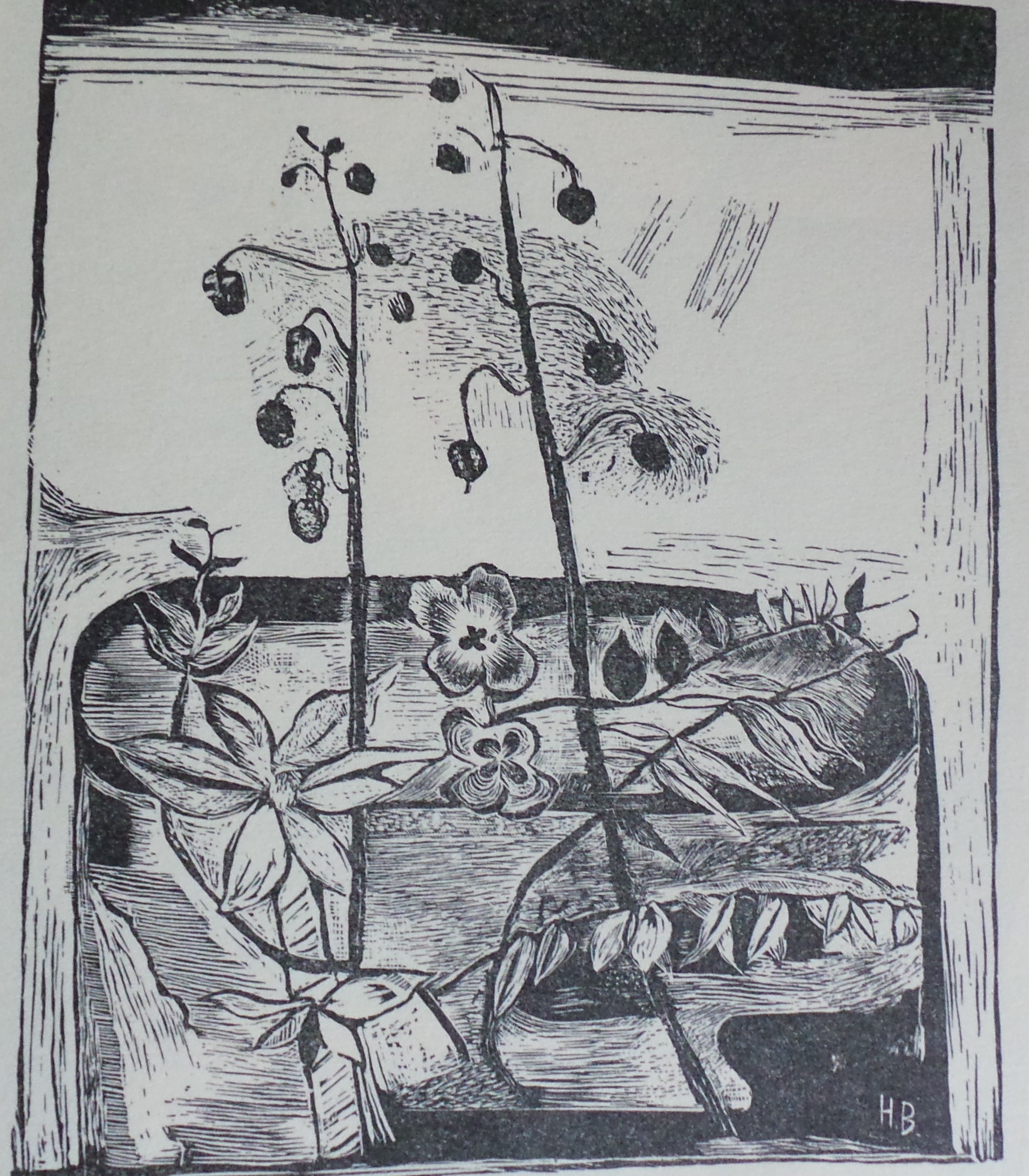
This week I described my collection of books as a monster and a friend; it makes me happy, frustrated and sometimes sad. However, I would not change it for the world especially when I find images like this one. I am a printmaker and last week I had the opportunity try out drypoint etching; it is quite different to relief printing and I began searching my books for examples to aspire to. As I dragged books from my shelves, I wished I had a proper catalogue and grumbled a bit as the books laid about on the floor. Then, as I found more and more examples, I delighted in them and so glad I was in a position to browse.
This image is by Hedwig Brauer in the Woodcut/Engraving : a contribution to the history of the art by Imre Reiner , it is a wood cut, I think, but would lend itself to drypoint. I don’t know anything about her and assume she was busy at the beginning 20th century.
 Coat Hanger Doll's House