Mills and Boon
This week I am thinking about my new venture in the organisation of the Cole Library and remember that the collection also includes 15 books by Sophie Cole (1862-1947), the sister of Professor Cole. As an adolescent, Miss Cole suffered from a long illness, and to pass the time she wrote a romance novel, Arrows from the dark in 1909, the first book to be published by Mills and Boon, who later became major publishers of romance novels. The book was well-received, and by 1914, 1,394 women had bought a copy. During her lifetime she wrote 65 books, and earned her living from them for many years. Miss Cole knew London very well, and wrote a non-fiction book on literary London, which is held in the collection. She lived in Brighton, but in her later years came to live with Professor Cole and his wife at Eldon Road in Reading. A number of the books are presentation copies from Miss Cole.

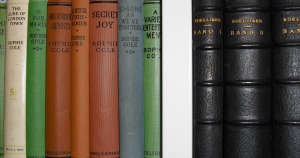
I have never read the ‘sophisticated’ passionate romance novels of Mills and Boon. But recently I came across a set of 15 hard back copies without dust jackets in the collection of Professor F J Cole who was a Professor of Zoology here in the University of Reading from 1907 to 1939.
The professor collected books all his life ending up with about 8,000 books about the history of early medicine, zoology, comparative anatomy and reproductive physiology. Amongst these there are 1,700 or more pre-1851 works, including many continental books. So why are this tales of ripped bodices and happy endings on the shelves of such an eminent collector of books
It turns out that the collection was written by Sophie Cole (1862-1947), the professor’s sister. As an adolescent, Miss Cole suffered from a long illness, and to pass the time she wrote a romance novel, Arrows from the dark…
View original post 169 more words
Weekly Photo Challenge …. Careful
Since I was a little girl I have longed to be an artist; my journey thus far has been fully documented on my blog and not ended where I hoped. Naively, I thought that artists merely threw about pencil and paint to raise to fame. So, while I do spend much time up to my elbows in colour I am mostly carefully engraving little pieces of boxwood and will not of course be notable.

Its Monday …
I had a horrible weekend and then, I didn’t. Yes, I wandered about in drugged up state and threw up at regular intervals but I managed attend a fundraising event for refugees at the Rising Sun Art Centre where I enjoyed some Indian tea. You will understand my preference is Chinese, so we had some friendly banter about the anti inflammatory qualities of tea, over some nice cake, not necessarily so healthy but good for the mood. The visit to the Rising Sun allowed me time to measure the Printing (redundant bookbinding) press that we are hoping to have printing for our next open day. It is in working order but needs some MDF blocks for a reason not entirely clear to me but important; so I was able to get this on Sunday.
Meanwhile, I have some Lily of the Valley bulbs that needs a new home, so after having bought some rotted compost, that task was enjoyed on Sunday morning. None of this was documented in my usual fashion, sadly due to my state of malady.
While I was unable to enjoy my art making so much as usual although I did buy a couple of new tools and in between episodes I was able to dry-point a hat and some holly.


Silent Sunday
Saturday …
 Went back to work this week and hoped the pain might relent or at least the distraction might be comforting … but no.
So this morning without my usual busi-ness and hope; I wish for those who cannot sit or stand to make art, a moment or two of painfree-ness
and little memento of a happiness.
Friday Snapshot from the Museum
Our Museum is still closed but its reopening is getting nearer ….
Since taking an interest in printmaking I have looked more closely at ‘paintings’ and I had not realised a picture that I pass by daily here at the Museum of English Rural Life is an engraving by Andrew Davidson. It depicts the contrasting landscape of the 1850s with that of the 1950s. It really is a ‘work of art’ and well worth a visit when in the area.
Alphabe thursday … When is for Who controlled our education?
Veja um exemplo de Mourão versos, cantado pelos Sebastiaos Marinho e Andorinha,
sobre o assunto “escola”
Marinho
A escola e o caminho
de uma nação feliz
Andorinha
Quem estuda se carinho
sabe o que faz e o que diz
Marinho
Quem estuda se controla
Está nas mãos da escola
o futuro do país
Concluída a estrofe, o outro repentista inicia uma próxima. sempre pegando na deixa
Andorinha
Faz algum tempo que fiz
Os meus estudos primeiros
Marinho
Fui um menino feliz
Junto com meus companheiros
Andorinho
E nos bons livros que a gente
Aprende, percebe e sente
Os valores verdadeiros
This is a Mourao poem sung by Marinho and Andorinha on the subject “school”
Marinho
The school and the way
of a happy nation
Andorinho
Who is studying affection
You know what it does and what it says
Marinho
Who is controlled study
This in school hands
the future of the country
Andorinho
Some time ago I made
My first studies
Marinho
I was a happy boy
Along with my fellows
Marinho
And in the good books we
Learn, perceive and feel
The true values
I think they agree that free education is vital for a free and happy nation. Not so good to air such views when others wanted something different.
I am unable to translate the repentista and think it describes this sort of poetry that is almost a debate … immediate. But I am not sure.
Nice wood cuts though


All women and Zumbi on Wednesday and the Day of Black Consciousness
I have been grumbling about my back for some time now and not without reason but now I find myself thinking that perhaps I should remember women who did so much through pain and neglect…
Wednesday has crept up on me; so today I will celebrate my daughter who sent me some nice pictures from Brazil at the weekend after having enjoyed a National Holiday. She had been a exhibition and seen some wood cuts and shared them with me.
She told me also that today she would be having yet another day’s holiday today for the Day of Black Consciousness in Brazil. Since the early 1970s, for a week around the 20th November, the anniversary of Zumbi dos Palmares’ death in 1695, time has been allowed celebrate Black culture in Brazilian society. The Day of Black Consciousness is a day to remember the black resistance to slavery in general and the first transportation of Africans to Brazil in 1594.
Zumbi (1655-1695) also know as Zumbi dos Palmares was the last leader of the Quilombo dos Palmares, a fugitive settlement in the state now known…
View original post 296 more words
Weekly photo challenge … extraordinary
Extraordinary? For me it must be someone with a vision and a fearless pioneer attitude. My dad fits the bill … but I was never able to tell him so.
This is a drawing of a boat he built and took us on some daredevil adventures.

This weekend …
This weekend was to be decision making time. I began wood engraving as a progression from my beginnings with cutting into pencil erasers. This with hindsight was not perhaps for me a natural progression. Wood engraving is a fine art, steeped in tradition and discipline. During this time I began lino cutting and that seemed more suited to my now developing, more sophisticated style.
While, I enjoyed my 6 monthly workshops and the occasional opportunity to exhibit and sell some pieces I still find the the wood engraving style a little uncomfortable.
So this weekend with Kate Dicker was a time when I should think seriously about my continued practice or not.
Sadly, my painful back issues of the moment didn’t make it easier. However, as I am no longer a beginner I am in a position to disregard the preliminary stuff that is vital when learning. It soon becomes second nature and we can learn how much or little we need. In a beginner’s class this is a stressful time and best overlooked (for me) if at all possible.
With all my printmaking, I begin with an object and often hours of drawing until I am ready to draw straight on to the plate. When the ‘drawing’ begins but in reverse like a reduction print each mark is carefully considered.
Sounds like a plan … but two or three hours in, I was still feeling vulnerable, afraid of the tiny piece of wood and the uncontrollable need to ask ‘teacher’ to find assurance. This is a mistake, plan already gone, lost, was my trust in ‘my’ teacher instinct, disappeared was my devotion and love for my production … I sought ‘outsider’ reassurance.
So, Sunday morning, I began again; breathing, mark making, proofing, loving and centring … smiling as decision’s made.


 Coat Hanger Doll's House