Alphabe Thursday X is for noughts and crosses


Noughts and crosses or Tic-tac-toe, is a ‘paper and pencil game’ for two players. Each player takes a turn marking a cross or a nought in a 3×3 grid. The winner is the one who places three respective marks in horizontal, vertical or diagonal row. It is an ancient game; the Romans played a similar game called Terni Lapili in the Ist century BC, the ancient Egyptians too played a variant. There is another ancient game called Three Men’s Morris that is played on a simple grid and requires a a row of three pieces to finish.
All this said I have never worked out how to win at noughts and crosses ; it has always seemed a pointless game.
I played it with my dad who never let me win; thinking perhaps it taught me to be good sport. When I played with my little sisters I was forbidden to allow them to lose; that would have been unkind! So a double whammy!
I don’t think many children now would find noughts and crosses much fun.

Women on Wednesday
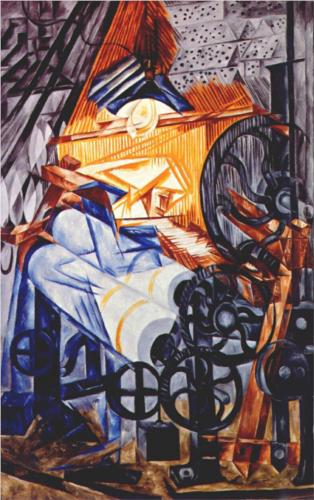
Last week I wrote a little about Natalia Goncharova, the Russian avant-garde artist, painter, costume designer, writer, illustrator, and set designer. After seeing her painting the Cyclist I wanted to find out more about her.
I did find a book published in 1999, on the occasion of the exhibition called the Amazons of the avant-garde ; Alexandra Exter, Natalia Goncharova, Liubov Popova, Olga Rozanova, Varvara Stepanova and Nadezhda Udaltsova. The exhibition celebrates the evolution of modern Russian painting from 1900-1920 by the artists who at the fore then. The women contributed to the development and the subsequent triumph of the Russian avant-garde. The exhibition concentrates on the studio paintings of each of the women; careful not to mention the other applied arts in which they all excelled, for instance, book design, textiles fashion, ceramics and stage costumes and sets.
In fact one author says that, the paintings of the women artists include images of tools and machinery, but goes on to say that the women do not ‘renounce their female occupations’ or feminine creativity. She lists the artists who have kept a female presence in their paintings, a sewing machine, thread, lace, trinkets etc. She mentions the loom in Natalia Goncharova’s the Weaver but goes on to say that ‘in this case in indicates an escape from the four walls of domesticity, towards a Futurist machine … This is where I perhaps gave up reading … thinking that maybe these women (all from the landed class) were not aware that most weavers at that time were not escaping domestic tedium but escaping the debt collector!
It is a hefty tome and I will not pretend to have read much and let alone understood it.
However it will be a good book to dip into over the next few months and make comparisons with the women I have written about who fought tirelessly in the early 20th century here in UK for women’s right to vote etc. Not just through the Art and Crafts Movement, active also at that time but through sheer determination and need.
Weekly Photo Challenge … Horizon (s)


As usual the photographic images (Doh!) for the weekly photo challenge are exotic and for me enviable; both technically and geographically. Although I travel a little and able to take a fair image; my horizons are restricted by more mundane factors such as my age and limited funds.
Having worked all my life to provide for a family and earn a meagre pension now my retirement looms on the horizon so while I may not have loads of money the time is tantalising!!
Another vision on the horizon is Christmas; this too has a financial and stressful edge that can detract form the joys of family togetherness.
Why do these horizons, glistening dreams and hopes become monsters when wrapped in financial and timely binds?

Monday; last week I couldn’t sleep …


One night last week, while I should have been sleeping, I had some thoughts. Prompted possibly by the recent discussion on the TV and in the newspapers about the privatisation of the Royal Mail. While it was 2 in the morning and not thinking too much about the rights and wrongs of such a decision. I was considering amount of money involved and the number of trees that in the form of paper had been sent about the world during the last century or so.Then still thinking into the early hours some more; about perhaps the economy installed and maintained on the back of the mighty and efficient postal service. Was perhaps it was viable and practical?
But still the ugly paper making industry with its loss of forests and its pollution loomed in my thoughts.
So the as I dozed again, the tune from the old folk song brought to the for in the 1950s by Harry Belafonte came to mind ‘There’s a hole in my bucket dear Liza’ and it is true there is no right or wrong we all want ‘convenience’ but it is very costly in more ways than one.
So perhaps tomorrow night my worldly problem will be less difficult and I will sleep more easily
So I thought I would create a little picture (s) to express this phenomena, it is not altogether a success. So, while I am not a world leader and unfit to put the worlds to rights; I am not yet an artist.
These letters and images represent the trees that have to sent to and fro the world by air mail.
Silent Sunday


Due to a prior engagement …


For the last two years or so I have posted to my blog daily. Don’t ask why or how this happens; it just does. Although I have a set weekly programme, the items are not conceived until the day before. Often I am pulling information gathered in a notebook and dragging images from Dropbox on the morning of the post.
Some days are less problematic: Sunday is silent but I still set myself the task to find an image on Sunday morning. While I am not surrounded by children or dogs to do convenient tricks, I am often seen (not by any self respecting person who would be in bed on a Sunday morning!) in my pajamas photographing yet another rain drop or a heron in an undignified pose! (me and the heron severally of course)
So with some (or a lot) divine intervention (there really is no other explanation) I get it done.
Until this week, I had a dilemma; a last minute invitation. My blog relies on not having last minute invites; but this one I could not refuse.
It was the celebration at the Open Hand Open Space exhibition that marked the beginning of the Whitley Arts Festival. There was to be food and drink and the ‘Handstellation’ was to begin its journey like the Olympic Torch into the Reading town centre and the festival that was taking place at various venues through the evening until 2am Saturday morning.
While I had not planned to see the whole event; I was keen to meet new friends and acquaintances; you might say networking, either way it seemed a pleasant way to spend an evening. Usually spent ironing and watching Garden’s World; I am pretty sure the world will not stop if I miss ‘ Have I got news for you.’
So I spent the last three days considering ways in which I could get the chores done,go to the party and do the post.
It didn’t seem possible, so I resigned myself to the ‘position closed, normal service to resume on Sunday. Like the ‘test card’ we saw so frequently in the early days of the BBC!
It is no good pretending I had not been in this situation; I do have friends and a real life beyond my blog, before but somehow the show did go on.
However, Cinderella did make it to the ball and a good time was had by all.
While I didn’t stay long enough to see the Handstellation lit up (these things do take longer than intended) or begin its journey I did have a good time and … like I said normal service will resume later.
Friday’s Library Snapshot
When I learned that Michael Harvey had died recently, I did a little research and am able to post a few images to celebrate his place in our Special Collections.
Michael Harvey (1931-2013) was already typographer and teacher, his work seen in cathedrals and the National Gallery, when he was inspired by Eric Gill’s Autobiography (1940) to become a letter carver. In 1955 joined Reynolds Stone, the wood engraver to help him carve inscriptions in slate and stone; in particular the inscription on the memorial he had designed for the politician and writer Duff Cooper.
In 1957 he began designing lettered book jackets for several publishers. From 1961 he taught at Bournemouth and Poole School of Art & Design.
The Ludlow Typograph Company in Chicago released his first typeface in 1964. Since then he designed typefaces for Monotype, Adobe, The Dutch Type Library and others. From 1980 he taught in Europe and South Africa; also in the United States where calligraphy had become very popular.


Further reading and images from
Lettering design ; form & skill in the design and use of letters by Michael Harvey foreword by John Ryder
Reynolds Stone ; engraved lettering in wood by Michael Harvey
Letters of Aldous Huxley edited by Grover Smith, Jacket design Michael Harvey
Adventures with letters : a memoir by Michael Harvey, Jacket design Michael Harvey
Alphabe Thursday W is for lots of things!


If only I had come across this little book 2 years ago I could have saved many prayers to the alphabet fairy on Wednesdays when frantically thinking about my post to Alphabe Thursday each week!
So I can use several little engravings for W is for wagon, windmill, whip, watermill, wheel, and more.
Ellenor Fenn (1743–1813) (née Frere) who often used the pseudonym Mrs Lovechild or Mrs Teachwell was a prolific 18th-century writer of children’s books.
This is book called Mrs Lovechild’s book written in 1924 is designed to teach children the ‘names of things’ … almost 300 years later I am not sure children today would recognize many of them
A woman on Wednesday a beginning and a bike!


Until this week I had not heard of Natalia Goncharova. I am a cyclist and a print maker. ; While they cannot be enjoyed at the same time they do have comparable qualities. Bicycles are aesthetically pleasing in a mechanical sort of way and printmaking is a very basic form of engineering.
So when researching these terms, engineering, mechanical, movement, art and women I came across the Futurists and to discover the women of the 20th century ‘galvanised by the violent energy of the futurist movement … who wielded [or welded] their brushes, needles and pens with much vigor’ ; I then found the Cyclist by Natalia Goncharova. While it is a long time since I have ridden with such eagerness; it is an image I would like to emulate on paper!
Natalia Sergeeva Goncharova born 1881, was a Russian avant-garde artist, painter,writer, illustrator, set and costume designer . Her family were politically liberal and well educated members of the rural gentry. Her early works reflected this environment although she preferred to focus her attention on the daily activities of the servants and peasants who lived and worked on the family estate.
At the turn of the century the art institutions were no longer segregating male and female students, however women were denied equal rights upon completion of the degree. Goncharova claimed that she had little training; nonetheless she taught and attended lessons at the Moscow Institute. Here she met Larionov; who moved into Natalia’s family home; together they set up a studio and shared living accommodation … this was just the beginning … The cyclist painted 1912-1913 after her first solo exhibition held for one single evening 24th March 1910 by the Society of Free Aesthetics in Moscow this made her uniquely visible as an artist and a rich and colourful life transpired …
Particularly as Natalia Goncharova’s Flowers sold recently for nearly 11 million dollars my painting will probably not!

Weekly Photo Challenge … What is my hue?


As a child of the 1950s I can longer be defined by a particular hue. Instead, I celebrated having gone through several colour revolutions. The years immediately after the war we were were deluged with rainbow shades to deliver us from the gloom of shortage, rationing and military garb. So the fashions came and went. It wasn’t only clothes that were dictated by the high street authority of trend; our kitchens, bathrooms and bedrooms were given regular and militant pigmentation washovers.
Navy, black, grey and beige came and went while we draped scarves and painted our eyes and lips with the last chic look; to ensure we didn’t bare our faded tones.
Me, like all others obeyed the fashion gurus. Who wouldn’t ?
So the styles have come and gone; more times than I can remember. So I have not discarded the trinkets and accessories; the emblems than ensure I never quite go out of fashion.
Nonetheless; as I near my 64th year I am inclined to lose the plot; so I have have a cunning plan … to wear or display colour of all shades all at the same time!
 Coat Hanger Doll's House