Weekly photo challenge … Dialogue
Oh dear ; not so easy this week. Plenty of people about me in deep dialogue; some lively debate that would make an interesting image. But me muscling in with my camera would not be over polite, if indeed legal. So best,I consider the conversations I have with myself ; these are just as difficult to portray, near impossible, but for the sake of Postaday I will try.
I talk to myself throughout the day.
Before I rise from my bed I ask ‘What day is it?’ ‘Week day or not?
Its raining.
‘Did it start before seven? Will it clear by eleven?’
‘What’s the plan?’
Just as well I am not a brain surgeon or a space rocket engineer ; nothing would get done before noon.
However, the discussions go on ; having decided I will go to work ; we/I mull over the location, the tasks involved and the style of dress required.
The pros and cons of breakfast; cereal and or toast, tea or coffee, the debates go on.
And still no image until further, more animated deliberation … which bag?

Soon, I will …
Have a day of; not just an odd day but a regular 4 day week. This adjustment to my work life pattern has taken much thought on my part and deliberation on the part of my employers. This opportunity to ask for flexible working pattern has to be considered very carefully.
I have worked all my life not always to further my career but to put food on the table. However, this has changed in the last 15 years or so. My salary is still vital to the household economy but I am in a better position to enjoy my work and get personal satisfaction. So to give up a reasonable income and a lovely job has not been an easy decision. So when I reached retirement age I decided not to rush to take up embroidery and crochet. So 4 years later I ask myself again ‘Do I or don’t I?’
While I am still not eager to give up completely I would like a day off and my employers agree ; but apparently the procedures are not as easy as we thought . So the cogs of organisation chugged on.
I am lucky to be in a position to take annual leave at regular intervals while the negotiations go on.
So today I have a day off and play at working a 4 day week. What joy!
I am going to find it difficult to adjust; for 50 years I have worked a 5 day week, more in the early days.
I will not be baking cakes or crocheting bed jackets … while these are admirable tasks I will for a while gaze on these sycamore seeds … beautiful …. I had never noticed.

Silent Sunday


Saturday again!


The effects of the events that happened last week could have gone one of two ways ; diabolical or DIABOLICAL. However that was in the world of Helen W. In the realm of Nela Bligh we have ways of making things seem better; diabolical becomes an illusion.
We had viruses of the electronic kind, parasites of the medical type and we had monsters of the lesser spotted credit card chewing variety.
We could have gasped and faded under the strain; or considered how life went on during the upheavals; tiny and even moderate works of art, daily posts with the relevant research, followed by happy and productive responses. I even went to work, whether I maintained an adequate level of production and accuracy is not for me to judge but I was there in good spirit and keeping high levels of tea.
Oh yes! and some successful wardrobe additions were made without a debit card but with good old paypal!
Colourful little pieces to wear at an art exhibition next week … So joy to the world!!
Friday’s Library Snapshot


I came across a little pamphlet this week; which made my day. When I began blogging I never thought that I would continue. Although I have a plan; each post is carefully worked to a schedule they are often fairly random. I am a library assistant I am not always in a position to wander off and ‘do’ research. I can honestly say my daily posts are written on the run. So there is not always a thread.
So this week I decided to go back to the beginning of printing and discover the way that women made an entrance into a man’s world in the middle of the 19th century, with a post on Wednesday about Mrs Fanny McIan.
So this pamphlet called A brief account of the Cuala Press formerly the Dun Emer Press founded by Elizabeth Corbet Yeats in MCMIII (1903) will help me put some meat on the bones. As this is supposed to be a snapshot I will not bore you with the details.
The Dun Emer Industries were established in Dublin in 1902 by Evelyn Gleeson ‘to find work for Irish hands in the making of beautiful things.’ All the workers were Irish girls and they produced:- embroidery on Irish linen, woven tapestry and carpets and they printed and bound of books.
Elizabeth Corbet Yeats and her sister Lily returned to Ireland from London to assist Miss Gleeson in the establishment of the Industries. Lily Yeats organised the embroidery workshop and Elizabeth founded the Dun Emer Press.
W.B. Yeats acted as an editorial adviser to the Press and Emery Walker, who had worked as advisor to the Kelmscott Press, the Dove Press and other private presses in England advised on typography and book production.
It is a lovely story that I will reflect upon at some later date.
Alphabe Thursday O is for oranges and lemons

Oranges and lemons,
Say the bells of St Clement’s.
You owe me five farthings,
Say the bells of St Martin’s.
When will you pay me?
Say the bells of Old Bailey
When I grow rich,
Say the bells of Shoreditch.
When will that be?
Say the bells of Stepney.
I’m sure I don’t know,
Say the great bell at Bow.
Here comes a candle to light you to bed,
Here come a chopper to chop off your head.
This old song is known to young children even when they never played the game that accompanies it.
The game is played in the manner of ‘London Bridge’ two bigger players determine in secret which one will be an ‘orange’ and the other a ‘lemon’ ; they form an arch by joining hands, and sing the song as the other players troop underneath in a single file. When the two players who form the arch approach, with quickening tempo, the climax of their recitation,
Here comes the candle to light you to bed,
Here comes the chopper to chop of your head,
They repeat ominously ‘chop, chop, chop, chop, chop!’ and with the last ‘chop’ they bring down their arms down around whichever child is at that moment passing under the arch. The captured player is asked privately whether he will be an ‘orange’ or ‘lemon’ he goes behind his chosen fruit. The games and the singing continues until all the players are behind one or other of the arch; whereupon there is a tug-of-war to test which is the stronger the ‘oranges’ or ‘lemons.’
The execution formula has been seen by some folklorists as a relic of the gory past, the days of public executions have been cited, when the condemned were led along the street to the sound of tolling bells.
What ever its background it was a favourite in the playground when I was at school.
Wednesday’s woman

Wood engraving was never seen as an opportunity for women to be artists. For instance Thomas Bewick in the early 19th century had three daughters and a son; and it was the boy who became his father’s apprentice. The girls busied themselves in the home, although the elder daughter was his confidant and it was to her he wrote the account of his life.
Later, when Ward and Lock published their Elegant arts for ladies the arts were described such as feather flowers and painting on velvet, while it was illustrated with wood engravings the technique was not deemed proper for ladies.The engravings in the book were undertaken by the Brothers Dalziel and it suggested that that firms such as this, guarded their professionalism and deliberately withheld tools, materials and opportunities from amateurs.
It would seem in the printing trade also young women were taken on until they married. A few returned if they were widowed but rarely did a girl progress beyond making envelopes.
It was not until a day-school system was established in 1830s where women were able to learn skills under the apprenticeship system. It began first for men only but a Female only school opened under its Superintendent Mrs Fanny McIan.
Fanny McIan (1814-1897) was an English artist who specialized in Scottish historical scenes. As the first superintendent of London’s Female School of Design, she promoted British women’s art education in the mid-nineteenth century.
Born Frances Matilda in Bath her father was a cabinet maker and mother worked as a upholsterer after she was widowed.
When Fanny was 16 she eloped with and actor and painter Robert Ranald McIan.
Fanny known for her epic historical scenes and intimate domestic images. She had her first exhibition at the Royal Academy in 1836.
Fanny McIan was the first superintendent of London’s Female School of Design,known later as the Royal Female School of Art, which merged with the Central School of Arts and Crafts in 1908.
Here respectable young women in need of employment trained to become porcelain painters and the opportunity to enter industrial careers.However McIan’s included more fine art subjects such as oil painting and wood engraving. She was criticised for allowing women students to learn figure drawing fro nude models. Charles Dickens who was personal friiend supported her complaints that the original building and its location was not ideal for art education.
Her husband died in 1856 when she was widowed a second time she inherited a property in Argyll and did not exhibit her work public again She died in 1897.
Weekly photo challenge …. Frayed!
I come from a generation who did not live beyond their means. My mother {and father] would make do and mend. Frayed collars and cuffs were turned to give shirts a new lease of life. Bed sheets were turned sides to middle; although with a rather uncomfortable seam down the middle, a would be frayed sheet would last a bit longer. The frayed edge of dress was trimmed with rick-rack braid or bias binding when a party dress had seen better days.
Long before shabby became chic, our mothers were using ingenious methods to make ends meet or thwart the fraying process.
But it is strange that the frayed look has become fashionable my denim jeans look best when a little frayed ; strategically!
While in Brazil we visited a street market where local craftsmen and women and artists sold their works.
One I particularly enjoy, is a lady who has maintained the skills of her forbears in making use of sacks used in the coffee and sugar trade. They are ‘works of art’ the frayed edges are combed and twisted to wonderful fringes …


While in Brazil


While in Brazil, having not yet traveled beyond Rio I was still amazed by the size of the trees. I come from UK where the trees are beautiful, they are tiny relative to those in the Americas.
Even the palm trees I saw along the road sides, boulevards and parks, with trunks solid as rock, stood tall. The mighty leaves high above were out of my notion or comparison, until I saw one fallen dead after a storm. Its stem was thicker than my arm, the leaf not as a paddle as I thought more like a giant feather; sections interwoven; dense and robust … I gasped at its beauty and stateliness.
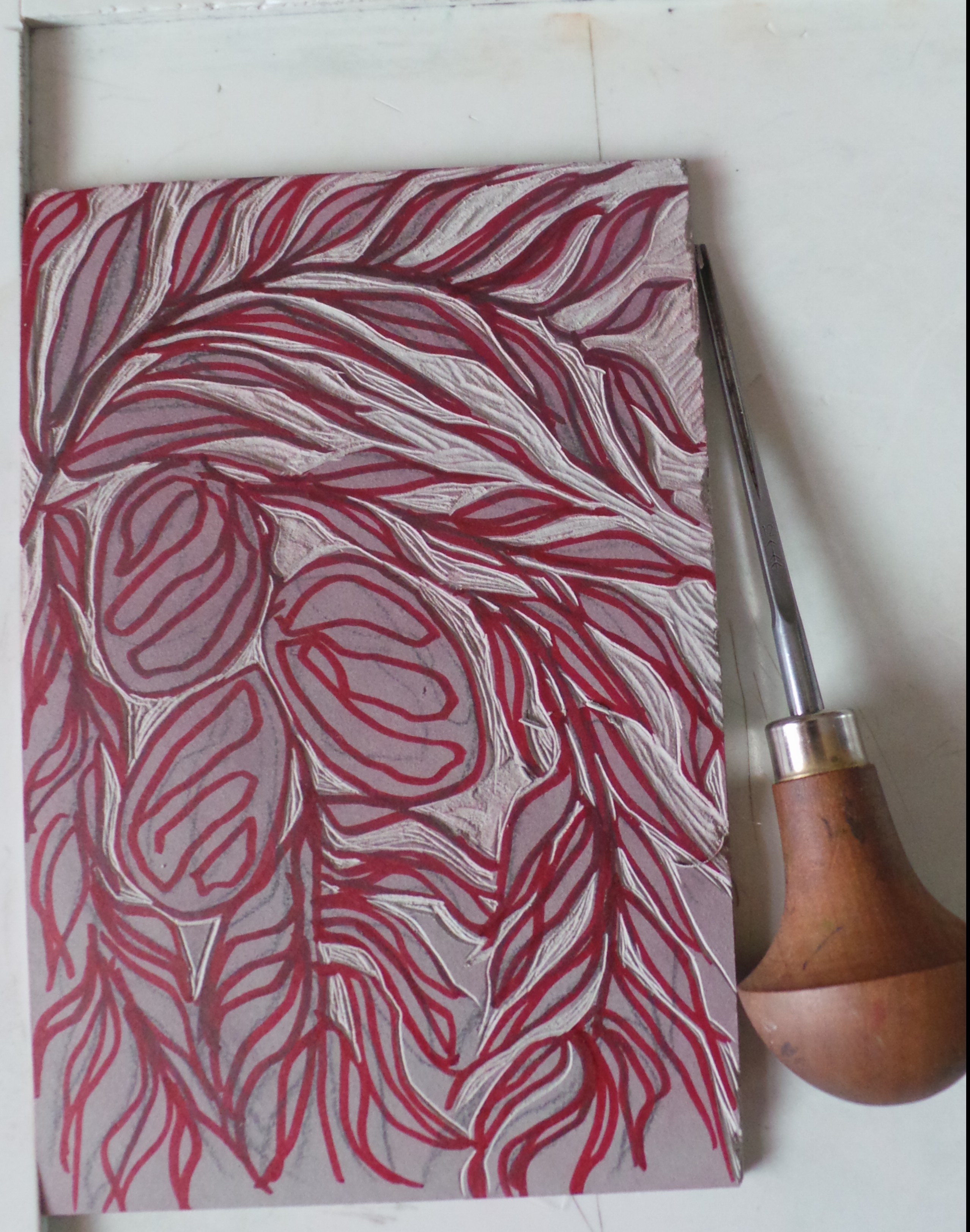
Each day I would attempt to draw the leaves and now I try to do a lino-cut but somehow it doesn’t ‘cut the mustard.’
Patience brings its own reward !
I too have a passion for the old stories … even understand them … but a little like our/my own good advice we/I don’t always listen or remember them … note to my self … ‘be patient’


My mother used to enlighten me with ethical stories at bed time. Those character building stories have left great impact on me.
Let me share one of those stories with you today 🙂
Long time back, famine broke out in a country. A rich charitable man distributed loaves of bread to children every day in his region. Every day the children gathered at the rich man’s house to get loaves of bread.
As soon as the servants brought out loaves, they fought among themselves and struggled hard to get them.
But one little orphan girl waited patiently for her turn. But every time she got the smallest loaf last of all.
One day as usual, she got the smallest piece.
She went home and sat in a corner to eat it. As she cut it, her eyes gleamed with joy. She saw a gold coin in it. She went back…
View original post 75 more words
 Coat Hanger Doll's House