Silent Sunday
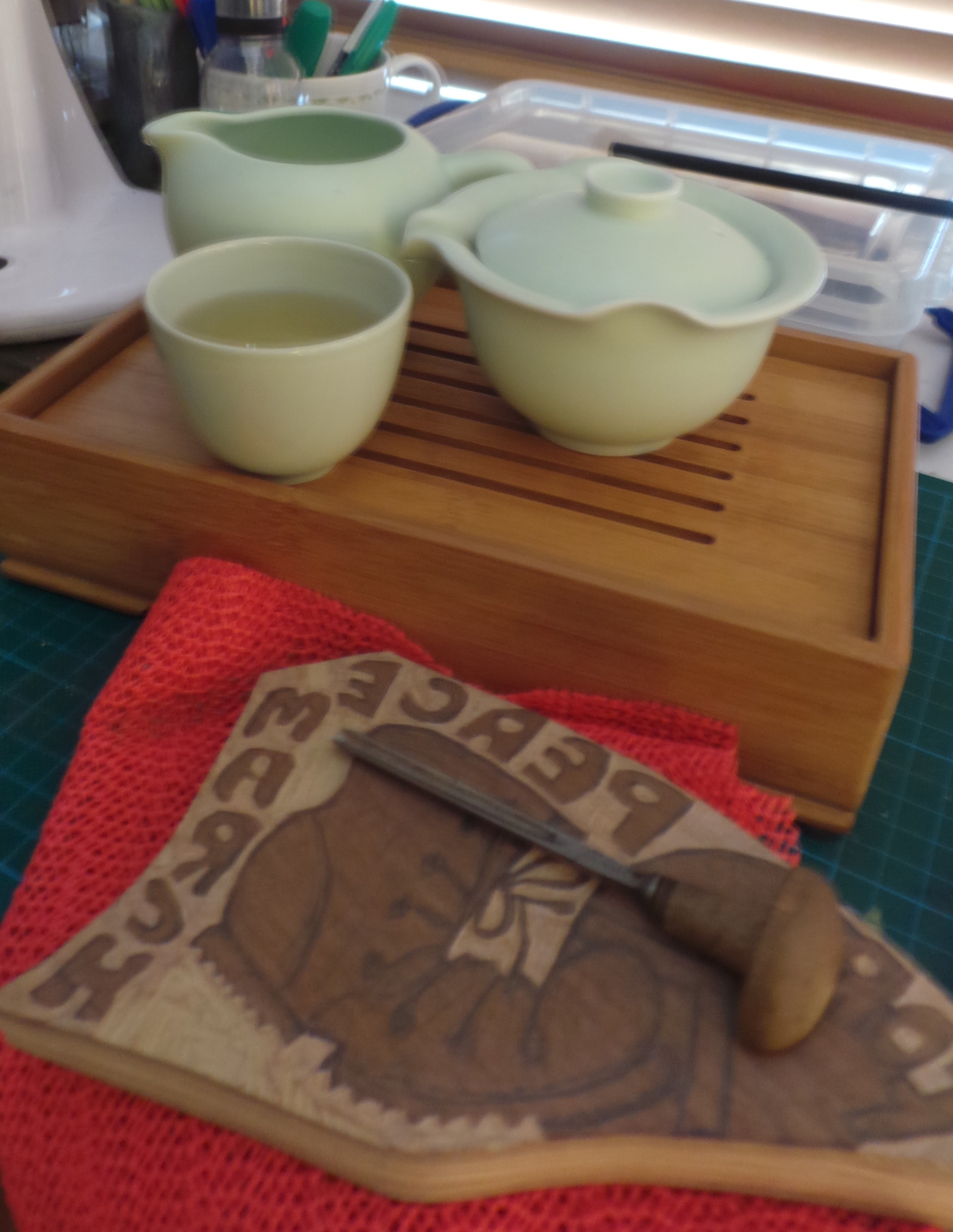
Saturday …
I had two art classes this week. One, was the final of a session of printmaking, it has been good I have learned a lot and consolidated some previous lessons. While I do find the school room experience a little daunting it is better than the feeling one has at home when the ‘art’ doesn’t go according to plan. I have wonderful facilities at home but the positive attitude of a teacher doesn’t come through and I lose the will to be experimental.
The other was one of a session of classes run by a local art group during the winter and spring terms at a nearby school.This week we painted chickens using ink and water colour. Not a subject matter I am a familiar with or like particularly; so already I was ill prepared. However, that is not unusual; this last two years (all my life) I have felt all of the above and more beside so I was ready for the panic.
Nonetheless, I was pleasantly surprised at the results of both classes, but I am still left with some decisions about the way forward. For example experimenting at home without a teacher and other students … the use of colour, reduction and other clever technical stuff. Then, there are the chickens do they have a valid place in my life?


A snapshot from the Cole Library …
I didn’t work directly with this book ; Titelkupfer zu Dr. Bloch’s Fischwerk by Marcus Elieser Bloch, from the Cole Collection. I have a work experience student at my side for one day a week and as she has become more confident she is takes over some of my tasks. While I watch over and share knowledge ; we have begun to reverse roles for an hour or two. It has become a gentle, good and productive way for a student with plenty of academic know-how to gain hands on experience before finding work in a library or museum.
So this item from the Cole Collection had a record on the old card catalogue, needed to be bought into the 21st century and given space on the ‘database’ not a difficult job for a library assistant or in this case her shadow. With the technical stuff done we hand it to a subject cataloguer to look at the fine details such as provenance, binding, author, illustrator. etc etc. But not before we look at the pictures ….


Alphabe Thursday Q is for Thomas de Quincey
 Along my walking alphabet I meet Thomas Penson De Quincey 1785 – 1859) was an English essayist and a close friend of William Wordsworth.
As a school boy De Quincey read the poems of Wordsworth. It is said that the Lyrical Ballads (1798) had consoled him in fits of depression and hoped one day to meet him. He walked many miles to fulfil his dream but he was not able to finance the journey so lived close to starvation rather than return home to his family. So after a poor start to his further education he did get a place at Worcester College, Oxford. Here, he met among others William Wordsworth (1770-1850) he left university before graduating and moved to to Grasmere, in the Lake District in 1809; and they became neighbours.
Sometimes De Quincey joined his friend on walks in the Pennines. It would seem that William Wordsworth’s legs were often discussed among females knowledgeable on the subject and were ‘pointedly condemned’ Thomas De Quincey replied ‘ There is no deformity about them ; and undoubtedly they have been serviceable legs beyond the average of human requisition; for I calculate, upon good data, that with these identical legs Wordsworth must have traversed a distance of 175-180,000 English miles – a mode of exertion, which to him, stood in the stead of wine, spirits, and other stimulants whatsoever to the animal spirits; to which he has been indebted for a life of unclouded happiness, and we for much of what is most excellent in his writings’.
De Quincey went on to have a lifelong passion for walking comparable to Wordsworth. We cannot measure the pleasure, but it is noted that walking was neither a subject nor a compositional method for the younger writer; perhaps he had other things on his mind. He was among the first to go on a walking tour with a tent; during his previously mentioned wanderings he needed to save money so it was a sensible alternative to lodging houses.
De Quincey’s best writing about walking was about the prowling the streets of London. We understand from his book the Confessions of an English opium eater , that he at the age of 17 ran away from a dull school and unsympathetic guardians; as a destitute youth; it was a very different kind of walking and writing. For 16 weeks he starved and made friends with other female street walkers who protected him against watchman who tried to drive him away.
For De Quincey his time in London was to have a profound effect of him and while there was no sequel, the rest of the book was devoted to the effects of opium and the rest of his life in rural places.

Wednesday counting down gently to my trip!
In a few months time I will be going to Brazil, it will be my third visit. On previous visits we have explored art galleries and museums for examples of Brazilian art. I have collected a few books and hand bills relating to those who have taken my fancy. I am not able to read Portuguese so I apologise now for any untruths I have recorded in my bid to share some notable printmakers.
Carlos Scliar (1920 – 2001 ) was a Brazilian printmaker, painter, illustrator, set designer, graphic designer and writer. He exhibited his work in Brazil and internationally with much success throughout his busy life. As social activist he engaged in various movements and produced posters, illustrated books and journals. While he was an engraver by choice he fell in love with with screen printing. It would seem Carlos was innovative and always on the look out for new techniques and materials, from tempera to acrylics, from painting murals to graphic arts.
These examples are lino cuts and lithographs … correct me if I am wrong …


Images from Poetica da resistencia aspectos da gravura Brasileira 1994
Weekly photo challenge … Orange
Orange was not my favourite colour; it doesn’t feature in my wardrobe and not been given space in my home since the late 1960s when all my kitchen apparatus were orange plastic.
However, since learning colour theory I have warmed to its sunny hue. While I may not add to my summer ensemble; I do celebrate it this week.


On Saturday I …


… I went to a printmaking workshop with Cath Baldwin. I was not sure what to expect as all materials were provided. All I knew was that the theme was Allen Seaby’s book Pattern without pain. I have a copy and had worked through some of the exercises in preparation.
The day began with a short overview of the exhibition of Allen Seaby’s work at the Reading Museum. Although, I had seen it before; it was extraordinary hearing about one of the leading pioneers of 20th century printmakers and those who inspired him and the way he went on to encourage contemporary printmakers and fabric and interior designers.
So, what seemed to start out, for me as another linocutting day turned out to be something quite different and exciting. While the lino, tools and the techniques were very important; the day was more about the joy; in the words of Seaby ‘no pain,’ of shape, colour and repetition. We did have a short clarification of the colour wheel that allowed us to make considered colour combinations or for me bring understanding to a theory that was not always clear.
As you know I am a poor student and fears and anxiety can cloud my vision, when it did become clear my pattern and colour combinations were not as zingy as the others in the class. However, it was a good day and I will put the lessons learned to practice in good time.
Silent Sunday ….

Saturday a celebration of a spoon and old tin can ….

This week has been joyous; it began seamlessly and conveniently as the weekend finished! On Tuesday, my new Monday, a parcel arrived from Brazil;quite a surprise. It was a lovely opportunity to celebrate, as we do, with wine and a takeaway. Like Pandora’s box there were some delights but my favourite, by far was a empty bean stew can! Feijoada is a stew, traditional in Rio de Janeiro. I enjoyed the vegetarian alternative while in Rio and since at home, neither perhaps enjoyed as they should be; nonetheless succulent and reminiscent of my other home.
A Carioca would not be seen dead buying a can of beans. But my daughter on a trek in the mountains beyond the city, needed a convenient option while without the required pressure cooker.
Then, knowing my passion for suitable or even less suitable containers she popped it in the post!
I was doubly pleased as I had found a rather nice but expensive walnut spoon that needed ‘space’ to be pricey … no spoon of my of such worth will go in a cupboard! I have learned over the years, when justifying an extravagant indulgence, is to have a ploy. The spoon can double up as a baren while pressing lino, cuts when not serving as cereal scoop!
So today, join me as I celebrate, parcels, spoons, feijoada, recycling and what we will , with love!
My snapshots from the library as usual are just a bit of beauty. I am lucky to work in lovely surroundings with of course a wonderful product. However, I don’t always take the time to look about me; but as the late winter sun came over the surrounding buildings and peeped through the stained glass windows … I could not resist the urge to gaze a while …


 Coat Hanger Doll's House