Alphabe Thursday B is for Brown
My little brown pot is not so brown it is Burnt Umber

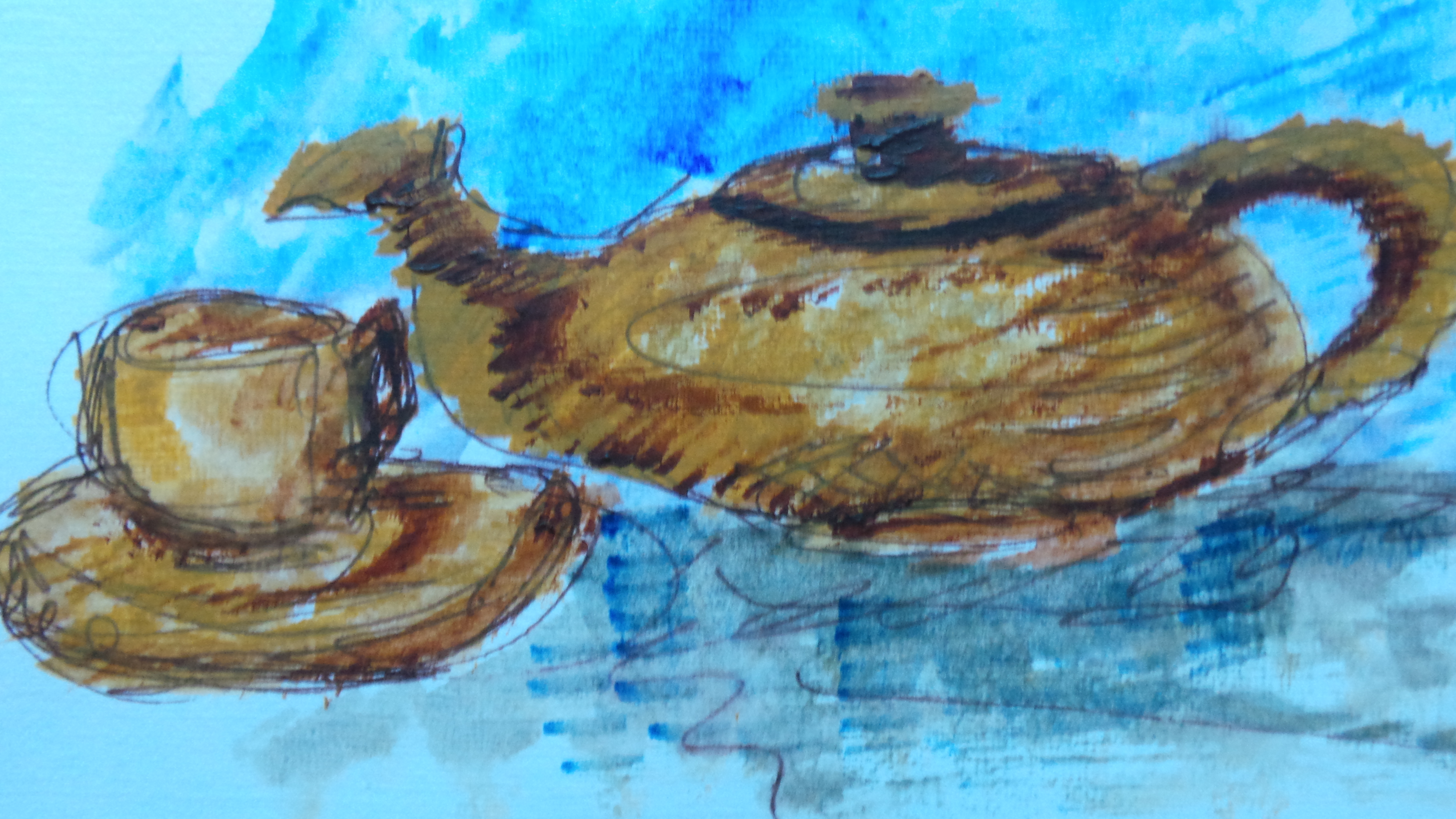
Remembering again my paintbox as a child; I don’t think I used the brown too often. We lived by the sea and the sun shone every day. Didn’t it? There was need for shade or gloom. Nonetheless, the names Burnt Sienna and Umber sounded so beautiful and foreign; but I had not understood why until quite recently. Brown did not come to the artist’s pallette until the late Renaissance; until then artists such as Cennino were lightening and darkening the tone of their works with white and black. Then the Baroque period came ‘the era of deep shadows, dramatic black, counterpoint to fulvous highlights.’ So between the golden glow and the heavy gloom came the new yellows, ochre and brown pigments
Brown really was the least lovely of all pigments; because it came from the ground albeit in a wide range of shades.
The ochres or iron ores have been…
View original post 183 more words
Alphabe Thursday B is for Brown
Remembering again my paintbox as a child; I don’t think I used the brown too often. We lived by the sea and the sun shone every day. Didn’t it? There was need for shade or gloom. Nonetheless, the names Burnt Sienna and Umber sounded so beautiful and foreign; but I had not understood why until quite recently. Brown did not come to the artist’s pallette until the late Renaissance; until then artists such as Cennino were lightening and darkening the tone of their works with white and black. Then the Baroque period came ‘the era of deep shadows, dramatic black, counterpoint to fulvous highlights.’ So between the golden glow and the heavy gloom came the new yellows, ochre and brown pigments
Brown really was the least lovely of all pigments; because it came from the ground albeit in a wide range of shades.
The ochres or iron ores have been used in painting for ever and those from Sienna have remained a popular choice. Raw sienna is a yellow pigment but when roasted it takes a warm brownish red. But still nothing matched the deep colour of umber. It was darker than sienna because it contained more manganese in the iron oxide. Umber has been used in European painting since the 15th century. It was assumed that umber came from Umbria, Italy; but this has been unfounded. Umber (also umbrella) comes from the Latin Omra meaning shadow. The rich red-brown burnt umber, highly valued for rendering deep but translucent shadow, was imported from Turkey.
The Englishman, Edward Norgate wrote in 1620s that burnt umber is ‘a collour greasy and foul, and harde to worke withall if yow grinde him he is bought, yett of very greate use foe shadowes and hayres etc.’ (sic)
In Colour, Victoria Finlay tells us of the British forger Eric Hebborn who suggests that the earth colours were not promoted because they were finer, stronger or better simply; they were cheaper.
The story of brown could be continued …

Wednesday’s women
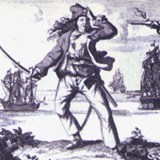
Here at the library we have a fine collection of Robinson Crusoe books written by Daniel Defoe. Although I have never read the any of the books from cover to cover; I do from time to dip in and look out for interesting images. They are not my cup of tea, I prefer a story that demonstrates a bit of girl power. Which is a shame because I have learned that Captain Charles Johnson (believed by some to be a pseudonym for Daniel Defoe) was aware of at least two female pirates who sailed the seas in the early 18th century.
Mary Read for instance born 1690 to a widow of a sea captain. Her mother, dressed her in boy’s clothes, when her brother died, so she could get money from her father-in-law. The habit remained and later Mary; dressed as boy was able to find employment as a sailor or soldier.
While Mary was fighting for the British in Holland, she fell in love with a Flemish Soldier; when she revealed her secret they married. Until her husband died they ran an inn, when she could no longer run the inn alone she went back to war. However, not long after peace was declared so she took a ship to the West Indies.
On the way Mary Read’s ship was attacked and captured by pirates; who she joined. Soon she met with Anne Bonny who had left her husband to be a pirate and had become the lover of Calico Jack Rackham. It is told that Mary and Anne become lovers; with it seems Rackham’s consent as they were his most valued and bloodthirsty pirates.
Meanwhile, Mary fell for a male pirate who managed to find himself challenged to a duel. Mary, renown for her fighting and afraid she might lose her lover promptly murdered his opponent.
By 1720 Rackham and his deadly crew were being pursued by bounty hunters. Later that year Captain Jonathan Barnett had captured the ship. It was, by some accounts Mary and Anne who fought while the men hid below deck. Rackham and his men were quickly tried and hanged. Mary and Anne at their trial were pregnant and spared the gallows but they both died in prison soon after.
As said earlier it was said to be Captain Johnson to documented the accounts of Mary Read and maybe embellished the story. Nonetheless it was true that a woman called Mary Read did serve with Rackham and the evidence is strong that Mary and Anne were able, strong and skilled pirates who were just as ruthless as their male colleagues.
Mary Read and Anne Bonny seem to have captured the public imagination in the so-called ‘golden age of piracy’ when women were usually controlled and protected.
It is a shame Daniel Defoe didn’t write a story about these courageous women. It is strange that piracy now considered terrorism was and still celebrated and romanticized.

Weekly Photo Challenge … the unexpected!

I am stuck for a particular image to represent this weeks challenge; but I do fulfil the category. My life is neither normal or straightforward. There are the usual regularities; but more often there are unexpected surprises. While some are good and others are more difficult. I get up in the morning no surprises there; but going to work on my bike is often dramatic. Things happen, mostly due to the weather, volume of traffic and the students who straddle the path oblivious to cyclists , Bless them! On the plus side there are the seasonal surprises that never fail to delight.
As the day progresses; those who read my blog will understand in my job there is never a dull moment; most days we come across a little treasure. Or conversely; as an assistant I am daily called upon deal with a less attractive surprise; a lost book, lost student, or a damaged book or student … maybe rundown by an old lady on a bike looking at the ‘Oh so surprising spring flowers!’
I am a mother of two daughters, a son and grandchildren; They of course bring me many surprises. While my son is self sufficient; my daughters like to unload their lives on me; and sometimes the role is reversed, so we share our fortunes and misfortunes. Crying or laughing in copious cups of tea.
My younger daughter and I enjoy the Weeping woman by Picasso it is an image we both hold near. Her expression is one a lady who might have when she is already emotionally charged and has one more unexpected experience.
I will stick with her … thanks Pablo!!
Monday … the week begins again!
 For the first time since I started to post daily I really am not going to make a fresh new blog post. I really cannot think of anything that will reflect my mood. As you know I have family in Brazil and you can imagine I don’t get to see them that often.
It is 9 months since we visited them in Rio and we made plans then for them to come to us at Christmas and since the flights were booked I have been counting the days and making lists. Unfortunately, due to a change in the immigration laws my son-in-law has been refused a visa. As in Saturday’s post this is not a legal requirement but does make for a comfortable entrance at border control. His previous application has been refused twice because ‘they’ cannot be sure he will return to Brazil in January. He doesn’t feel like going through the procedure to be refused and humiliated again.
My daughter and we too almost agree there just didn’t seem to be away around these very strident laws or feel able to ‘prove’ he will go back. Of course he wants to go back to Brazil it is his home!
He can apply again if we stand as sponsors, also if he uses my daughter’s data i.e. her return ticket and commitment to her employers in Brazil.
This means we have to provide evidence of our salaries and financial stability. Even then there is no guarantee that they will change their minds. So while he begins the whole application we are all with heavy hearts and little hope in the British bureaucracy.
Silent Sunday

Saturday … end of a hard week

This week has been up and down. My daughter now has a work permit for Brazil. There were some initial sad implications, but overall it was welcome; now my daughter will have opportunities to make positive choices in her life.
Like come home for Christmas. Of course ‘M’ can within reason come and go across English borders without fear. However, her boyfriend who is Brazilian cannot. Although legally he does not need a visa to visit the Uk for less than six months it has proved on previous visits to be a prudent requirement. ‘Unwelcome’ visitors have been turned back to Brazil at UK Border Control. His application for previous visits have been accepted with no problems.
Sadly, this time since the new immigration laws and for reasons best known to the UK Border Agency his requests have been refused. It would appear ‘they’ think he will not return…
View original post 206 more words
Saturday … end of a hard week
This week has been up and down. My daughter now has a work permit for Brazil. There were some initial sad implications, but overall it was welcome; now my daughter will have opportunities to make positive choices in her life.
Like come home for Christmas. Of course ‘M’ can within reason come and go across English borders without fear. However, her boyfriend who is Brazilian cannot. Although legally he does not need a visa to visit the Uk for less than six months it has proved on previous visits to be a prudent requirement. ‘Unwelcome’ visitors have been turned back to Brazil at UK Border Control. His application for previous visits have been accepted with no problems.
Sadly, this time since the new immigration laws and for reasons best known to the UK Border Agency his requests have been refused. It would appear ‘they’ think he will not return to Brazil after his holiday. This is appalling and inhuman as he fully intends to return to his home, work, and studies.
My son-in-law has provided as much as he can to prove his return but there is only so much one can do. Then, at the end he is treated as a liar and unwanted in the UK.
I understand that there are ways to buck the system; but he will not tell lies. Also, he is reluctant to disclose details (if we were to allow this) about our financial position and our daughter’s personal data.
Surely it is not necessary to tell lies and go through hoops! I understand there should be some sort of security at any border control but this could be sensitively policed surely?
He is a human being wanting to spend time with his ‘English’ family and go home again.
I am hoping we have found the the support of our Local MP who will I hope understand we inviting to our home a dear man who not only cares for our daughter but also his country, mother, father, sisters and little niece. His is not a waster, scoundrel or vagabond even if her were he deserves better than this.
Friday’s library snapshot …


Armed with a magnifying glass and new found knowledge along the shelves I found another item with a monogram; this time a tiny ‘h’ (seen in the first image bottom right) the signature of William Snelling Hadaway. The book translated from the French by Jessie L. Weston (1850-1928) who was an independent scholar and folklorist particularly interested in medieval Arthurian texts and the illustrator; Caroline Watts of whom I know nothing.
The book called Guingamor, Launfal, Tyolet, The were-wolf. It was published in London by by David Nutt at the Sign of the Phoenix in 1900.
William Snelling Hadaway (1872-1941)Artist born and educated in America. Trained in Massachusetts 1890s at the Museum of Fine Arts. For a while in England he designed stamped cloth book covers for all the books issued 1898-1899, for several publishers including Constable, David Nutt, S.P.C.K., James Bowden, Horace Marshall, Harper and Ward Lock.
After graduating, he continued to study in Sicily and Italy for two years before going to the Madras School of Arts, India where he stayed until 1927. Here he specialised in Indian visual arts and published several works on the subject.
Alphabe Thursday … A is for Azure

A is for Azure blue. As a child I remember my first paint box with little blocks of colour and their mysterious names like burnt sienna, lamp black, cadmium red or umber. Never getting the complete answers to my questions; often a shrug or ‘ask your teacher’.
I also wondered about the sky was not always blue? I have learned since that the sky is not a colour; but chemicals moving about reflecting light and ‘being’ colour.
However, my brain can absorb no more and I have wandered away from my paint box and painting the sky. Not with sky blue but with Ultramarine or Azurite.
But then I learn that ultramarine, with the sound of the sea also is not a colour but a term used to describe all goods but mostly exotic from ‘beyond the sea’ in landlocked Afghanistan. It comes from lapis lazuli, a stone of bright blue unlike azurite that is less bright and often used as a cheaper alternative. From what I understand Azurite is not a stone but a mineral produced by weathering of copper ore deposits
The Lapis Lazuli is pounded to a powder very carefully so the dust doesn’t ‘go off; I imagine to where dust goes! Once it has been pounded, sieved and pounded again it is mixed with pine rosin, gum mastic and wax all carefully measured; the procedure according to Cennino d’Andrea Cennini in the Craftsman’s handbook is long and complicated.
While on the subject of azure I have often wondered why the Virgin Mary in paintings and frescos is often wearing a blue gown or dress? I have since discovered that this is not entirely true; she is inclined to wear red at times. In Russian icons she wore red, also in Holland scarlet cloth was the most expensive and befitting the virgin mother. In the 7th seventh century the Byzantine artists favoured purple because it was the most expensive dye. Sometimes we are told she wore white and black .
It is suggested by Victoria Finlay, when considering colour symbolism, red is for birth, purple perhaps mystery, blue maybe the colour of heaven, white shows her innocence and black for her coming grief.
It seems likely though that when in the thirteenth century; ultramarine arrived in Italy as the most expensive colour available, it should be used for the most precious symbol of faith.
I cannot tell what colour was used for my little early 20th century medicine bottles but I would like to think they are azure blue.
Further reading
Colour by Victoria Finlay
The Craftsman’s Handbook by Cennino d’Andrea Cennini
 Coat Hanger Doll's House