Alphabe Thursday O is for Oak
 This week’s contribution could go anywhere pretty much but I will go for O is for Oak Tree. The female
Cynips quercusfolii is a small black gall wasp, is noted for her unusual nest making. In the spring she punctures a home for her eggs in the soft young buds of the oak tree. The tree naturally protects itself against the ‘invasion’ and forms little nutlike growths around the wasp holes. These oak galls are collected before the wasps hatch and used to make ink of the most intense black. It was used throughout the medieval times and was probably learned from the Arabs who used it for ink, dying clothes and mascara.
The ink contains tannin and is highly astringent and found in many other plants but it is not in such a concentrated form. Tea leaves can also be used to make ink.

Wednesday’s Woman … Zelia Nuttall revisited


Last week I wrote about Zelia Nuttall in relation to my colour theme and Alphabe Thursday; but I have read a little more about her and she seems to worthy of some recognition.
Zelia Maria Magdalena Nuttall, specialised in pre-Columbian Mesoamerican manuscripts and the pre-Aztec culture in Mexico. She was an American archaeologist and anthropologist, born at San Francisco in 1857. She lived and was educated in Europe between 1865 and 1876; during this time she attended the Bedford College for Women in London. She married Alphonse Louis Pinant,the anthropologist and linguist and had a daughter Nadine. Soon after she separated from her husband. It was about this time when she was appointed to the post of “Honorary Assistant in Mexican Archaeology” at the Peabody Museum, Harvard, a position she held for 47 years.
Nuttall published her first paper before moving to Dresden in 1886. From here, she took an expedition to Mexico where she worked in the Mexico National Museum. Now divorced from her husband; She was sent to Russia by the University Museum to gather books, exhibits and information. It is not clear how she came across the Zapotecan Manuscript (now called the Codex Nuttall) but she was able to trace the Mixtec codex and write the introduction for its first facsimile publication in 1903 (see below) Soon after this she settled in Coyoacan, Mexico where she died in 1933.
I would like to see the original codex, Zelia’s introduction describes quite a different picture that the book portrays.
‘ In the year 1519 the Spanish conquistador Fernando Cortes sent to the Emperor Charles V ‘dos libros delos que tienen los yndios’ or two hand painted books from the native cultures of Middle America. One of them may have been the Mixtec manuscript now known as the Codex Nuttall.
Originating in what is now the State of Oaxaca, Mexico, the Codex Nuttall was painted by Mixtec artists at some time not to long before the Spanish Conquest. It is, in effect a Book of Kings, one of a series of masterworks narrating in picture and hieroglyph the sacred history of the Mixtecs. Centring around the year 1000 AD., it shows the births of kings, their marriages, offspring and major events in their lives.
Over a dazzling white gesso background swarm hundreds of figures painted in rich earth colours. Kings in elaborate costumes of textiles and skins, ornamented with feathers, wearing elaborate masks of pre-Columbian gods, carrying ceremonial objects, wearing strange accoutrements, they stalk or squat through the pages.
Warriors in battle dress advance, marriage ceremonies are celebrated with bowls of frothed chocolate, kings and their consorts face one another in solemn rites, a child is born, a naked priest rips the heart out of a victim in a stark temple, rows of figures bear tribute or offer ceramics and decorated aprons, grave men make hieratic gestures to one another, a leopard bares its teeth, a woman kneels by a stream, fantastic twin temples rise to the sky, and the strange Mixtec symbols mostly undeciphered, convey a hint of place-names now lost’.
She ends the introduction by saying ‘ This is a strange world of vision, perplexing at times in what it communicates, awe-inspiring for its simple, powerful technique, at times baffling, but its realm of beauty and visual symbol without modern counterpart. Within its alien aesthetics it is one of the most beautiful books in the world, and it deserves a modern re-experiencing.
Weekly Photo Challenge in three!


I am not sure I can keep this down to three images … this little lady already has a story to tell. Inspired first by Peter Hay she has developed from a little print on an easer; to the windswept beauty on lino, to a work in progress as she sits by her bike that has a puncture…
Do I have what it takes? It is more than a good roller?

I wish to become a print maker; or at least improve my skills so that I can exhibit my work and maybe sell a piece or two. It all began as a bit of fun, with minimal investment about two years ago. Inspired by Peter Hay of Two Rivers Press I began a little journey. It was, and remains so to a degree, a joy, productive and I have even showed and sold a few items.
While I was having fun, I did see some potential and raised my stakes a bit. I returned to drawing and painting and attend some classes and workshops. I even found myself an art teacher to remind me of the basics; learned years ago but forgotten in the mists of time. This has given me the impetus to develop my printing making. Which, I have learned through other printer makers, is more than aesthetically pleasing but a craft that needs eyes and hands for the technical, balance, symmetry, order, tradition and good tools!
Skills and words used by my dad as a boat builder, a colleague who is a bookbinder and my brother, an engineer etc.
So I need skills and tools I don’t have yet. Yes I have some tabletop, basic tools and the skill to match, but not much else.
So I set about ways to improve the situation and enrolled in a couple of weekend classes I also made an appointment to spend a day with a printer for one-to-one training. She was to advise me on the art and craft of printing, using the tools I already had. Then she went on to tell me how I might improve with a modicum of investment. Ways in which I might improve my workmanship, maintain or increase my levels of enjoyment and become a competent print-maker. Six hours later I got the idea and understood the need for good tools and the right products such as ink, cleansers etc. My dad’s mantra singing in my head.
I have a shopping list of ‘must haves,’ they are not going to break the bank; but added to the money already spent means I have reached or almost there of a place of no return!
The bottom line is I don’t want to be cutting erasers for the rest of my life. I do want to be an illustrative print maker; it is my dream. But there is a need for further investment, of time and money both are limited and do these match the skill now or that to be achieved?
Silent Sunday
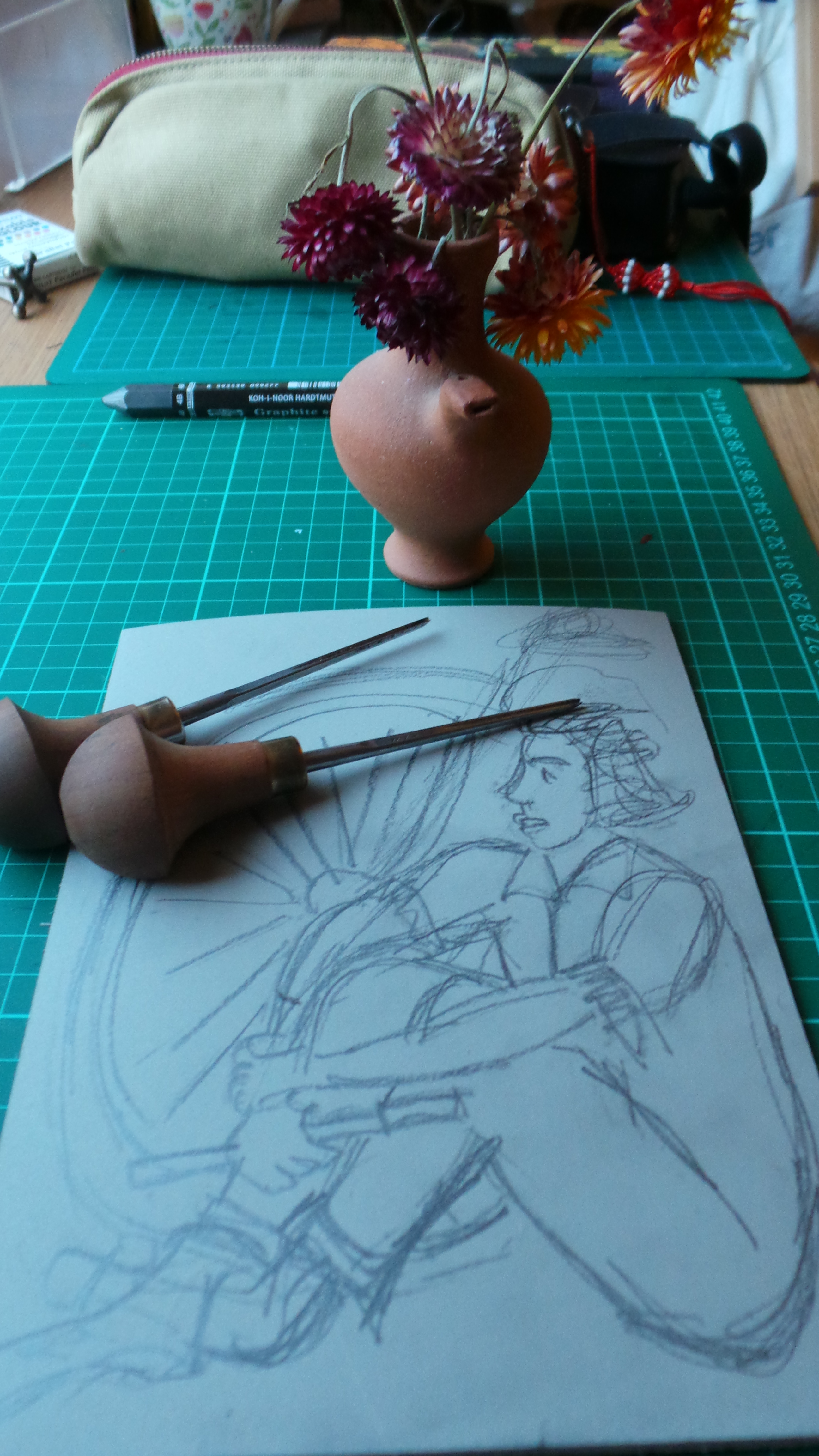

Saturday and the art classes
Last week I attended a painting workshop at my local school. I have not attended many art classes since I left school in 1966. It was a very new experience; not only did I use acrylic paint but I was learning about abstract art. Although I know the theory, putting it into practice was a bit of an ordeal.
However; I was not easily phased and did take a supply of tea; after about the third cup I was getting the hang of it all … or not!


Friday … a snapshot from the library
This week as usual on Tuesday between 1 and 2 pm. we had a public talk in the Conference Room or was it the Seminar Room at Special Collections? As usual I retrieved the required viewing material. It was half a dozen or so editions of Wind in the willows by Kenneth Grahame; a nice little selection from the Children’s Collection. They were displayed in the foyer under the eye of the Librarian for the visitors to browse as they left the talk.
I, tempted by the subject material sat at the back to listen while eating my packed lunch. The lecture was well attended and everyone listened intently as the speaker spoke about the more ‘meaningful, chapter 7; “The Piper at the Gates of Dawn” where Pan makes an appearance. I had often wondered why this had happened; but didn’t think too deeply about it; even when my hero Van Morrison wrote a song about it.
After 45 minutes I was still none the wiser; although I did make a few knowing nods (along with everyone else) as I peeled my particularly smelly orange as my interest flagged towards the end. ‘They were not peeling oranges or flagging I am sure; but they did enjoy the books at the end; but not me with my sticky hands!


Alphabe Thursday N is for Zelia Nuttall, purple and snails etc.


Zelia Maria Magdalena Nuttall (1857 – 1933) was an American archaeologist and anthropologist born in San Francisco, who specialised in pre- Columbian, Mesoamerican manuscripts and the pre-Aztec culture in Mexico. The Codex Zouche-Nuttall was made in the 14th century; and reached Spain in the 16th century. It was first identified at the Monastery of San Marco, Florence, in 1854. Nuttall researched Mixtec Codex now called the Codex Zouche-Nuttall and wrote the introduction to its first facsimile published in 1902.
The Codex Zouche-Nuttall is an accordion-folded pre- Columbian piece of Mixtec writing, now in the British Museum It records the genealogies, alliances and conquests of several 11th- and 12th-century rulers of a small Mixtec city-state in highland Oaxaca, the Tilantongo kingdom, especially under the leadership of the warrior Lord Eight Deer Jaguar Claw; who died early twelfth century at the age of fifty-two.
It was while Zelia was in Tehuantepec in Mexico, studying the ancient cartoon paintings made by the Mixtec people that she noticed the purple skirts worn by the richer women in the marketplace. Although she was had no real knowledge of textiles. She saw that design and colour was like those she had seen in the pre Columbian paintings. The codex, was painted on deer skin; containing information about the peoples, their culture and their gods. The skirts where the identical colour to the beautiful pigment in the codex, painted more than 400 years before; not only used on clothes but on their bodies.
Nuttall spoke with a weaver who remembered as child the fisherman obtained the dye from the caracol or sea snail but by the time of Nuttall’s visit the supply had all but dried up so the fishermen were having to sail further to fulfil the demands of the Mexican ladies. She was concerned that the industry would soon be extinct … I will have to read Colour by Victoria Finlay a bit more to discover whether she was right or not.
Wednesday’s Woman … Marinês Busetti
Marinês Busetti – Xilogravura from Spaghetti Filmes on Vimeo.
My research into worthy women began soon after I starting my blog; it would not have worked without my daughter’s input. Each Tuesday I agonise over my Wednesday woman; between us we usually find a likely candidate.
This week, my comrade has really come up with a champion. My daughter and I are would be printers while not yet tried wood we are becoming more adept at lino cutting. So we are always on the look-out for inspiration and when she found Marinês Busetti we were delighted
Marinês Busetti studied art at university; she enjoyed printing, drawing, sculpture and in 1987 had her first exhibition. During this time she also practiced the art of paper folding. She began experimenting with other materials; using optical illusion, light and shade and perspective.
In 2003 she returned to xilogravura (wood cutting) working with a living material and using an age old technique. She enjoyed the opportunity to preserve the old art form and welcomed the opportunity to share it with children. It was then she remembered how much she had enjoyed origami; with its lines and forms and found ways in which she could apply it to wood engraving.
Marinês is able to repeat her patterns so her works are often several feet square.
Recently she has appling her prints to other materials, using colour ; as she says and old technique in a contemporary way


Weekly Photo Challenge … Treasure
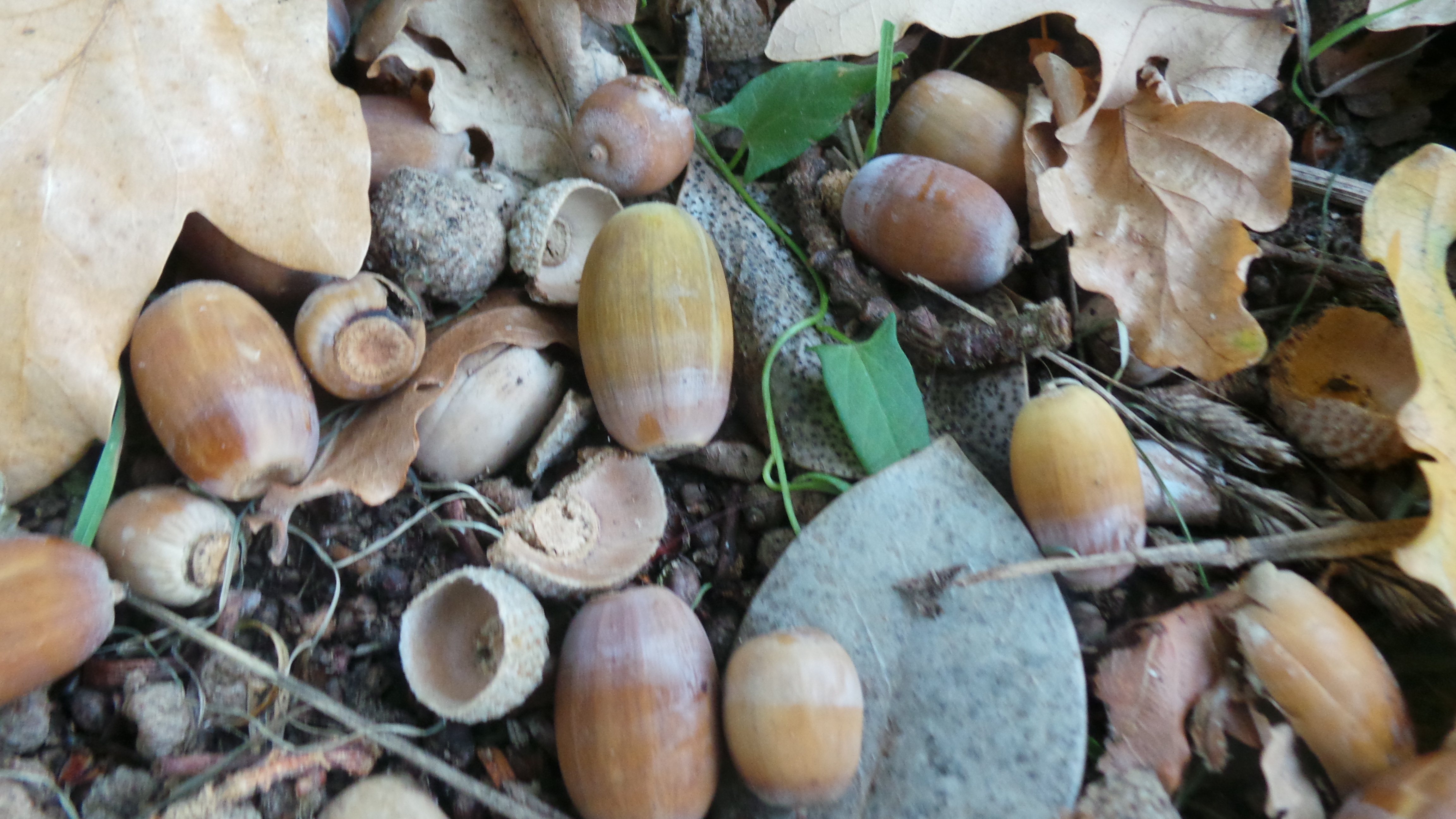
These acorns represent the shortness of life … already they have lost their new bloom beginning to snuggle down into the soil to make roots and grow into trees and produce more acorns.
For me my most valued treasure is time and space …
My material needs are minimal; I have a home, family, friends and paid full time employment. Of course I have dreamed about finding treasure;especially when in-comings didn’t quite match the outgoings. But somehow over the years we have always managed.
But now, as I draw nearer to the end of my working life and I make plans; I dream more about the time to enjoy the things I do … even though even in retirement the space will be filled with I hope treasure of a different kind.
 Coat Hanger Doll's House