Friday’s Library Snapshot …
I don’t often get the opportunity to work with new and shiny books; this was a nice experience especially as many of the images were from here at Special Collections.
Russian-born American Jewish artist Max Weber (1881-1861) is widely recognised for introducing Cubism to New York. Max Weber: an American Cubist in Paris and London, 1905-15 is the first publication to examine his career and influence with a European rather than an American context. It accompanies the first major museum exhibition of Weber’s work in the UK at Ben Uri showcasing the University of Reading’s rare collection of 14 works (c1910-1912), formed by Weber’s champion in England, American émigré photographer Alvin Langdon Coburn (1882-1966). Following his formative years in Paris (1905-1908), as a founding member of Matisse’s art class, Weber played a crucial role in the significant cross-cultural dialogue between Paris and London. He was included in Roger Fry’s inaugural Grafton Group Exhibition in 1913 exhibiting alongside artist including Vanessa Bell, Duncan Grant, Percy Wyndham Lewis, C.R.W. Nevinson, Helen Saunders and Wassily Kandinsky.


Alphabe Thursday

There are not so many nursery rhymes beginning with ‘I’ but my favourite is:-
Ipsey Wipsey Spider (Incy Wincy)
Climbing up the spout :
Down came the rain
And washed the spider out:
Out came the sunshine
And dried up all the rain:
Ipsey Wipsey spider
Climbing up again
Not sure of its origin but at least it is a happy Nursery Rhyme or at least has a happy ending … and involved a bit of role play!

Wednesday’s Wood Engraver
I promised myself earlier this year I would look out for some more women wood engravers. It was not as easy as I thought. It would seem that wood engraving has remained an art led by English speaking nations and women played a relatively small part in its development.
However, since the early 20th century, Britain has corrected this, producing a significant number of women wood engravers; such as Joan Hassall, Gertrude Hermes, Clare Leighton, Agnes Miller Parker, Monica Poole and Gwen Raverat, who have become more than notable in the medium. This was no mean achievement in a culture where women were confined to the home and had no consideration in the apprenticeship system.
It was only women from a privileged family who could afford to study at Art College.
Like Mary E. Groom (1903-1958) who studied wood engraving at Leon Underwood’s Art School; with Underwood himself, Blair Hughes-Stanton, Gertrude Hermes and Agnes Miller Parker. Mary Groom was part of the English Wood Engraving Society, a splinter -group of the Society of Wood Engravers. She is best remembered for her engravings in the 1937 edition of Milton’s Paradise Lost.


Weekly Photo Challenge … a relic
Ha! I am a relic according to my baby brother of 55 years, my grandsons would perhaps agree. I work in a museum and library among relics of past centuries, where there are books written before the discovery of the Americas. My home and garden is well past its sell by date. I am spoiled for choice
But this pretty little picture, spotted on the pavement this morning, surely fits the bill! Not 500 years or even 100 perhaps not even 10 minutes but a relic of this throw away world!

Monday Mark-Making …


I have talked much about my depression and complicated grief and will not dwell on it further. It is not only deadly dull to those who don’t understand for those who do know, it is best not to comment (unless requested). So, like many of those who suffer from depression and complicated grief we spend time confused and alone both mentally and physically. We find ways to make these alone times pleasant and even joyful! We garden, sew, make music, sing and dance and more, often well and successfully. I have found this so and particularly mark-making has become for me a method to get me through. Mark-making is something I do before I begin a larger or more detailed work. I could take a few minutes or several hours.. There are two ways (at least) in which the session could end; there might be a finished piece or a heap of marks. Either way there is a lot of material; some good and some perhaps not so. I am reluctant to bin it directly, the best option is to recycle not in the traditional way; I am not sure there is a particular need for my bits of art. But I am sure in time it will be reused.
Like I said earlier, this mark-making often begins in a miserable place with thoughts of loss, regret, grief and hopelessness; but as the marks, colour and shapes come together so the feelings drop away.Then space is made for feelings that are less tiresome, those that are positive,energizing and creative.
So I have salvaged the results of previous mark-making sessions and am putting them together in an album. Not of finished pieces but scraps that can be embroidered or enhanced by another hand in Brazil maybe. … Today I hope these slivers of joy regained from the gloom can be bound in a monument of less complication at least!
Silent Sunday
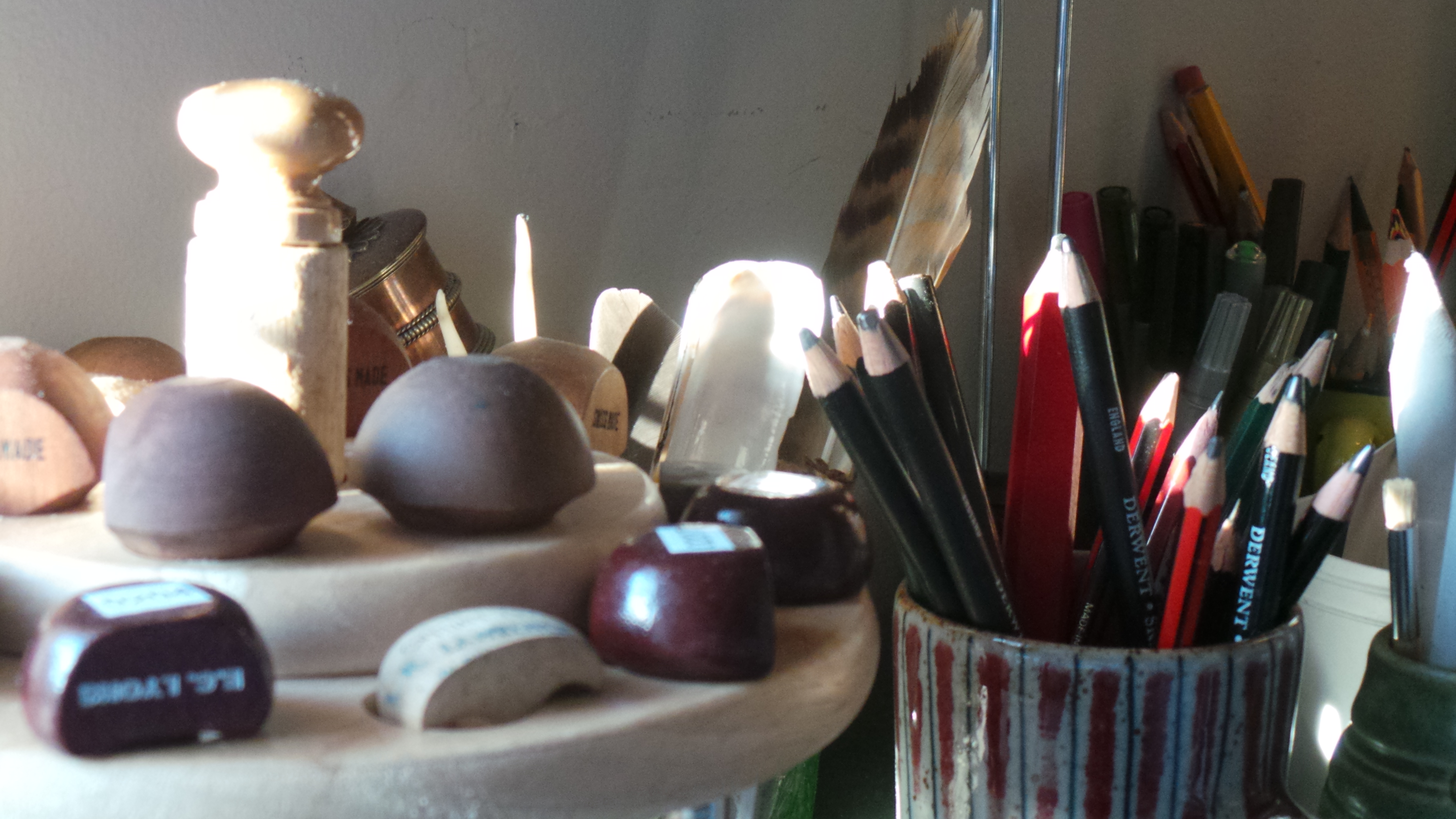

Saturday and the Pendulum swings

Each Saturday I look at the last seven days and ‘decide’ what has been their nature. ‘ Scientifically’, looking at the events and consider how they made me feel and throwing them (the results) at the swing-o-meter and watching where the pendular points. Pretty much without fail the pendulum hangs in the middle; I am a lucky lady; its clear. Good and not so good stuff comes and goes, by the end of the week things resolve themselves.
However, I do have one issue and it hangs over me like a judge. My hair loss is all but complete; I do have two half eyebrows at the moment. This is not such a problem I suppose with an eye brow pencil except that I have forgotten exactly where there were! So I am conscience that my attempts made to draw them at 7am are perhaps not as attractive as I thought by the end of the day!
The head, I continue to cover with scarves; I am, so they say good at accessorising. This all works most of the time, so the swing-o-meter tells me. Sometimes I feel horrible. Since I had a bad experience with my GP I have sought alternative medicine and that has worked so far. However sometimes the need for the support of a General Practitioner is paramount; especially in the workplace. I am lucky I work in a kind environment, should it be otherwise and needed time off (even extended time) I would need a Doctor’s note. This week in a sad and desperate place I tried make an appointment with a GP to ask for specialist advice after all I have lost all my hair in a few weeks surely that is enough. I did however this time get through the barrage of receptionists who while they didn’t quite see my condition was life threatening I did wave a letter from my therapist. Even the doctor was surprised at the audacity and reluctantly gave me the URL of a website where I could book my own appointment with a consultant dermatologist. It will take 3 months to see someone; during which time my eyebrows will have grow back and I will look a little less like Cruella de vil. Oh! just realised it was the look that scared the Receptionist not the letter from psychotherapist …. boing the pendulum dangles comfortable again …. Thank You for humour! Have a good day.
Friday’s library Snapshot …
This week I began the cataloguing process of a book already in the Cole Collection but without a full record. I, as an assistant don’t do the full monty this is the domain of a ‘Cataloguer’ but I am able to look at the pictures ; these from the Osteographia, or The anatomy of the bones by William Cheselden surgeon to Her Majesty; F.R.S. surgeon to St. Thomas’s Hospital, and member of the Royal Academy of Surgery at Paris and published 1750.


Alphabe Thursday H is for Hey Diddle Diddle


Hey diddle diddle,
The cat and the fiddle,
The cow jumped over the moon;
The little dog laughed
To see such sport,
And the dish ran away with the spoon.
This is probably the best known nonsense verse in any language and a considerable amount of nonsense has been written about it.
So I will not waffle on about the speculations … that over the years have been discounted Sufficed to say it appear in print in 1775 referring back to a work called A lamentable tragedy mixed ful of pleasant mirth, conteyning the life of Cambises King of Percia, by Thomas Preston, printed in 1597, [sic]
They be at hand Sir with stick and fidle
They can play a new dance called hey-didle-didle. [sic]
Another is in the Cherry and the Slae by Alexander Montgomerie, 1597
But since ye think’t an easy thing
to mount above the moon
of your own fidle take a spring
And dance when you have done.
The stores then become convoluted and confused so the pictures are welcome. These are from R. Caldecott’s second collection of pictures and songs printed in 1956 which were originally published 1878-1884.
Wednesday’s Wood engraver … Lucien Pissarro


Today I wander a little way from my Wednesday theme; because it is my theme and the images are pretty. I am enjoying finding out more about women wood engravers but came across these by Lucien Pissarro and couldn’t resist sharing them.
Pissarro (1863-1944), the landscape painter, wood engraver and printer, was born in Paris. He studied with his father Camille the French impressionist and was influenced by Georges Seurat and Paul Signac. He came to Britain in 1870 during the Franco-Prussian war and returned later in 1890 when he settled permanently in London. He married and had a daughter who also became an artist. During this time he met Charles Ricketts and Charles Shannon and contributed wood cuts to their Dial an art journal. In 1894 he founded the Eragny Press and with his wife printed illustrated books until 1914, during this time he he designed the typeface Brook Type. Pissarro associated with Walter Sickert and in 1906 he became a member of the New English Art Club. Between 1913 and 1919 he painted landscapes in southern England and during this time he became a British citizen.
Pissarro went on to become a founder member of the Camden Town Group of artists and formed the Manarro Group giving artists who had been inspired by the impressionist a place to show their work this opportunity was short lived.
From 1922 to 1937 Pissarro visited the south of France and ventured to Wales and Derbyshire to paint.
He died in Dorset 1n 1944.
 Coat Hanger Doll's House