Changing into your Mum?
http://mothersalwaysright.wordpress.com/?s=duster
You think you might be changing into your mum or your grandmother because you have become rather unnaturally attached to your duster. If you have taken to draping the duster across your shoulder like a fashion accessory (as you do soon after one becomes a mother when the muslin cloth becomes your closest ally) then you do have problems.
You have begun to wash out plastic containers and jam jars and stash them anywhere in the kitchen. Worse, you are washing out polythene bags and pegging them on a little washing line between two nails in the back yard. I mean, the little washing line as opposed to the big washing line with its complicated pulley system allowing the washing to be hoisted above the roof tops like a galleon in full sail. While the sheets and towels blow the breeze your neighbours can observe the brilliance and the careful use of the ‘blue bag.’ If you do feel the need to search out a ‘blue bag’ I wouldn’t worry they became redundant when biological soap powders flooded the market. They were indeed little bags of blue dye added to the final rinse to brighten it.
No! When I was a young mum in the 70s the little line was for ‘smalls’ and not so ‘smalls,’ those perhaps mended beyond repair – Mending! Seek advice should you begin to repair your smalls.
Then, you are definitely turning into your grandmother or worse mine.
There it was … gone!

View from Crableck to Swanwick
Last week for old time’s sake I took a walk along the Hamble. I parked at Moody’s Boat Yard and walked to the end of Crableck Lane and back again. I took snap -shots of the scenery as I went to perhaps record any changes over the last 50 years.
It was low tide and the air was still – very pleasant although rain threatened all morning.
There were no striking changes, certainly no more buildings except that the farm had been changed into a rather an exclusive residence and the path alongside the river was a ‘trim’ gravel drive for the 4×4 discreet in the double garage carefully disguised as a boat house so it blended with the nautical themes. The converted barn didn’t seem so grand with its UPVC windows and Leyllandi hedge rather than the yellow rambling rose I remember distinctly.
Further down the river is Universal Boat Yard; I remember a few cradles, a dry dock and some surrounding converted war ships serving as workshops and for storage. There were huge open ended sheds for repairing and building boats. Now called Universal Marine is an obscene example of 21st century affluence. The wooden boats I remembered were lifted and pulled from the water so their bottoms could be cleaned and repainted. A dozen or so may remain in cradles on the quayside for the winter. Now the fibreglass boats virtually maintenance free had been lifted and cleaned and stacked on huge structures protected from the weather until the next sailing season.

Boats away for the winter
I didn’t feel the need to photograph this (it is well documented on the internet) remembering those past years I still felt a little out of place and wanted to hurry through.
Back on the path: a little oak tree, its growth thwarted by the wind marked where our milk box was once placed, 50 years on, it was still struggling to match the mighty oaks that grew unhindered back from the river.
The jetty at the end of Crableck lane and been replaced probably because of health and safety regulations and thoroughly secure from the public with a rusty padlock – not so protected from the weather perhaps? The boats moored were no longer homes – they were for weekend use. My dad’s workshop; a converted landing craft with its green corrugated iron superstructure was no longer there. It had been a comforting and familiar landmark for me when I returned from my shopping expeditions Also gone was a motor torpedo boat called Anzio, in my time home to a family displaced by Second World War bombs in nearby Southampton.
It was as if we had never been there; I strolled back to Swanwick happy and relieved knowing that no one else other than mother nature had taken our domain, yet sad that there was no sign to say ‘we woz ‘ere’

Upper Hamble at Burseldon

University Challenge and the Karma Sutra

As a teenager I would enjoy ‘University Challenge’ on the TV; I did not take it seriously; it was a snap-shot of life that I had only read about in campus novels such as Lucky Jim by Kinglsey Amis and others like Evelyn Waugh’s Brideshead Revisited. Seeing these hairy bespectacled geeks and hurray Henrys with their foppish hair styles, I would smile.
Even their names oozed richness and the promise of a privileged future. There was Barnaby Forthrite-Jones reading philosophy, Rufus Cleverclogs reading law and Benjamin Toffeenose reading medicine,
Did I imagine I would ever go to university? Probably not. However, I did nurse a secret ambition to go to Art College or long before I dreamt of being a librarian. These childish dreams faded, but the deep-down desire remained .
This was the turbulent 1960’s – the decade of flower power, free love and student protest. I was a country girl watching on the TV from the confines of my front room the actions of rock singers such as Janice Joplin, a ‘gutsy ballsy girl who wanted to do what boys did’ and Joan Baez, a folk and protest singer, quite unlike Joplin but nonetheless meaningful and other favourites like Richie Havers at Woodstock. And yes, I did have a poster of Che Guevara on the back of my bedroom door!
I did venture to Southampton every Saturday morning to attend an art class the technical college. During the week I did a paper round to finance it, a small step towards fulfilling my secret ambition. At 15 years old it was to be my first experience of a city. I remember the students talking of the Kama Sutra an ancient sex manual, maybe in a bid to shock the new country girl.
I didn’t lose much time in searching for the Kama Sutra , a Hindu literary work by a philosopher called Vatsyayana I found a translation and was shocked and delighted by the images.
It was considered the height of erotica so as a teenager hearing of free love and the hippy trail; its reading became the ultimate aim. Little did I know that all these years later I would be able to read it in its original Sanskrit .
Terrible terries
I can remember the original ‘terry toweling’ nappies; I used them for my two oldest children born early in the 1970s. I was lucky to have a twin-tub washing machine but I didn’t use it for nappies – twin- tubs weren’t always next to the water supply and had to be dragged out from under a work top to reach the taps, and I therefore only used it for the weekly wash. So, nappies were steeped and washed daily. If you were lucky enough to have spin-drier, then life was a little easier – I didn’t.
But we did have nappy liners so we were able to remove solids – the joys of motherhood – before too much staining occurred, but still the sterilizing process had to begin:-
- wet and soiled nappies were rinsed in cold water
- placed in a bucket containing a a ‘Napisan’ solution for several hours
- rinsed
- boiled in a galvanized pot on the stove or Baby Burco (an electric freestanding boiler)
- rinsed again
- rung out and hung out to dry.
We would only have a dozen nappies so it was important to get into a routine because the process would begin again the next day. There was no fabric conditioner, so unless you were able to use ‘Fairy Snow’ – a new and expensive soap powder guaranteeing whiteness and softness, then they when would be harsh and uncomfortable.
Then, there were the plastic pants or ‘rubbers’. These were relatively soft when new but nonetheless the elastic gripped the babies plump little legs, unless you were able to place the elastic on the nappy leaving a little of the toweling showing. This of course defeated the object and wet seeped through to babies’ clothing, sheets and blankets creating more washing. The ‘rubbers’ too had to be washed and sterilized so after a few washes they became hard and cracked and useless. Also, the plastic pants over the soon to be wet nappies created a hot house for germs. This lead to raw red bottoms that no amount of Vaseline would soothe.
So you can imagine how delighted we were when disposables became a available. But our joy was short lived, they were badly fitting and after a night they just a soggy mass of jelly or padding depending on the brand. Most mums I knew stayed with ‘terrys’ until a better design came along and of course they did!! When my third child was born sixteen years later I was delighted that disposable nappies were the norm and the choice was huge. I was blissfully unaware any effect on the environment.
Meanwhile, any attempts to redesign the terry nappy and make it more user friendly for mother and baby was thwarted by the by the disposable nappy money making machine. Fortunately, young mums are better informed than I was and using better designed ‘reusable’s’ is now making economic sense.(Forbes 2011)
Now 40 years later we do have some choices and can treat our babies’ bottoms a little more kindly but it is still costly and not yet making a huge impact on the struggling environment. (Services 2011)
Forbes, M. (2011). “Out with the bucket.” Mothers always right, if not ask Gran. from http://mothersalwaysright.wordpress.com/2011/05/16/out-with-the-bucket/.
Services, V. E. (2011). “Real nappies: the facts.” from http://www.veoliaenvironmentalservices.co.uk/westberkshire/Waste–Communities/Waste-Minimisation/Real-Nappies-The-facts/.
Girl overboard!
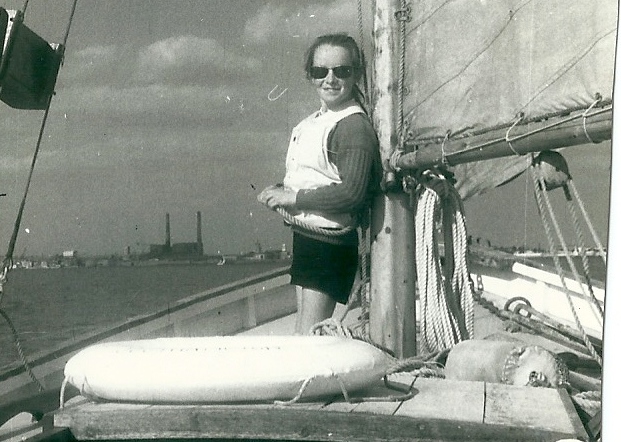
Sailing out of Hamble Fawley in background
I am not sure that my dad ever planned to ‘replace’ the little Falmouth Quay Punt that he lost, when it sunk of the Kent coast on his way to Hamble. But our sailing boat he then converted from a ship’s life boat did bear a striking resemblance to the pretty thing. My dad salvaged the life boat from a ship called Trooper and we retained that name. She had, in layman’s terms a point at both ends and not particularly attractive; so my ever resourceful father removed one end and replaced it with a transom this nautical term means a ‘wooden beam across’ and in this case the back end. Hey presto!! After many more hours of bending, screwing, riveting and sewing of sails she became a 30ft sailing yacht.

Trooper in waiting for mast and sails
Once sea worthy we spent summer weekends and holidays sailing the creeks and rivers of the Solent like water gypsies. It was a surprisingly social event, those Saturday afternoons in the channel from the Hamble to Calshot Spit towards Cowes was a steady stream of familiar boats. We, children would wave heartily to other crews while the adults would make knowing nods and begin to baton down the hatches.

Not much wind!
When we reached the spit we would decide east or west and catch the wind … us girls would look forward to Saturday night supper in Yarmouth (IOW), Buckler’s Hard, Portsmouth Harbour, Ryde or Cowes. We were never disappointed, although the course chosen depended on the wind and tide there was always a conflict between a challenge and the easy ride. I suppose as we got more experienced at sailing the decision became more of a choice and less ‘spontaneous’
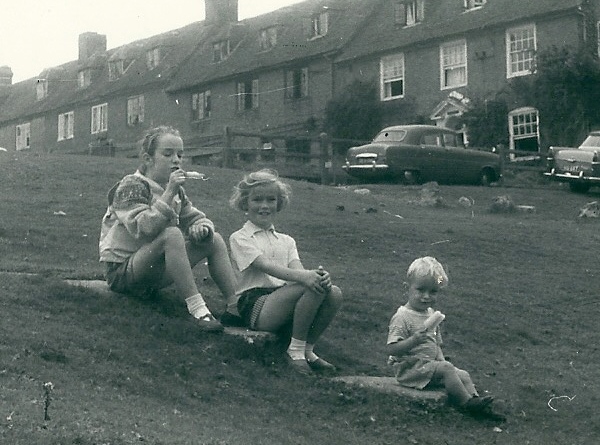
Enjoying an ice-cream at Buckler’s Hard
We did have a couple of mishaps that might have ended in tragedy. Once we thought we had lost my little sister over the side. She was about 4 years old and still inclined to have an afternoon nap. One day the water was a particularly choppy and we were all ’hands on deck’ and it was not until we settled to a smooth tack that we noticed the little girl was missing. We hunted high and low but she was nowhere; so in a panic we turned back to search the waters, we were rarely without life jackets so there was a little hope that we might find her by looking for her bright yellow lifejacket … then from a locker below the aft deck where the ropes are stowed a little bleary eyed girl appeared … soon we were back on course.
We tried to sail to France once, when an unexpected storm blew up. As we neared Cherbourg the waves were so high the lifeboats were not able to get near us. So we had to ride the storm, thanks to my dad’s expertise we survived. This episode is really worth time so I will write more about this soon.
The student experience
Every year I am given the dubious responsibility, of giving a ‘work experience’ student an idea of the work we do here as archivists and cataloguers in the ‘special collections.’ Although passionate about my job and keen to expound my knowledge, I am a little dubious since the student has not necessarily chosen to be in this particular experience. At 15 years old who would?
Early in our ‘relationship’ having established he was learning the history of science at school I assumed that he would be interested in the Versailles, Pliny, Isaac Newton volumes that graced our shelves. Previous students had also enjoyed just ‘seeing’ these rare beauties but this guy was eager to ‘turn over’ the pages and marvel. But then, he took out his mobile phone. I thought this was a sign of the end of a beautiful relationship but no, this something else! He wanted to record this great opportunity. Touching such a book in the British library without membership is forbidden and use of a digital camera in our Reading Room is charged for. I welcomed this student’s straight forward curiosity and relieved that not all was not lost.
I also learned that he was interested in Japanese manga and anime and was learning Japanese language. By coincidence the previous week the University of Reading library had received a gift from a Japanese University to mark 60 years since the nuclear bombing of Hiroshima. Sixty years before when the university was being rebuilt after the devastation Reading University had sent s selection of books to help restock their library. In return they sent a piece of clay tile from the remains of the old library as a souvenir and a set of comic books (manga) byKeiji Nakazawa telling the story of a boy called Barefoot Gen and how he survived the Hiroshima bombing.
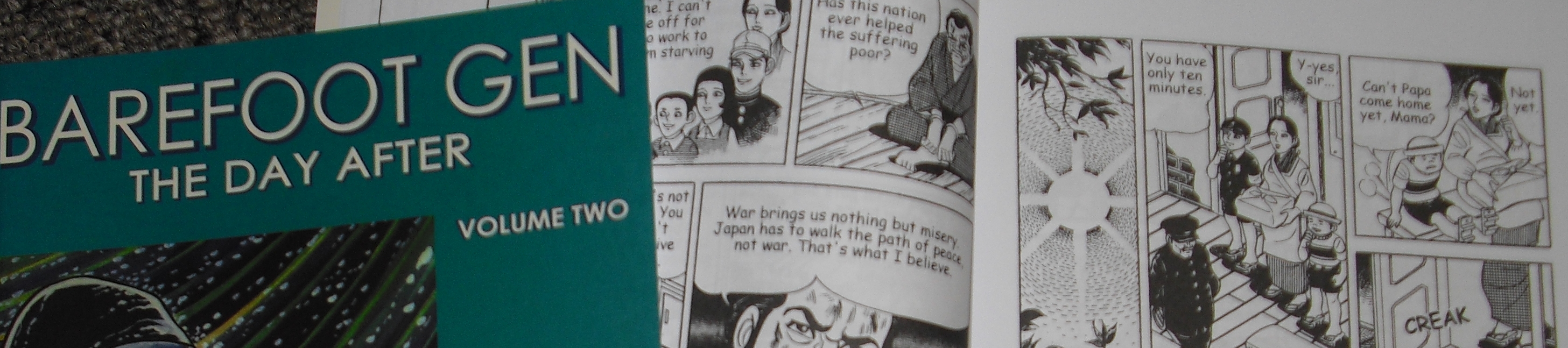
by Keiji Nakazawa

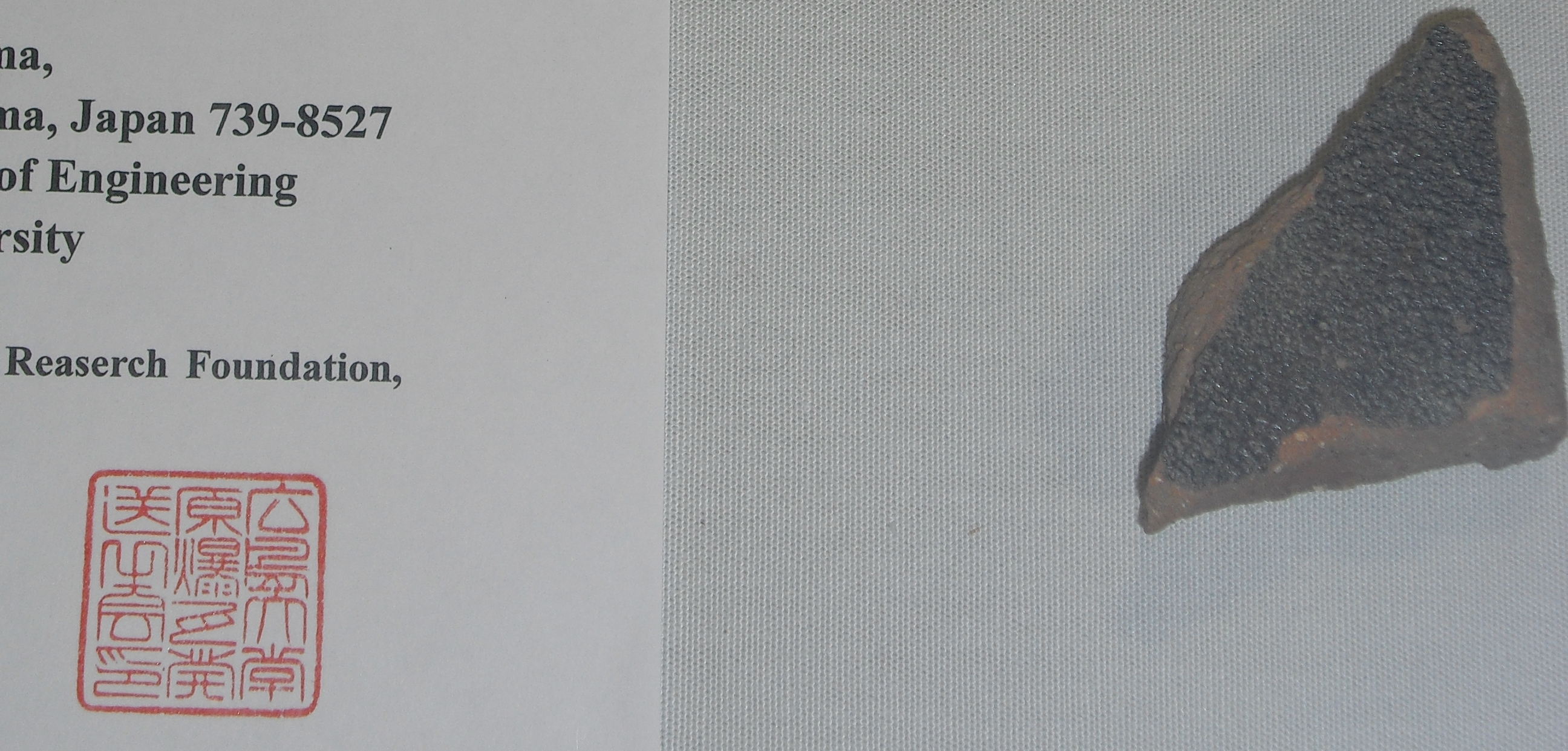
Relics from Hiroshima

From exhibition in Reading University Library
Our student noticing the books and tile on my desk waiting to be ‘dealt’ with was in heaven clutching the little tile (no longer contaminated). For the next hour he enlightened me on the art of manga and between us we are able to create an adequate record on the data base for other students studying Japanese comics.
So what might have started out be a rather tedious task for us –both, was a unique opportunity to share knowledge and a hope that this little gem will be added too and attract new kind of reader to our special collections.
Better to have loved and lost … a boat
My father was in the Merchant Navy before and during the war where he learned to be a boat builder. The war over he returned to his home on the Essex coast where he was able to apply his carpentry craft in a factory that made wooden dash boards for the car industry. But his true love was sailing and sailing boats. So my father and a friend began salvaging and renovating boats not just for sailing but for homes or work sheds, in particular LCAs (landing craft assault vessels) used for transporting troops to the beaches of the Normandy coast on ‘D’ day. There was a thriving boating and sailing community around the Blackwater River in Essex, but the Solent and the Hamble as the home of the Royal Yacht Club, was the place to be for experienced boat builders in the new and upcoming boat yards.
So, having decided to make the move he and his friend prepared two landing craft and his recently acquired boat – a Falmouth Quay Punt, planning to tow them from Heybridge Basin to Hamble to begin a boat building business. Unfortunately things didn’t turn out how they expected.
Although my father had repaired the yacht, she still was not stable enough for the long journey and she sank on the way with all his belongings. He stripped to his underwear and swam out to save her –but all was lost. So, my father arrived in Hamble in 1948 with nothing more than the clothes on his back.

The lost boat
This tragic story was documented in a book called the Blackwater men by Arthur Emmett. This was not the first time in his life that he had lost all his possessions; he had been torpedoed twice during war. This could not have made it any easier for him especially as during this time my not-yet-mother had arrived in Hamble from Essex where they had met sometime before. She was, I am sure expecting to find a home to come to.
However, he persevered and he did become a boat builder on the Hamble and provide adequately for his coming family.
The richness of a ribbon
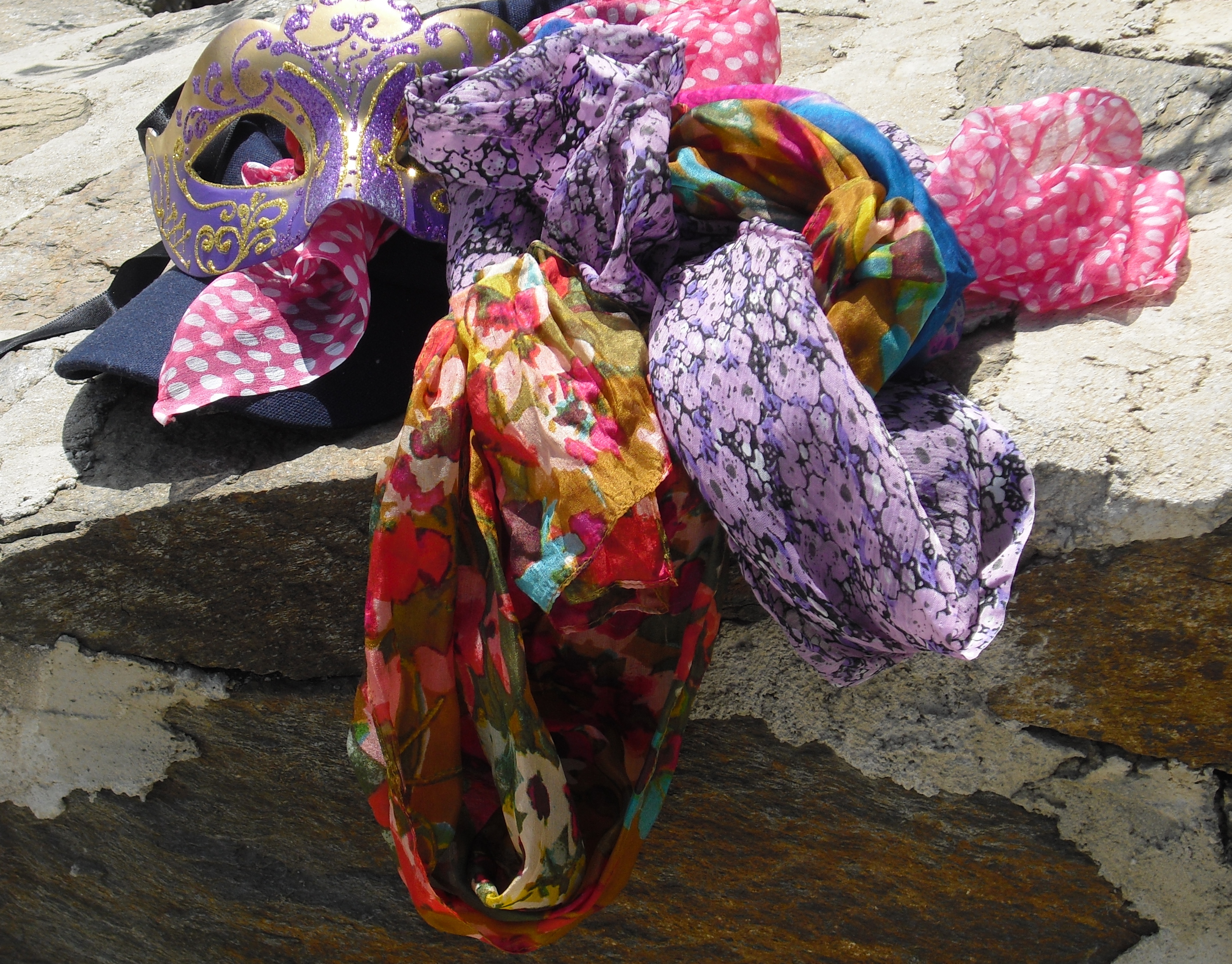
Jewels in the sun
When I was a child we had little money so instead of having a new outfit every season we had a new hair ribbon … who didn’t?
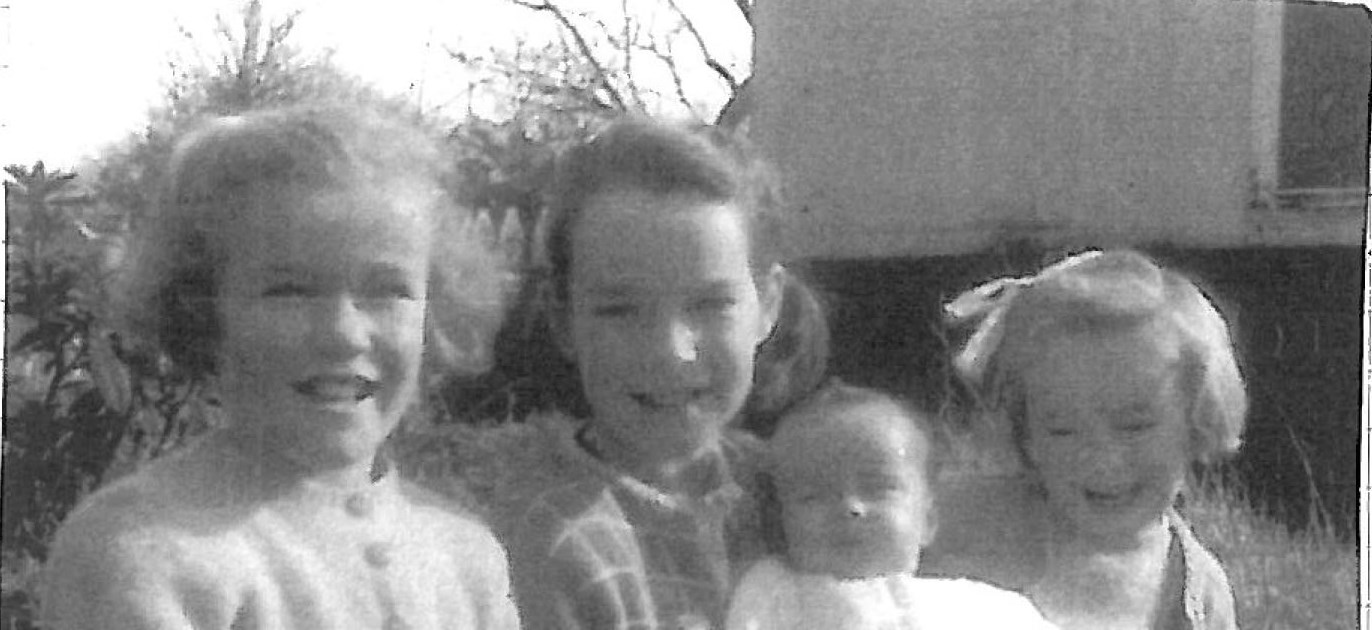
Hair brushed neatly & tied with a bow! Me in the middle.
The very thought of it being tied in my hair evokes memories of parties and happy times. But some time later they were evicted from my wardrobe when a fringe and kiss curls became the rage.
But recently, browsing through a Grazia magazine I came across a picture of the ‘Desperately seeking Susan’ Madonna of the early 1980s. The sight took my breath away. In seconds I was scrabbling in my scarf drawer.

Madonna-seeking-Susan
It was as if a cork had exploded from a bottle … With a scarf tied in my hair and some bling in my ears I was on a roll. It was the most liberating thing I had done in years.
However, going to work feeling as if I was Madonna – and I did – was another kettle of fish, but I was determined, if not a little anxious. Walking into the office that Monday morning was for me like a bride walking into church with her frock tucked in her knickers. The stony silence, averted eyes and the almost audible ‘crazy woman, she has really done it this time. Maybe this time I had gone too far!
Undeterred, I have carried on and even bought some more outrageous ribbons. I still get quizzical glances, but mostly the looks are favourable with comments like ‘I wish I had the nerve to do that!’
Recently, some strangers in local restaurant called me over; they were trying to work out who I looked like, with tongue firmly in my cheek I ventured ‘Madonna’ kindly they laugh ‘some hopes, no,no, its Paula Yates’ WOW, not’s so bad eh?
The feeling that the bow bestows is almost beyond compare; I have this childlike sense of well being.
Endeavour, Lulworth and Velsheda … ladies- in- waiting.
One of the inhabitants of Crableck was rich enough to employ my father as a boat builder and handyman to maintain three rather special ladies he had acquired before the war. There was Lulworth, 151 foot, ocean going gaff rig cutter – gaff rig describes the 4 cornered main sail and cutter means she is fast. She was was built by the White Brothers in 1920 for Richard H. Lee who sailed her in the premier yachting league in Europe.

Lulworth in full gaff rig
Her farewell race was in 1930. In 1947 she was saved from the scrap yard by Mr and Mrs Lucas my father’s employer, who mud- berthed her and she became their home.
Very comfortable home?
Befitting of a lady who had waited so patiently , in 1990 with much deterioration her hull was shipped to Italy, where she was restored and sailed again. Lulworth is currently the world’s largest race cutter.
Then there is Velsheda and Endeavour– both 130 foot ‘J’ Class yachts. ‘J’ Class is a rating for large sailing boats designed between 1930 and 1937 for the rich and famous yachts men who competed in the America’s Cup.
‘Velsheda was designed by Charles Ernest Nicholson and built in Gosport by Camper and Nicholson in 1933 for the managing director of Woolworths. She raced for 3 years and was mud- berthed in Crableck in 1937 and was a home until 1984 when she was refitted and sailed again.

Velsheda-in-waiting
Endeavour; was also built by Camper and Nicholson in 1934 for Thomas Sopwith. Using his aviation experience he was able ensure the yacht was the most advanced of its day with a steel hull and mast She won many races in her first season including those against Velsheda‘.

A lady-in-waiting
Her racing life was short and she also spent 46 years in the mud at Crableck until she was rescued and restored to her former glory.
If it were not for the guardian angels of Crableck these three ladies may have been scrapped in the 1940s. Thanks to the mud, their preservation is hopeful. The soft, squishy environment gave support and kept the planking tight; it is still a popular way to store boats during the winter.
The farmer’s manual, Pliny and the printer
Now I have your attention I would like to tell about a couple of items in the Special Collections in the library where I work and why they are considered so.
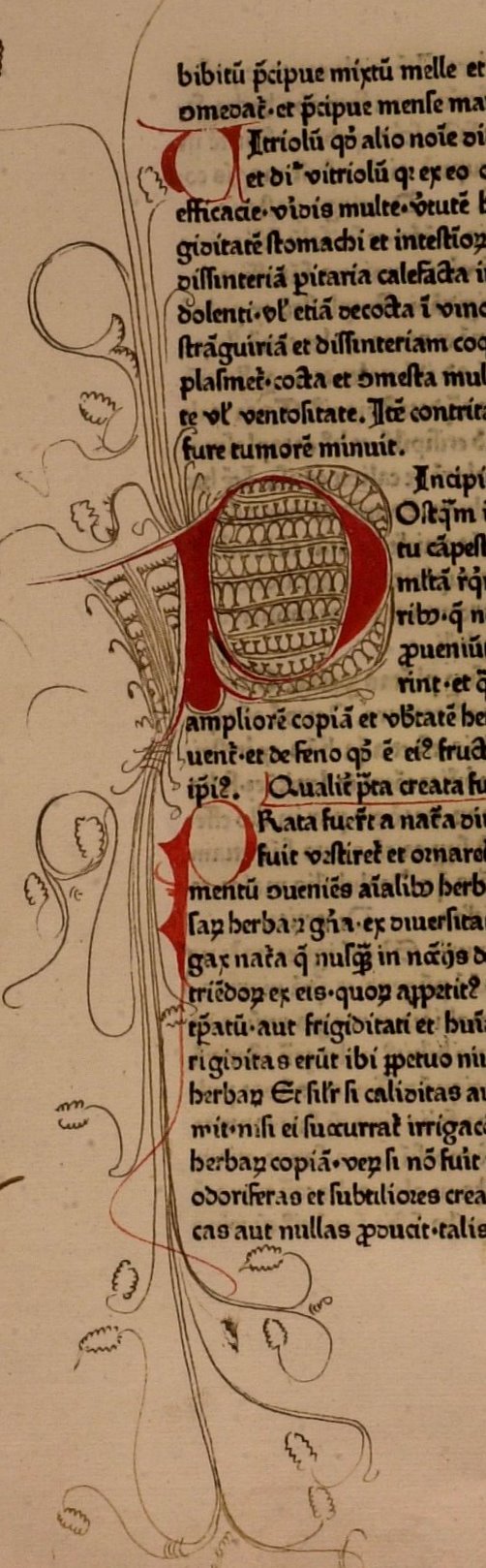
The farmers manual
For instance, Ruralia commoda by Petrus de Crescentius the oldest printed book in the University library. De Crescentius (1230-1321) who lived in Bologna was a scholar of logic, medicine and natural science, and later he studied law and served as a judge in Bologna. He wrote the Ruralia early in the fourteenth century, drawing on various Roman authors such as Cato, Columella, Varro and Palladius. It is considered by some to have been the most important original medieval work on agriculture, husbandry and horticulture. Frank J Anderson in his Illustrated history of the herbals suggests that : ’the contents of Crescenzi’s book provided anyone who worked on the land with a well-organized manual of procedure. Book 12, for example is a calendar of duties and tasks to be performed month by month. There are a number of woodcut illuminations in our 1471 Latin edition.
Pliny’s work, Naturalis Historia (Latin for Natural History) is an encyclopaedia written about AD 77-79 by Pliny the Elder, the illuminations are striking. It is one of the largest single works to have survived from the Roman Empire, and purports to cover the entire field of ancient knowledge. Like Crescentius, Pliny relied on the input of other famous scholars such as Varro, Agrippa, Herodotus, Thucydides and Theophrastus. According to his nephew Pliny the Younger such was his enthusiasm to complete the encyclopaedia that; he remained in Pompeii when the volcano erupted to complete his work and he died.

The natural history
The celebrated printer and publisher of this book was Nicolaus Jenson who was born in Sommevoire, France (1420-1480). He also designed and created the first model roman typeface as seen in our copy. This was widely copied and was inspiration for other typefaces. The style later came to be called “Venetian oldstyle”.
I have not exhausted the possibilities of the precious items and there is plenty of information the www. that will satisfy the most eager student ; however I believe that the best way to experience them is to see them and we would welcome you at the Special Collections.
 Coat Hanger Doll's House