in the style of Celia Pym …

This little coat hanger person is called Celia; she is a child and therefore a little smaller than the others I have made. Her shorts are made from the off cuts from a part of dungarees; made to fit another rather short person. Her sweater is knitted with some fine brown tapestry yarn and patched with yellow; in the style of Celia Pym. When The weather improves, she will star with her little sister in a film that involves a see saw; but don’t hold your breath this horrible weather is not conducive to good filmmaking. Have a good day
Counting down …
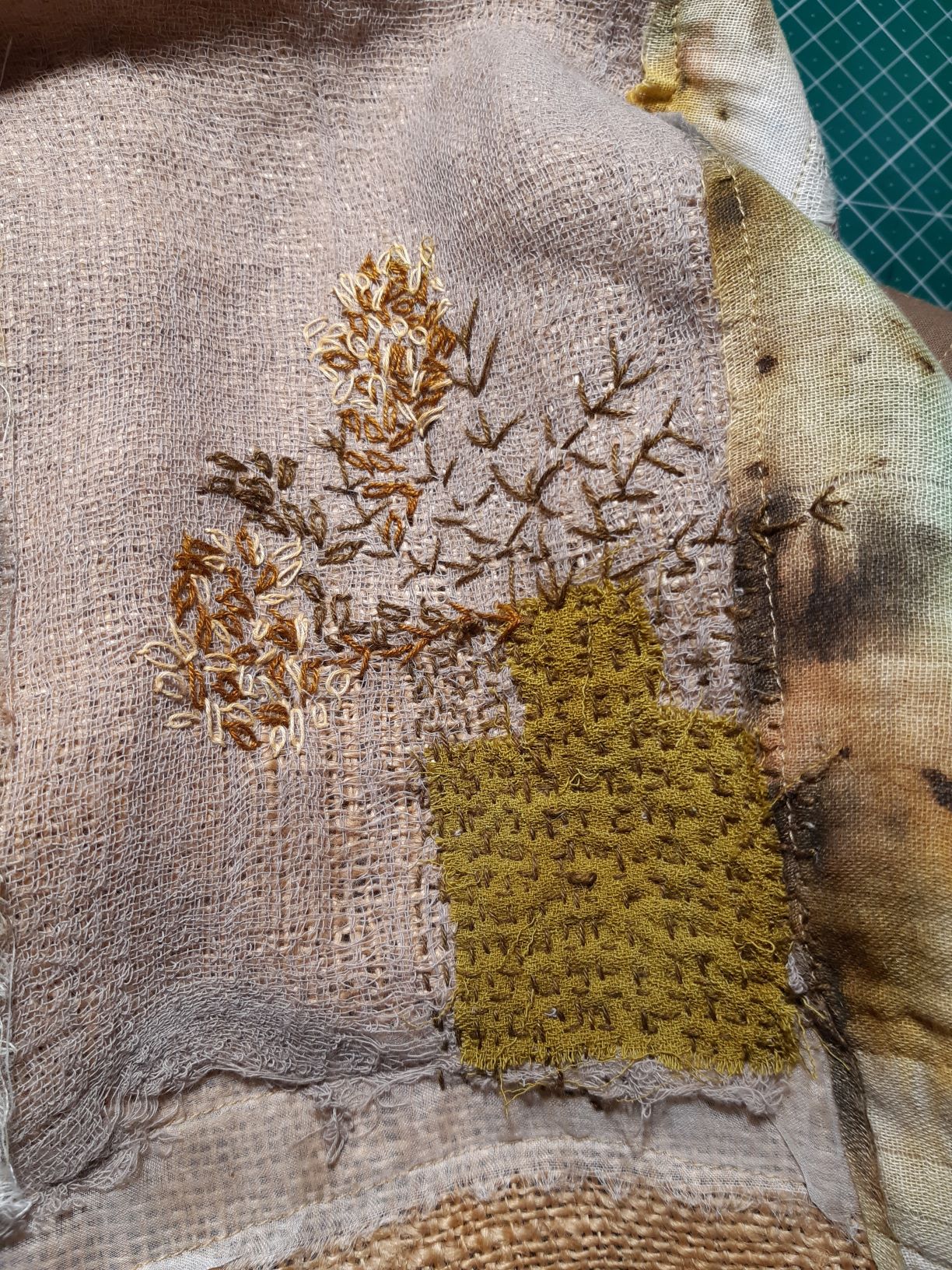
Eight days to go before Christmas; after a troublesome year I am trying to focus on the little things that have brought joy.
This detail from a recent arpilleras represents the delight I find in my studies for my MA in textiles. They have gone on all year despite lockdowns, restrictions and my self-isolation. I have managed top read, research, stitch, make films and attend with the use of Zoom; lectures, meetings and tutorials. While I was able to meet with other students, I did miss the human contact; so, I make wishes for next year; for a vaccine and less restriction.
Vase on the window ledge;
lightens a dull winter day
‘til the petals drop.
rethinking Natalia Goncharova…
Very excited to be looking back at Natalia Goncharova, who I researched a little when I began to be a printmaker. I was able to see her recent exhibition in the UK at the Tate Modern. It was be just before I began my MA in Textiles; so not looking at the collection this time as a printer but as Textile Artist. However, even then I was not considering theatre and costume design although the display was as Jane Pritchard (2019) said ‘simply fabulous’ and goes on to say ‘Goncharova is recognised today as one of the giants of twentieth-century theatre design as well as a major artist.
As I consider my work in stop motion and costumes for my coat hanger people, I will be looking more closely at this catalogue at least.
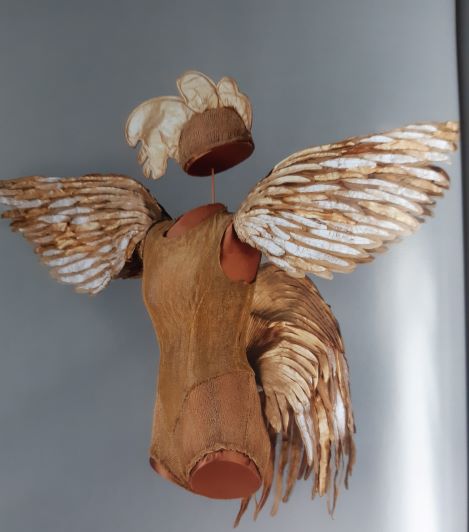
Gale, M. and Sidlina, N. (2019) Natalia Goncharova. Harry N. Abrams.
The prison wall …
East facing prison wall
secures and withholds inmates
reflects rising sun …

As I finish No. 3 sack of a set called the Mask and Mutant Covid19 looms in the Home Counties; I wonder. This piece is called the wall and is a prison wall and in particular that of Clink Prison at Southwark. Built in the 12th Century it is one of England’s oldest and most notorious prisons and built of brick unlike mine made of stone. I live near the also famous Reading Gaol; neither of which are attractive places nor should they be. I feel sadness for some prisoners who find themselves not only isolated from family and kind human life but in squalid conditions. One hopes that prison life is a little more humane in the 21st century. To that end my prison wall has a tiny glow reflected by the rising sun.
The hedge
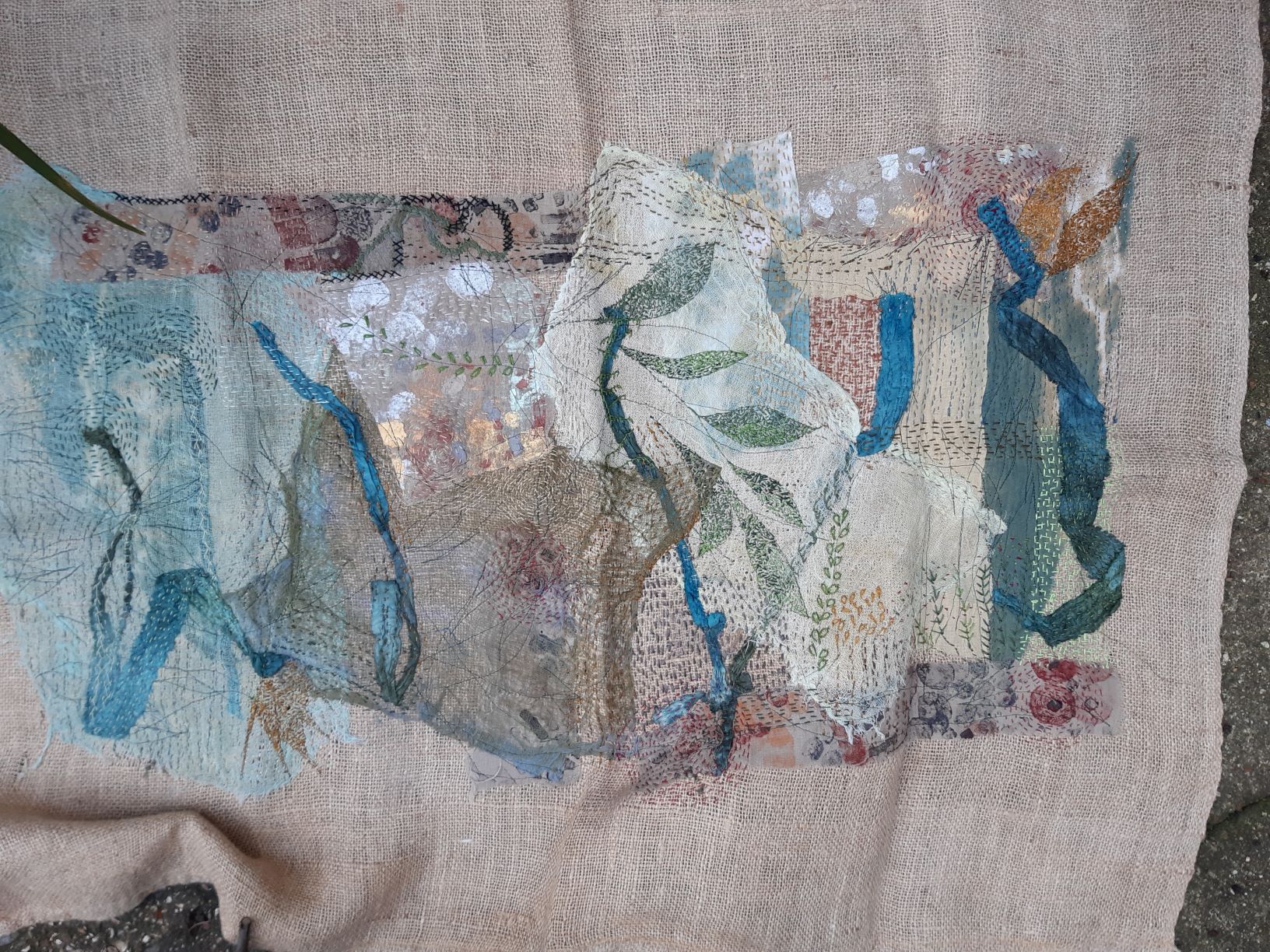
The hedge
Just beyond the hedge
My neighbour alone afraid
Within twigs life!
During confinement I have been able to go out into my garden. It is a tiny space full of small trees, hedges, shrubs, plants and flowers; a beautiful haven for birds, insects and me. However, it still remains a walled garden; the hedge is a disguise and seemingly less confining.
Arpilleras …
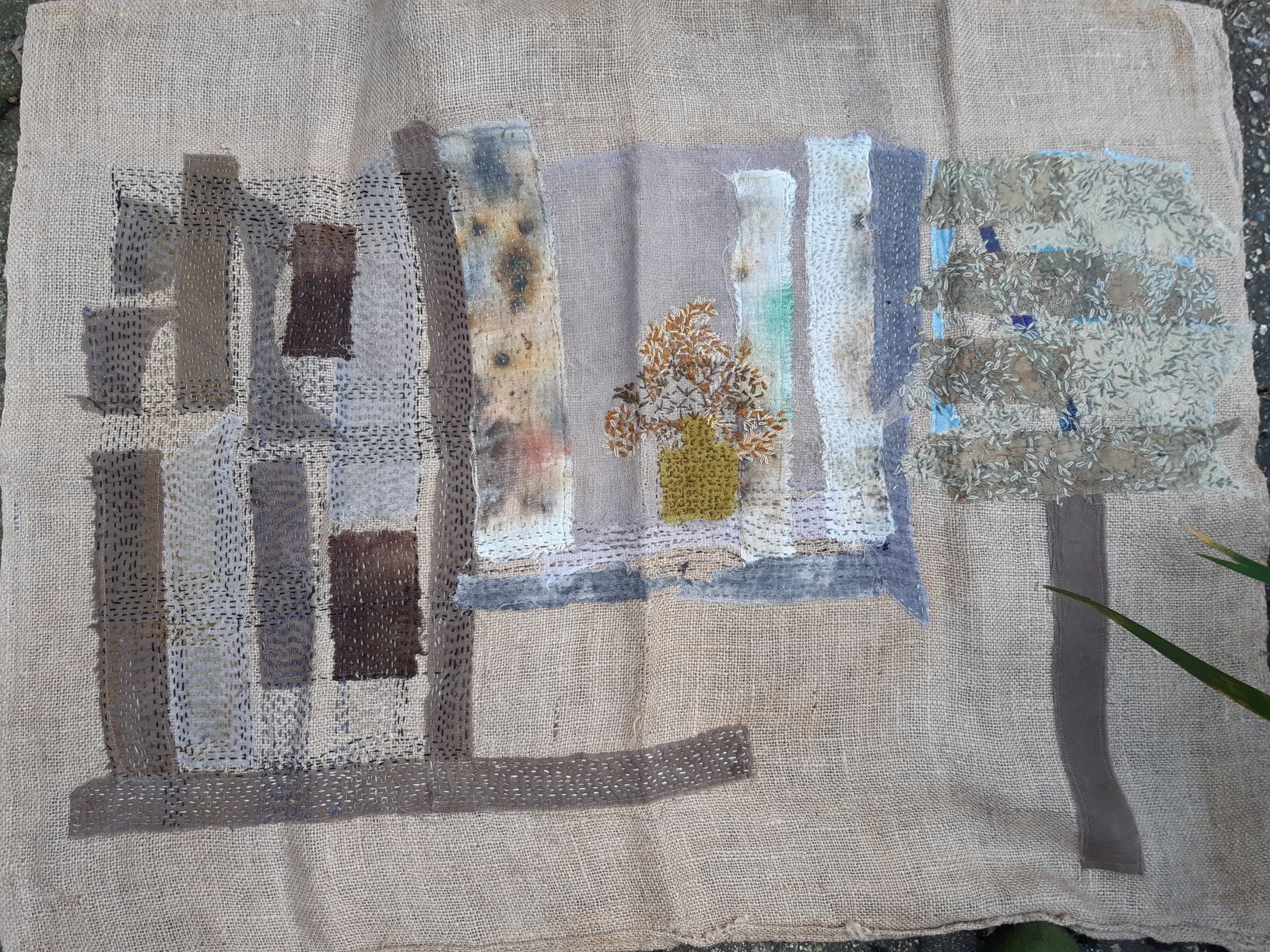
No one enters in
window and door keeps me safe
no one ventures out
Long before I realised that embroidery on hessian was a part of the rich South American culture or indeed story cloths were happening in the Hmong community in refuge camps in Thailand. I began stitching sacks bought back from Rio de Janeiro where I had seen coffee and sugar sacks and floor cloths made into all sorts of beautiful household items and scarves. Using skills learned during a time when the slaves on the sugar and coffee plantations wanted to decorate their hovels or find a way to supplement their paltry salaries. So, since I have discovered that story telling is happening in Chile as well and the women of Northern Ireland use the art of arpilleras to ‘interpret their pain’ during troubled times.
Violeta Parra’s isolation …

When I began Blogging, I wrote about women who I considered wise and that while I researched, I hoped I too would appear wise or even noteworthy. Well, that didn’t happen; I even thought that doing a MA might bring the beguiling wisdom, but that thus far hasn’t occured.
However, in the event of Covid 19 and my self-isolation for the last 9 months I have found to time to reflect on these women and learn a little more about their extraordinary lives.
Violeta Parra for instance, (1927-1967) was Chile’s foremost folk singer and political activist as described in my previous post ‘Violeta Parra was a well loved and respected woman who tirelessly bought folklore tradition of Chile to the fore. Violeta was brave enough to disregard the imperialist rhythms that may have harmed the already fragile culture of Chile’.
During Parra’s short life she suffered with depression and violent mood swings. In 1960 a natural disaster cut short a concert tour of the south and her health was threatened yet again. For a month nine earthquakes, more intense than ever recorded, devastated huge areas of Chile and killed 10,000 people. Karen Kerschen in her book ‘Violeta Parra: by the whim of the wind’ describes this unparalleled devastation more fully and the horror that Parra had witnessed until she was able to return home after her aborted concert. At home, raw and exhausted was diagnosed with hepatitis and confined to bed for several months. It was here where she found solace with needlework. Having seen the arpilleras in Chiloe, an island of the coast of Chile, she used coarse wool thread and embroidered every piece of cloth she had at hand; bed sheets and curtains were removed without remorse. When Violeta’s friends visited her during her convalesce, Violeta encouraged them to unravel wool sweaters and wind them into skeins of colourful embroidery threads.
Violeta in a meditative state stitched intricate ‘pictures’ of people, she was able to embroider character, poetry, colour, texture and drama, depicting her everyday surroundings. The art that came out of these isolated conditions would receive great acclaim many years later.
While I cannot pretend, I know what it is like to have my world shattered by an earthquake beyond that on the Richter scale. Or, to be so aggrieved and hopeless to take my own life like Violeta Parra.
We have been isolated and threatened by a deadly virus and one hopes that from this relative extreme situation we might discover our wisdom.
behind the hedge …
Having finished stitching the ‘Hedge’ on a coffee sack; I tried it out. I am somewhat pleased, but it does raise some other issues. I am not sure how much time, energy, alongside my inexperience I can spend on this; as I go into my second year of my MA and increased research.
The star…
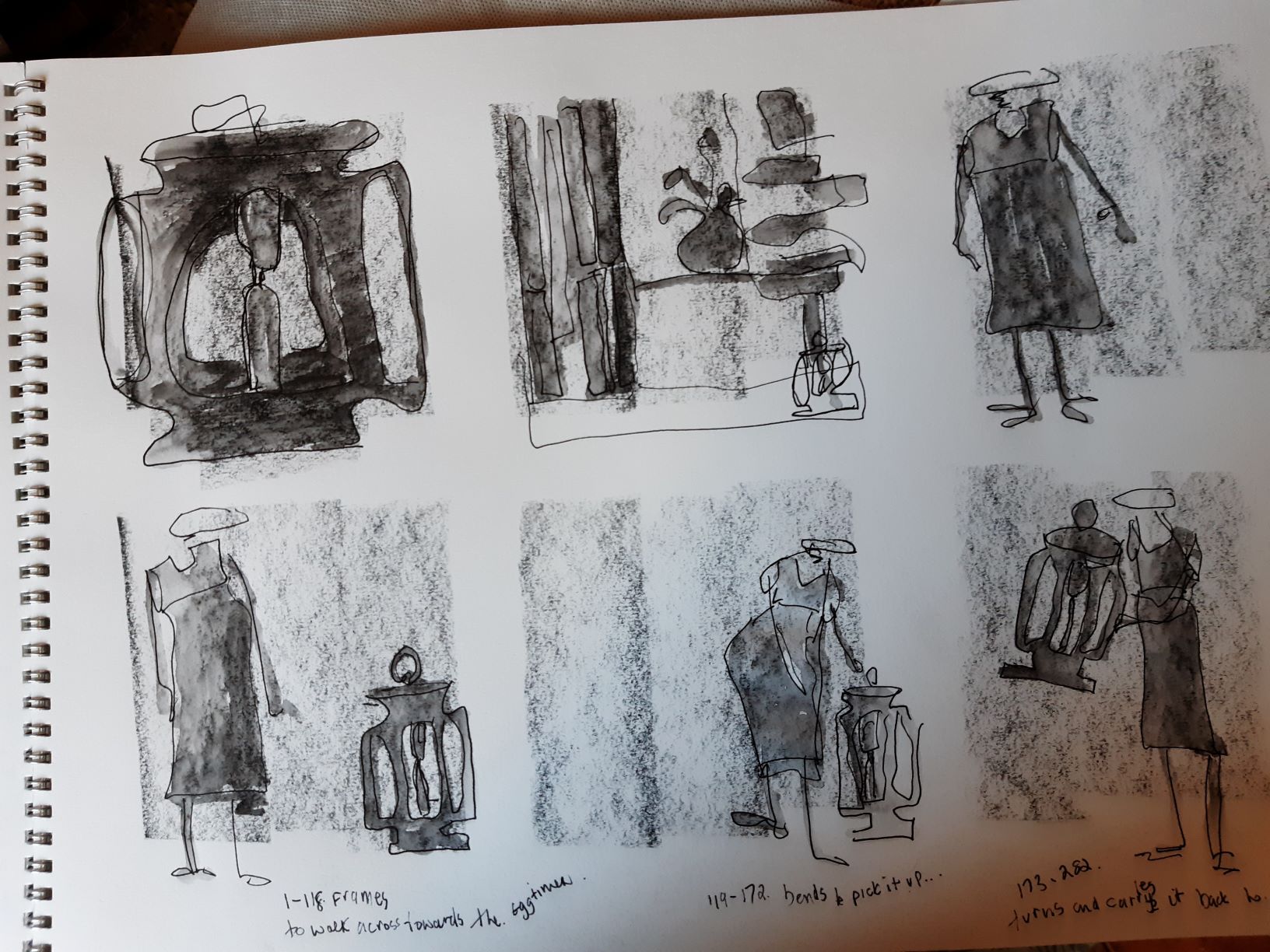
A day or two back I posted a film of a coat-hanger person in the street moving an egg timer. It was never planned to be significant; as I said on the day the weather wasn’t promising any prolonged clemency. I grabbed the nearest and only thing my fingerless person could hope to carry anymore than a few steps. It worked, with of course much room for improvement.
However, looking back at the film and story board for all its few seconds is revealing. Although the backdrop is a street scene it bears no resemblance to mine. This tiny terraced house is one of many thousands built in the mid to late 19th century, for the workers in Huntley and Palmers biscuit factory, Courage’s Brewery and Sutton Seeds, have no front gardens and there are no trees. Very few have more than a tired Christmas Cacti on its windowsill. We have no space for the mandatory two wheelie bins, so they line the street two by two in military splendour until the bin men on collection day place them hither and thither.
During the recent austerity and more in lockdown, neighbours have been placing unwanted clutter on their steps for others to take if required. A strange array of stuff hangs around for a day or two until removed, replaced or not. I too have enjoyed and benefited from this practice, whether it is cooking apples from a laden tree in the back yard, a sideboard and of late, props for my filmmaking purposes.
It would seem we are all seen carrying something. I have lived here for over 30 years and lost count of the times one or other of houses have been renovated almost beyond recognition. Therefore, frequently there is a skip by the kerbside being filled with stuff ripped out with careless abandon that was ceremoniously built in some years before. Then men in battered white van bring more delights to replace it.
So my coat-hanger person is a star of the Clarendon Road Show representing time and things that pass usually unnoticed.
Keep hopeful …

Oh dear, without dwelling on my clinical mental disorders; yesterday self-pity was also a bit overwhelming. That and high expectation as regards my studies and lack of ability was verging on the unreasonable. Life is pretty rubbish at the moment; but at least I am fortunate enough to find ways to relieve fatigue and loneliness and understand that it is not always achievable.
Yesterday and the previous few days I was in a dark place. I talked about my lost short-term opportunities and my foreseeable end of life. Of course, none of us can plan for the future confidently anymore; Covid 19 notwithstanding, Brexit looms and Global Warming is not going away.
So, for me with that in mind I am grateful that I can at least address my disorders and discomfort creatively.
I was prompted to these thoughts while reading a book called Whispering Cloth, a children’s book by Pegi Deitz Shea, illustrated by Anita Riggio and stitched by You Yang. It is a story set in a refugee camp in Thailand about a Hmong child who tells her story of terror in cloth. While I cannot even imagine the plight of any refugee child; this moving story urged me to carry on with my endeavours to cheer me and others albeit a feeble attempt for the time being.
 Coat Hanger Doll's House