Friday’s Library Snapshot


This book featured in a recent exhibition at the Museum, each day I passed, I looked forward to a time when I could open it. The opportunity came this week; and I wasn’t disappointed; the illustrations are lovely although the book has been well enjoyed by its previous owner. Items in our Children’s Collection are mostly donations from personal collections and often annotated. So some of the items perhaps worn and torn, have an extra story to tell which I find much more fun
This book is by Walter Crane (1845-1915) born in Liverpool. At the age of 14 he made a set of coloured designs and sent them to the wood engraver William James Linton. He was very impressed and took Crane on as an apprentice. Where he was not just taught the theory and practice of illustration but also encouraged his interest in politics.
Later he met Edmund Evans with whom he began to produce a series of cheap children’s books which made Crane’s name. With this wealth of experience he joined Dalziels for Once a Week and Fun, His illustration work in general would help to establish the Aesthetic Style of the 1870s and 89s.
Meanwhile he met Burne-Jones and Morris and joined the Socialist League that was established in 1883. In the same year he joined the Fabian Society and for the rest of his life he used his talents for the Socialist cause. He was also involved with art education He was also the founder and first master of the Art Workers Guild and various other Societies.
Alphabe Thursday L is for Logwood

Logwood otherwise known as Haematoxylum (means bloodwood from the Greek Haima for blood and xylon for wood) is a species of flowering tree in the legume family. It is native to Mexico and Central America; where it has been and remains to a lesser extent of great economic importance. The country Belize grew from 17th century English logwood logging camps and many Belizians are descended from the slaves who were forced to fell the heavy trees.
Logwood has been used for centuries as a natural source of dye; it was considered a versatile dye on fabrics and paper. The bark and leaves are also widely used in various medical applications.
The Spaniards brought the logwood from the New World to Europe. It was a good source of red and black dye; not well used in England until 1575. However it was not before long; it was banned. Parliament suggested that the ‘colours that were roduced from from it were of a fugacious character’; pretending to be looking after the interests of the users. In truth they were concerned only that Spaniards were making a huge profit. So after the law, banning of logwood dying in 1581; so the battle of the Armada happened in 1588.
Much later in 1673 the laws were repealed, saying now the dyers of England had discovered ways to fix the colours made from logwood. But Victoria Finlay in Colour thinks that maybe this change of heart might have something to do with with the fact that the British had now had access to natural logwood plantations in Belize in Central America and needed a home market for their new resource. Meanwhile, in 1667 England and Spain had signed a peace treaty; with the Spanish granting trading rights in return for the British suppressing piracy. So while there Caribbean was a safer place there were a lot of redundant pirates who joined the band of merchants collecting and delivering logwood; with its new fashionable black dye.
Further Reading Colour by Victoria Finlay

Wednesday’s Woman … Voltairine de Cleyre


I am lucky, drawing near to the end of my working life, I work in an environment where women are fairly treated. However this has not always been the case; women in a capitalist society and the consumer culture are abused, used and taken for granted by employers, husbands and politicians.
I spend much of my time researching for women through the ages who have fought against this. I thought the movement began in the 1960s; but it seems there were women speaking out about birth control, anti-marriage and independence before women had the right to vote.
While dipping into Quiet Rumours again I came across Voltairine de Cleyre (1866-1912) she was an American anarchist writer and feminist. She spoke out, opposing the state, marriage and the domination of religion in sexuality and women’s lives in general.
She was named after Voltaire the well known enlightenment writer, historian and philosopher, and born in Michigan,to a poor and unhappy household. At twelve her father eager for her to be better educated sent her to Catholic Convent; she says in her essay that ‘by early influences and education I should have been a nun and spent my life glorifying’ as her school friends were doing still doing as she spoke. She goes on to say that she still pitied the little girl ‘battling solitary in the murk of religious superstition unable to believe’ but not having the courage to say otherwise.
Three years later she left the convent a free thinker; but without having read a book or heard a word of encouragement. Her story ‘The making of an anarchist’ written during the time that followed has a cinematic feel.
While she become influenced by Thomas Paine the English-American political activist and author and Mary Wollstonecraft the eighteenth-century English writer, philosopher, and advocate of women’s rights, amongst many others it was after the hanging of the Haymarket protesters in 1887, when she became an anarchist. “Till then I believed in the essential justice of the American law of trial by jury,” she wrote in an autobiographical essay, “After that I never could”.
Voltairine was considered an excellent speaker and writer and a tireless advocate for the anarchist cause. She was a colleague of Emma Goldman it is said while they disagreed on many issues they maintained a loyal relationship. She had a son by James B Elliott; but she had no part in his upbringing; Harry was bought up by his father.
Between 1889 and 1910 Voltairine lived in Philadelphia among the poor Jewish immigrants where sympathy for anarchist beliefs was common. Here, she taught English and music and she learned to speak and write in Yiddish.
Throughout her life she suffered poor health and depression; attempting suicide more than once. December 19th 1902 a former student tried to kill her; she understood that he was ‘rendered insane’ so she forgave him saying, ‘ It would be an outrage against civilisation if he were sent to jail for an act which was the product of a diseased brain’. The attack left her with chronic ear pain and a throat condition that affected her speech and her ability to concentrate.
Voltairine de Cleyre died on June 20th 1912 from septic meningitis. She is buried near Emma Goldman, the Haymarket defendants and social activists in the Forest Home Cemetery formerly known as Waldheim Cemetery
Weekly Photo Challenge … object

I didn’t have to look far for an object; I collect them.Mostly of the useful kind; believe me I will use the egg-timer when I next boil an egg! Sometimes however, it usefulness is over looked if it appears particularly pleasing. This object comes into that category. Although it is a fully functioning lock with its required keys; it is far too lovely to be exposed to the harsh elements of being a security guard.
I suppose this leads me to number two reason why I collect random objects.This one looked so uncared for on the back shelf of a dusty shop … thats what I do give a home to sda and lonely objects.
Monday and what I learned last week …
As week two begins; since my daughter’s accident I cannot bring myself to consider the things I have learned. They are all too painful. I know; they are alive it could have been worse; is a mantra that rolls of the tongue. Nonetheless being 6000 kilometers away from a child who is destined to spend 6 months unable to walk is not easy; especially as it would seem physiotherapy has not yet begun So the poor girl is laid in bed 24/7 at home apparently ignored by the post op care team. So while the flights are booked for our visit; I send good wishes to them both especially my son-in-law. He has spent nearly 10 days in bed with non-immobilized fractures; this appalling. I am truly grateful for all those (friends and family) who have supported my daughter and son-in-law and really understand that the medical staff are under pressure; short staffed etc but this doesn’t yet quell the tears.
So sadly I can only hope that this week brings some positive activity; I don’t expect miracles, the accident was severe the damage immeasurable; and they will recover and meanwhile I remember happier days at Christmas.

Silent Sunday


Saturday Supplication …
This week has been long and miserable. The days for me after my daughters recent return to her home in Brazil had been bitter-sweet; we had had a wonderful time, even with the death and funeral of my mother. Her father and I had booked our flights to visit in July. She had returned with great hopes for the future; with work and study, also she had many kilos of christmas gifts to reopen when she returned. The following Saturday, they all but finished unpacking and had taken their motor bike to distribute other family gifts, bought back from the UK. I remember the day we spent buying the gifts and wrapping them and even more clearly the time we squeezed them unceremoniously into the last remaining spaces in the cases.
They were driving back to spend some time with a friend and celebrate her birthday; it was the middle of a pleasant afternoon they were happy to be home in Rio. Life seemed good.
Until, a car shot out from a right hand turning and hit them broadside; with such power they were flung over his bonnet and onto the pavement and stopped by a small tree growing by the road.It was only my son-in-law’s quick thought that saved my daughter from more and even fatal injuries. He held her body close to protect her from the imminent secondary ‘crash’ as they catapulted towards the tree. More injuries were curtailed by his helmet.
He was a hero; he remains in hospital with multiple wounds inside and out and a badly broken leg; they cannot operate until the risk of infection has gone. He is sad, lonely and still feels responsible to my daughter’s situation. My daughter also has a badly broken leg; but fortunately her other injuries were not so bad and her operation was fairly straightforward; she is home convalescing nonetheless it will be several months before the pins are removed and she able to walk unaided.
As I said my son-in-law not yet in a position to ‘begin’ his recovery and is dealing with a trauma that will take much longer to heal.
So to day I send good wishes to Brazil to those caring for my precious family. Also, to the driver of the car who I understand has been visiting them while in hospital.
I send good wishes to my daughter’s work colleagues who have been pillars of strength with practical and emotional help. I am truly grateful to my son-in-laws family; mum, dad and sisters who stayed by their sides and kept me posted. Also to my dear son-in-law who saved the day and to whom I remain grateful.
Meanwhile; I have a good network of supporters here in UK who have wiped the tears of this wailing woman in particular my art teacher who is blissfully unaware of the recent mishap. She was however supportive on the evening of my daughters recent return. It was the first clear dry night for several days so she built a fire in the garden. So with paper and pencils and a cup of tea nearby she allowed me to paint my emotions in the light and the warmth of the fire. I was was a beautiful experience and one I hold in a time when everything seemed so ghastly and would unbeknown to be get considerable worse.
So Daughter and Son [-in-law] lets not celebrate the Wailing Woman … I give you the Dancing Queen … we will dance soon!

Friday and Edward Lear


To celebrate the birthday this week of Edward Lear
AlphabeThursday K is for Kohl and the Kama Sutra
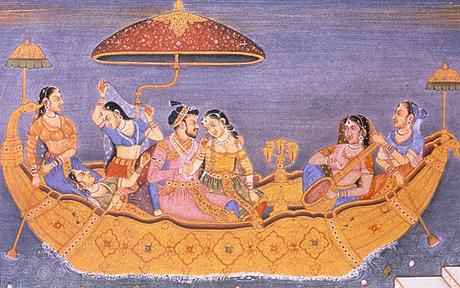
In the late 1950s and early 1960s I was beginning to experiment with makeup; rummaging through my mum’s makeup bag or the top drawer of her dressing table. Covering my face with weird concoctions thinking I looked the bees knees.
Not much later when I had pocket money and discovered Woolworths I was able to buy more suitable products such as eye shadow, mascara and kohl. Feeling very grown up not thinking too much about the history of such sophistication.
Until now; In Roman times a young girl decorated her face for special occasions; she may have tried charcoal to draw round her eyes, until she found Kohl, an alchemic metal, that was kinder to skin, which remains a useful cosmetic to this day.
The word kohl comes from the Arabic kahala meaning to stain the eyes. In Europe we use it as an ornament but in Asia it is used as spiritual protection to charm away demons or it is used as medicinally when treating conditions such as conjunctivitis. Taliban soldiers might wear kohl around their eyes to indicate that llah was looking after them.
Although I have read some of the Kama Sutra in Sanskrit I wasn’t aware that among the pieces of advice for lovers there is a recipe for the ultimate in mascara.
First the bone of a camel is dipped into the juice of the Eclipta prostrata (also known as the tattoo plant because it secrets a dark blue dye) and then burning it. The black pigment is stored in a box also made of camel bone; it is applied to the eyelashes with a camel-bone pencil.. As a result the love manual says will be ‘very pure and wholesome for the eyes’ and goes on to say it ‘also serves as a means of subjugating others to the person who uses it’
mmmm I haven’t found that my mascara has had this effect …. maybe its the lack of camel bone?
Wednesday’s woman

During sad and unsettled times over the last days in an attempt to alleviate my impotency and grief I have dipped into book that got left behind in the recent return to Brazil. It is a beefy tome and may have increased the ‘baggage a little too much. Still Brazil’s loss is my gain; there is always space for a book in my book case (s) by or about Elizabeth Bishop. This one, One Art is a selection of letters written over 50 years; from 1928 when she began her career as a poet at 17 years old until she died in 1979. I have read a little about her and some of her poems; but these letters, a fraction of several thousand are an intimate reflection of a very private woman while keeping in touch with her friends. We learn about the great love of her live which lasted 15 years and ended in tragedy. The name of the book stands for the art of poetry to which she devoted her life. She said, we understand, that ‘man is forced to choose perfection of life or work’ she choose the latter. Her battle for perfection in verse was renown She began writing one of her most famous poems the Moose in 1956, promising her Aunt Grace a copy when it was completed . Sixteen years later it arrived in the post. The poem one of many that received critical acclaim but Bishop remained always modest about her achievements.
One art also stands for the art of letter writing; which Bishop clearly practiced perhaps more easily and with increased results. However, while she was a good letter writer she also enjoyed reading them.
Her library contained many books of letters; those of Lady Mary Wortley Montague, Jane Austen, Virginia Woolf and others. She even gave a seminar on letter writing called Letters – readings in personal correspondence, famous and infamous, from 16th to 20th centuries discussing people she said ‘like Mrs Carlyle, Chekhov, my Aunt Grace, Keats and a letter found in the street’.
I cannot do justice to the book in a few words but I will continue dipping in until I return the book to it rightful owner in July.
Further reading One art, letters, selected and edited by Robert Giroux
 Coat Hanger Doll's House