Silent Sunday
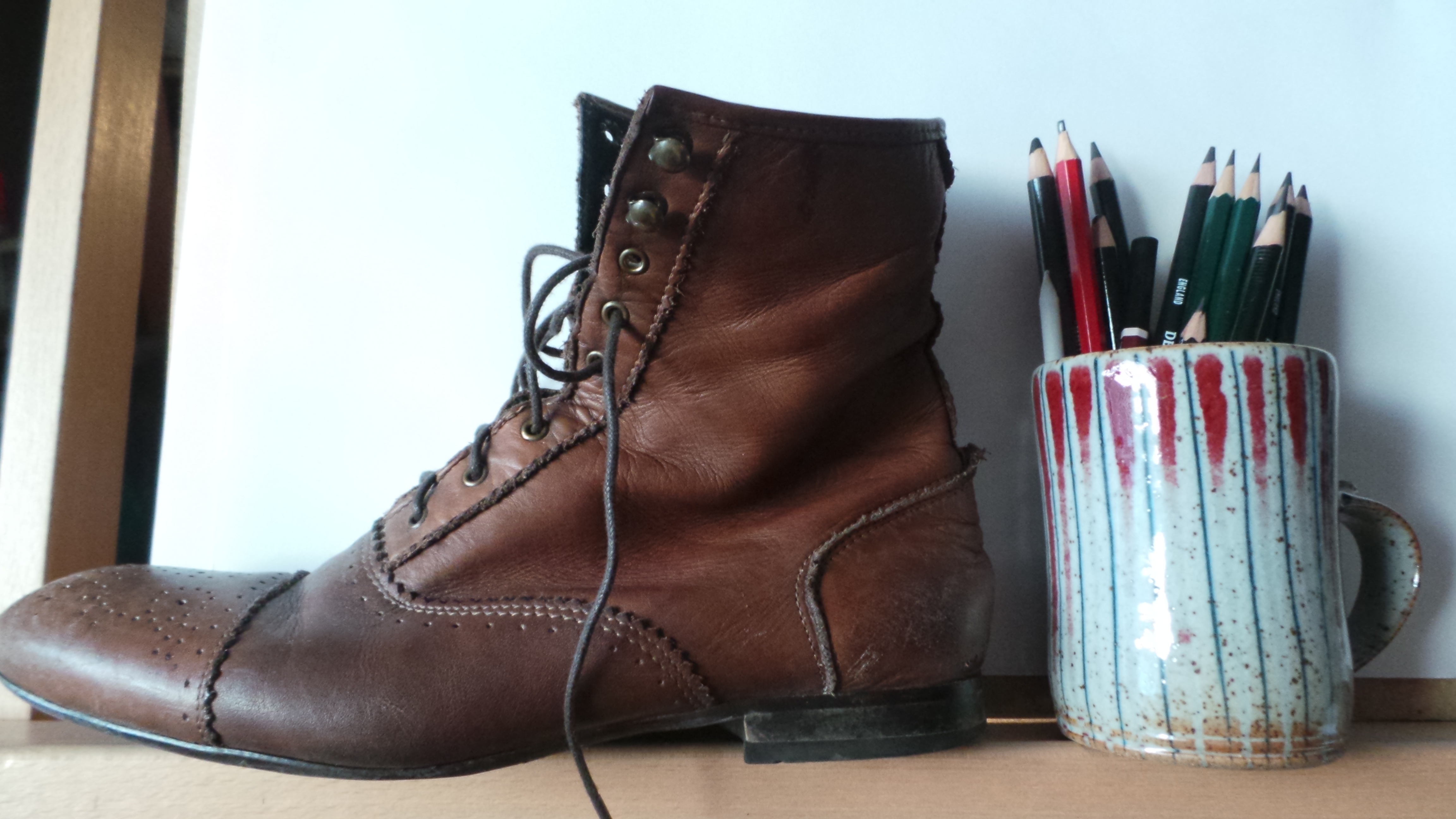

Today I have an art class; it is my regular monthly printing session. Since last month much has happened to me in the world of art. I have enjoyed an abstract painting class, a day at Artichoke Printing and of course my fortnightly one-to-one with Julia. So why have I not ‘made’ it? Why do I find myself gazing at videos, books and journals, buying the magic paints and mediums and wondering … when can I give up my day job?
Maybe it has much to do with the journey and the tea and cake I will expect around 4 this afternoon!
Meanwhile I hope to discover the next step for my feisty person born this week after a more than our fair share of rain.
For instance: How do I mix denim blue? How do I make her boots shine in the pouring rain? Then the two tone umbrella? How do I do that … ?


Friday’s Library Snapshot


This week I received the winter issue of the Illustration, it is published 4 times a year. I have not read it fully yet but there is plenty for me to enjoy. However, glancing through I came across a picture by Barbara Jones who I have featured before on a Friday.
Barbara Jones studied at the RCA and worked as a muralist, illustrator and writer of books. She was a major contributor to ‘Recording Britain’ and it is in reference to this that she featured in the Illustration journal.
In the 1930s a landmark project was begun to record various aspects of the English landscape that looked likely to vanish in the near future. Professional and amateur artists chose an eclectic mix of historical buildings and rural countryside and created images in pencil, pen and ink and water colour. The results were published after the war but later they were largely forgotten.
Now a touring exhibition is bringing the original artworks back to the regions and reminding us of places and scenes now consigned to history.
The Recording Britain exhibition will be at the Cecil Higgins Gallery in Bedford until the 20th March 2014.
Further Reading
The School prints ; a romantic project by Ruth Artmonsky
English fairs and markets by William Addison with illustrations by Barbara Jones
Alphabe Thursday P is for Plumbago and pencil lead


I have recently learned that these days there is no lead in a pencil. We understand that indeed real lead was used for drawing; Pliny says that it was used for ruling lines on the papyrus, so that the junior scribes would write neatly. Later, in the 14th century Italian artists’ pencils were made by mixing lead and tin; any errors, apparently could be rubbed out with bread crusts.
However, since the the 16th century, when discovered the the hills of the British Lake District, graphite has been used. It is a relation to black carbon and called then plumbago, black lead or wad. It was used mainly in ammunition casting. A thin layer of plumbago round the inside of a cannon ball mould would allow the finished missile to pop out of the cast easily.
It was much later in the 18th century when the oily stone was renamed graphite to be used for making marks on paper.

A woman on a wet and windy Wednesday
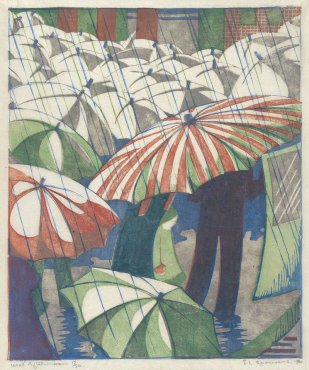
Long before we had the wettest winter since records began, here in UK; I fell in love with this lino cut by Ethel Spowers. I promised myself I would buy a copy when we had recovered from the Christmas expenditure. However we were taken over by a catalogue of events which included the aforementioned appalling weather and it is only now that I have finally taken delivery of the lovely thing.
I came across Ethel Spowers when I was researching Cyril Powers and Sybil Andrews. She was born in Australia and trained at Melbourne National Gallery Art School (1911-1917) where she gained a reputation for black and white children’s illustrations. She was presented with a copy of Claude Flight’s Lino-cut book (1927) by her friend Eveline Syme and together the two travelled to London where they studied under Flight at the Grosvenor School of Art (1928-1929)
The Grosvenor School was hugely influential for Spowers. Her work always had a clear narrative to tell, but now she incorporated the rhythmical expression and colour harmonies which Flight taught his students.
On her return to Australia Spowers helped set up the Contemporary Art Group (1932). The group defended the modernist movement against its more conservative detractors. She also championed the work of Flight, both through the dissemination of his ideas, but also by acting as his agent and taking orders for buyers interested in purchasing his, or his London-based student’s linocuts. Edith Spowers’ work is now found in major collections around the world, including the British Museum and the V&A, London.
Weekly Photo Challenge Abandonment
I ‘suffer’ from depression; I am not about to suggest when it began or make any profound reasons why I do have this condition. Suffice to say over the years I have established coping mechanisms and learned there is no absolute cure. As I have got older while there has been no let up, I do ‘enjoy’ some of the coping strategies. Also these methods sometimes disguise the less attractive effects that depression has. While we are able more and more to discuss depression it never ceases to astound me, the number of people, even close friends and family who simply do not understand. So I prefer to leave them in the oblivion.
My dad left me and my younger siblings when I was 10; already I was an anxious little girl, and prone to alopecia; another effect of anxiety that was rather upsetting and remains so when life becomes a little unbearable. I felt this abandonment deeply. To this day, the act of leaving, mine and others and its various manifestations, triggers a deep sense of grief. LikeI said, I have learned to manage this and even more l can understand that impermanence is not abandonment. More the act of leaving is a demonstration of impermanence and therefore the very essence of life and death. So it would seem that coming and going and change, rather than a time of despair can be celebrated.
And my little walled garden not far from the town centre is in constant state of flux as one flower fades and dies so another blooms and brings delight.


A little sadness in Rio today … the graffiti cleansed!
Although ‘things’ in Brazil are not ‘back to normal’ by a long shot; my Brazilian family are on the way to recovery. They are in a good position to think more positively about our visit in a few months time. So it is with this in mind that I reblog a previous post. Also I remain in debt to to family and friends in Rio who remain on hand my daughter and son-in-law who are gathering strength to enjoy the Carnival and Shrove Tuesday albeit in the confines of crutches and local parties
While we in UK get excited about a pancake or two!

I am sad about this; my daughter who lives in the Morro da Babilônia (a favela in Rio de Janeiro) sent me this picture.
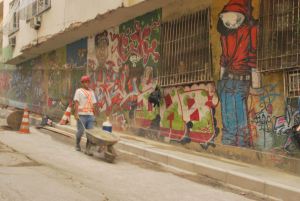
I took this picture while I was in Rio in March.
The favela has been cleansed and regenerated in preparation for the Earth Summit 2012 http://www.earthsummit2012.org/ For me this ‘cleansing’ is a step to far … What next? Children must file past in an orderly fashion, smiling and waving flags!
It is interesting alongside this summit the is another conference going on called the Peoples Summit and there is a Women’s March planned for the 18th so issues such as this will addressed. http://cupuladospovos.org.br/en/
Silent Sunday

Saturday gratitude …


Today is the 1st day of the 3rd month of the year. The last two months have passed in grieving heap! This is sad because I had such hopes; we all did.
As the New Year came and went in heavy rain and storms,we took the opportunity a little later, as the clouds cleared to send some lanterns and good wishes to the night. They were silent wishes; I cannot remember mine but imagine they were connected to good health and prosperity; not just me and my family but for all beings. I hope that you have received your part of the bargain; for me I do feel a little let down.
Nonetheless; I have never been one to pout for long … I reiterate any wishes made that night and add
That I am truly grateful for the good fortune I received over and above anything I expected; my friends, family and strangers have been like the good Samaritan they have pulled out all stops … offered emotional, financial and practical treasures that we can never repay
Thank you!
Friday’s Snapshot from the Library


These two little books have been on my desk for a day or two. I kept meaning to shelve them but they seemed to say ‘look at me’ with a theatrical air. I soon discovered the illustrators were set designers of some renown.
The woodcutter’s dog (in the French called Le Chien de Brisque) by Charles Nodier ; beautifully Illustrated by Claud Lovat Fraser is a delight.
Claud Lovat Fraser or Lovat Claud (1890-1921) a theatre designer, woodcut artist, illustrator and draughtsman was a self-taught artist, attending Westminster School of Art with Sickert for only one year. He began his career as artist and designer in 1911. His first published works of designs and decorations appeared in Flying Fame (1913). He is best known for his theatrical designs, settings and costumes for As You Like It and The Beggar’s Opera, produced at the Lyric Theatre, Hammersmith in 1920.
The other Mr Marionette told by Katherine Colville and illustrated by Albert Rutherston is also a joy to look at.
Albert Daniel Rutherston (1881–1953) was a British artist, brother of William Rothenstein and pupil of Fred Brown. He painted figures and landscape, designed posters and stage sets; particularly for the plays of Shakespeare and Bernard Shaw and illustrated books by Shakespeare and Maeterlinck.
 Coat Hanger Doll's House