Alphabe Thursday is for Zangar (verdigris) or green!

Z is for Zangar Urdu for verdigris as described by Cennino as ‘lovely to the eye but doesn’t last’. Leonardo da Vinci a century later was worried that ‘it vanishes into thin air if not varnished quickly’. There also was another problem with the paint, like white lead, verdigris was a mortal enemy. It was made rather like white lead but the metal suspended over the vinegar was copper after a while the combination would produce a poisonous green deposit. It was a often called Van Eyck green because the Flemish master used it often and successfully. Unlike the Italians, namely Leonardo whose verdigris blackened as Cennini warned.
The Flemish artists used a varnish on the paint to preserve it and it has indeed lasted centuries. As seen in in Van Eyck’s Arnolfini Marriage

Wednesdays Wood engraver


I have a lovely home and garden and I look forward to a day when I can spend a little bit more time in both. Not necessarily doing gardening or housework but just enjoying them. Of course there will be degree of housekeeping but mostly I want to watch and create; particularly in the garden. Even when the weather is inclement I need not even venture out; I can see the extent of my garden from my kitchen window and my back door also has a pleasant view.
I will not retire fully, I hope straight away, rather reduce my hours, as I still enjoy my work and it is rich source for my creativity at home.
This week I came across a little book in the Museum Bookshop; a prime example of the things that turn up to whet my appetite and provide fodder for my blog.
The book published by Little Toller Books in 2010 (first published in 1935) called Four Hedges by Clare Leighton (1898-1989) and introduced by Carol Klein. For me, this is a double (or more) delight because Carol Klein, the Gardener’s World presenter is also inspirational in my garden. Clare Leighton was one of the finest wood engravers of the 20th century. In the 1930’s she settled in the countryside with her long-term partner Henry Noel Brailsford the political journalist. Her garden became her passion; planting and tending trees, vegetables and flowers. While observing the seasonal changes in the garden she grew familiar with its wildlife and character. Forging a relationship which went on to fed her work as an artist and contributed to the happiest years of her life. I cannot pretend that my back yard in the centre of Reading can compare with Clare Leighton’s garden deep in the Chiltern Hills but I hope I will find endless images to sketch and engrave.
Clare Leighton was born in London and studied in Brighton, Slade and Central schools of art. Travel in Europe nurtured an empathy for rural workers and their culture reflected in her work. Although she was an accomplished writer, designer and artist she was best known as a wood engraver who inspired a revival of the craft in Britain and North America. She illustrated books by Thomas Hardy, Gilbert White and Henry David Thoreau as well as her own Four hedges. Country matters, The farmer’s year and Southern Harvest. She also created designs for Wedgewood and several stained glass windows for churches in New England. In 1939 she emigrated to America and settled in North Carolina where she taught at the Duke University and was elected to the National Academy. Her work is held in public collections around the world, including the British Museum in London and the Metropolitan Museum of Art in New York and the Art Institute of Chicago.
Weekly Photo Challenge on the move


I cycle and have done all my life; I like walking but for quickness my bike is my preferred mode of movement. I have owned only a handful of bikes (Strange expression for something as large as a bicycle) in all those years; I have kept them in good repair and they have been reliable and true. However I have not been so carefull about their appearance; never a wash, polish or protection from the weather.
I have been remiss and I am not proud of this. I always promise myself to be attentive to the bike cosmetically but I fail miserably
Nonetheless I do admire those who do look after their trusty friend …
At the weekend I learned


This weekend I learned the art of reduction (in relation to the the art of lino cutting and printing not yet mastered) did not and will not be achieved in day. I tentatively broached the subject at my printing class last week and was warned against the unhealthy habit with ‘don’t do it!’ or words to that effect. This was like red rag to a bull and I went on stubbornly. Made the design and planned carefully the colours I might use and in what order. Although reduction is a good way to produce a coloured print from one block, for example the plate will always register well because the second and subsequent colours will always fall in place because the same block is used. There is a downside; once the plate has been reduced you cannot get it back again and reprint the first or any previous colours. This is why this method is called the Suicide Print and why my fellows were so against it
To ensure the print is successful the procedure is complex and demands careful planning and thorough execution!
I was also warned to prepare for a degree of failure and to make plenty of copies at the first stage, even so after only two colours and a weekends work I am not sure that they are ready for human consumption.
It is in situations like this, I wonder why I didn’t take up some other hobby like rocket science!
Silent Sunday

Saturday … Buffs, Beanies and John Cage
This week has been good (note to myself ‘remember this’) I have learned about ‘Buffs and ‘Beanies’ and that I have run out of ways to use a ‘comb over’ or rather the comb over has all but gone.
No worries; my hairdresser is coming on Thursday, as there will be no hair to cut, we will be able to talk about anything even my next holiday. As it happens, it will be to Brazil in 10 weeks time! Deal with that hairdresser!
(To be fair my hairdresser doesn’t ask me too much about my holidays; he is a friend and alway supportive through my difficulties and hair loss)
Seriously though; losing my hair is not a new phenomenon and my snow white locks (spiky crop) were my joy. I will miss them as much it seems as a parent, pet or anything one holds dear.
Nonetheless, the angst has faded a little and as I said ‘found ways to make me feel a bit more comfortable’ not a lot but enough for a while. The buffs and beanies have been fun and flattering. If not a little hot and itchy; I wonder who would chose to wear them.
Also, this week I have been helped by visits to some experts; (not in alopecia, no one knows about it and its causes) who will help me come to terms with the grief at the moment and in the next few weeks. So that I don’t concern myself too much with the hair and its return (or not) I need not go down the road of self pity, I am not to blame; my body is is functioning well. My hair has decided to stop growing … end of!
I remain intact; the truth. Yesterday gone and tomorrow just tommorrow, just a breath.
But looking back again, as I can; on last week it was good; work was productive and jolly; in a library this is not always an easy combination. I had some good ideas for my blog, and future postings, which is pleasing, as for a while I was seriously considering giving up, certainly a daily post seemed out of the question.
The beanies and buffs apology for repeat, but they were instrumental in this; not them but the angels who recommended them!
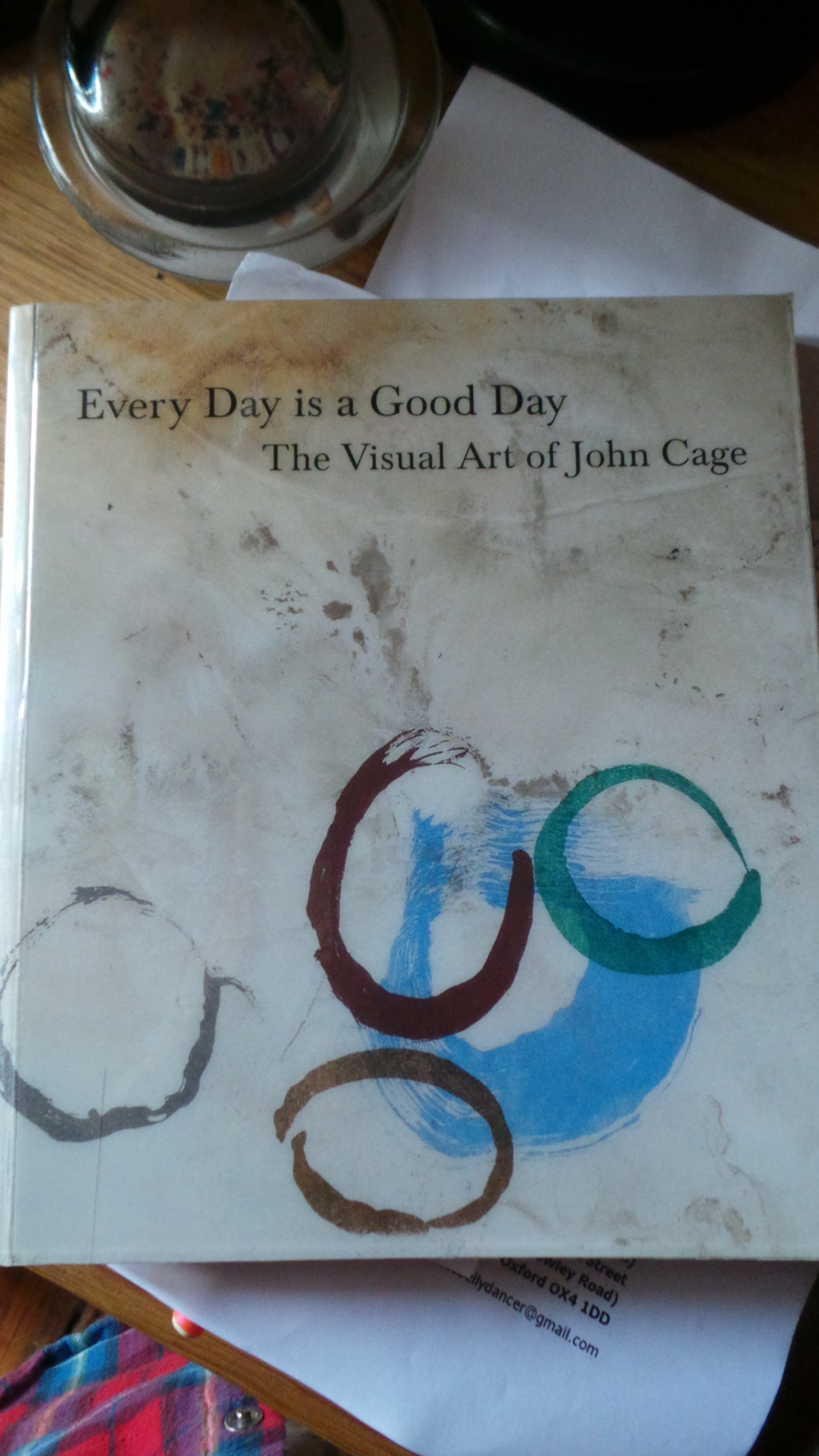
Then, I found a book; nothing new in that but I think it will something to dip into (nothing new in that either) and eventually read through out (that is the deciding factor; good or not so) It is the style I like, and would love to write (note to myself begin today!) in a similar vein. It is called Every day is a good day : the visual art of John Cage.
John Cage (1912-1992) was not only a composer, artist and author, but a thinker who applied his ideas to sound, visual art and writing. He came to visual art in his 60’s ,as I did but there the comparisons end. He was a radical composer and pioneer of the 20th century avant -garde
Dipping into the ‘Companion of Cage’ was so uplifting like no other book I have read/looked at of late in a bid to ‘help myself’ get better, be an artist , be a better person etc. So I will give this book some time and leave you with these quotes
… ‘Art is a way of life. It is for all the world like taking a bus, picking flowers, making love, sweeping the floor, getting bitten by a monkey, [losing ones hair] reading a book, etc ad infinitum … Art when it is art as Satie lived it and made it is not separate from life (nor is dishwashing when it is done in this spirit)’
‘Formerly, one was accustomed to thinking of art as something better organised than life that could be used as an escape from life. The changes that have taken place in this century, however, are such that art is not an escape from life, but rather a an introduction to it’
Friday’s snapshot from the Museum


This snapshot doesn’t come from the library here at Special Collections it can be seen in the Museum of English Rural Life. We share the same site and work closely with one another. We are always finding ways that our collections are linked making our collections more accessible for students, academics and the local community. .
This one was unknown to me, but did make me consider ways in which I too can venture into the Museum from time to time.
This images are from a installation of stainless steel panels forming a circular design in the floor of the museum.
They were originally scraperboard pictures of the farming circle by Harry Brockway. Who was born in Newport, South Wales in 1958. He studied sculpture at Kingston upon Thames Art School and The Royal Academy. While he trained as a stonemason and worked at Wells Cathedral he was also an illustrator and better known to me and the library. He is a member of The Society of Wood Engravers and an associate member of The Royal Society of Painter Printmakers and Engravers.
The ‘floor’ is a constant to adults and children and it is usually being used by would be brass rubbers during school holidays and weekends.
Alphabe Thursday Y is for Yellow

I have dined out on yellow far too many times; but needs must! Again I am at a loss struggling at the end of the alphabet.
But it is the brightest colour in the rainbow not because it is more intense but because it the yellow photons generate the biggest optical response from the eye. I am not sure if yellow is regarded as a special colour in Tibet; certainly it is favoured in China as it is the emperors colour. In some cultures it is considered less attractive and its metaphorical and symbolic associations are denigrating. It is traditionally the shade of treachery and cowardice.
Also clothing designers admit that yellow is very difficult to sell and inclined to call it gold! It cheers me though!
Wednesday’s Wood Engraver


I was introduced to the work of Anne Hayward at a recent wood engraving course at Badger Press in Hampshire. I am new to printmaking and always on the look out for inspiration, so when I found a copy of her book Wood engraving and linocutting I was really pleased. Sadly, I have learned little about her except that she is painter and printmaker and her work has been exhibited at the Royal Academy and the British Library and commissions have included work for the House of Commons and the Folio Society
Anne studied painting and printmaking at Southampton College of Art, ( my claim to fame I also attended Southampton Art College) St Martins School of Art and the Institute of Education, London University. She is a member of the Hampshire and Berkshire Guild of Craftsmen and the Society of Wood Engravers. I would like an original print by her and one day to meet her. Meanwhile I just hope I can learn a little from her book and begin to make some meaningful marks in the wood!
Weekly Photo Challenge … Spring


My back yard is tiny, north facing and surrounded on all sides by houses and rogue sycamore trees. For the 25 years I have wrestled with shade; In truth I gave up fighting years ago but she has never been a comfortable garden fellow. I cannot sneak in with a sun loving plant she will ‘shadow’ it to death!
Fortunately I learned early in our relationship the plants she loves; as a result my garden is a constant delight.
So while the back of my house is in shade so the front is always in the sun. Sadly, I don’t have a front garden just a space where the dustbin was kept before we had wheelie bins (now parked on the pavement) So I have a galvanised water tank as a planter and able to fill it with sun loving beauties. These Irises only grow when their roots are exposed to the sun’s roasting rays.
This spring they have bloomed in the face of shade as she hangs out in the back yard!
 Coat Hanger Doll's House