Wednesday’s Wise Woman … Gill Learner

When my daughter left home and went to live in Brazil – my heart broke. I took lots of measures to alleviate the pain. Reading poetry I found helpful. Quite by accident at work while cataloguing our collection of works published by the Two Rivers Press I come across a poem by Gill Learner.
The calorific value of anxiety for Emma
I stalk through the atlas,
study weather, calculate the time
it must be there, decide you’re heartless
then that probably it doesn’t seem
an aeon-and-a-half to you, among the smells, noise, flavours of exotic places :
and when at last the phone does ring
I shrug away your reasons or excuses.
Consider all the parents, lovers, partners
fretting for backpackers, peace-
keepers, explorers, migrant workers,
their worry gathering in clouds like gas.
Harnessed, this energy could power
a small country for a year. (Learner 2010)
Although ‘M’ and I have kept in contact (our communication skills are finely tuned) and I rarely ‘waited’ for calls, I have indeed burned much energy and can sympathise with the ‘waiting person’.
I have since become more able to cope with the separation; it has not been easy and not yet fully accomplished. But writing about it has helped and I have even written a few poems. Whilst they do not match those of Gill Learner it is a skill I would like to perfect and use some of the wasted energy.
At the airport
At the airport
No strolling out one summer’s morn,
Almost, she strides from the fading wintery sun.
Gone the hesitant step of yesterday
The whys? What ifs? And When?
Have all been asked.
Each kilo weighed and unweighed
Every winter woollie put away to grieve,
Instead summer slithers fit each crevice to offer protection from the sun.
Each strap strained and pulled
The planes face west, more west.
No rest now,
The plans come to an end and new plans awaken.
Lorca, Neruda and Laurie Lee you are to blame,
But even you she has laid aside with love I know.
You will not pay the rent or mediate with officials
But wait,
Your political poems and plays – prize winning language of love,
Neruda’s green ink of hope,
Will nourish her mind and remind her from where she came.
Nela Bligh
Bibliography
Learner, G. (2010). The agister’s experiment Reading, Two Rivers Press.
A missing sail and compass … Part 2
My dad had an older brother, Douglas, who graduated from university with a degree in Mathematics. He joined the Royal Navy and after the war became a school teacher this ended when he got tuberculosis. Then he became a nuclear physicist and was sent out to Maralinga to test a nuclear bomb (1955). Because his entire sea service in the Navy was swinging the anchor round the Isle of Wight. (Unlike is little brotherwho had sailed the world several times) So he opted to fly out to Maralinga via Singapore and back via America thus circumnavigating the world and giving him the opportunity to visit his maternal grandfather Lawless in Boston.
My dad had also visited the family in America. During the war when his ship carrying rockets, destined for Russia, were to be unloaded in New York and transported across land. The dockers in New York were not prepared unload them as they had their war heads on them – even though ship’s crew offered to help – it was still considered unsafe and against union rules. While they argued, Dad took a greyhound coach to Boston. Where he was greeted by the family with open arms as he was the dead spit of grandfather Lawless, who had immigrated to Boston from Ireland many years before.
On the other hand, while in Australia poor Douglas had grown a beard. When the Lawlesses met him at the New York airport they were horrified. They couldn’t get him to the barber quick enough – only hobos wear beards. Douglas was annoyed as it was his pride and joy.
While he was at Maralinga, one of the other men involved with the testing was intrigued by Douglas’ name (Carrick) which he had only ever heard it once before. Had ‘Douglas got a younger brother?’ ‘Was he in the Merchant Navy?’ ‘Well ask him what he’s done about that sail?’
Silent Sunday
Wednesday’s Wise Women … An Ancient Greek Lyric Poet
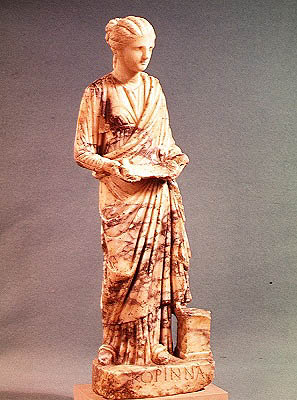
A fragment of Corinna’s poetry.
Terpsecore [told] me
lovely old tales to sing
to the white-robed women of Tanagra
and the city delighted greatly
in my voice, clear as the swallow’s.
Corinna an Ancient Greek lyric poet, was born, it is believed in May some years before her pupil Pinder who was born 522 BC. She was the daughter of Acheloodorus and Procastia from Thebes or Tanagra. She was one of four female poets we know something of living in the Classical Age. First Myrtis ‘… and sweet-voiced Myrtis; all craftswoman of immortal pages’ it is thought that she was the teacher of Corinna. Then, Praxilla and Telesilla survive in a few scattered lines. All earned considerable reputations during their times and after. Plutarch, c. 46 – 120 AD, a Greek historian, biographer and essayist referring to fine deeds of women writes of Telesilla the poetess who urged the women to fight against the Cleomenes for the possession of Argos. Eusebius sings the praises of the Lyric poet Praxilla (Blundell 1995)
It is said that Corinna defeated Pindar in poetry competitions and as a result Pindar called her a sow. It was suggested by Pausanias (a geographer of the 2nd century AD) that her success was due to her beauty and her use of the local Boetician dialect different to the Doric of Pindar’s poems. Corinna was critical of Pindar’s work she described them as being ere embellishment with rare words, paraphrases, melodies and rhythms. In revenge he wrote the famous song ‘Shall we sing of Ismenus or gold-distaffed Mekia or Cadnus or the holy race of sown men or dark-snooded Thebe or the all daring might of Heracles or the glorious honour of Dionysus …’ When he showed it to Corinna she laughed and said that one should sow with the hand not the whole sack. For Pindar had mixed together different myths into one song.
As the only lyric poet of Thebes, Corinna’s tomb is placed in conspicuous part of the city and Pausanias says in his Description of Greece in the the gymnasium there is a painting of her tying her hair back in a ribbon to mark the victory she won over Pindar. (Campbell 1992)
It is sad that little of her work survives but it not surprising as most modern research shows that women’s achievements have been overlooked in a continued male dominated society.
Bibliography
Blundell, S. (1995). Women in ancient Greece London British Museum.
Campbell, D. A. (1992). Greek lyric : 4. Bacchylides, Corinna, and others. London, Harvard University Press.
Wikipedia (2012). “Corinna.” from http://en.wikipedia.org/wiki/Corinna.
A missing sail and compass … Part 1
My dad’s family home in Kensal Green, London was bombed during the 2nd World War so they went to live in their holiday home, on Canvey Island. My dad was always mad on sailing and had a dinghy. The Master of a Thames barge lived nearby and Dad was always stowing away on the vessel and not coming out until it had left land, too late to put him ashore until the first port of call. His mother got tired of that and sent him to sea school- on the T.S. Vindicatrix. Dad hated it, apparently the treatment of the trainees was harsh and unforgiving – not unlike the environment he had left. He joined the Merchant Navy in 1940. Meanwhile he continued to enjoy sailing his dinghy between trips.
He sailed to Zealand for lamb or to bring beef from South America. German submarines used to lay in wait off Freetown, Sierra Leone and on one occasion my dad’s ship was torpedoed there. So they took to the lifeboats, an American plane flew low over them and dropped some cigarettes but nothing to light them with. The airmen, via the radio gave them a compass direction to nearest land, wished them God’s speed and flew on. The compass directions didn’t agree with what the bosun had worked out for them. He asked what he should do, the sailors said they would have gone happily with his readings if the plane hadn’t appeared so stayed with his directions – and they were proved right. During the long days afloat they discussed the future and Dad talked of his sailing at home, and said that when they reached land if nobody objected, he would like the ship’s compass for himself. Another crew member who was a sailing enthusiast said that he would like the sail – and it was agreed.
Eventually they landed in Bahia, Sao Salvador where they sold the lifeboat to pay for transport. Taking the compass and sail with them they went inland to where a small charter plane could be found. It was old and frail working on only one engine. The owner agreed to fly them to Cape Town where a plane was waiting to take prisoners of war and displaced seamen home. He couldn’t risk the weight of sail and compass, so regretfully they left them behind …
to be continued.
Silent Sunday
Wise women and sisters?
Long before my daughter went to Brazil, I collected the music of women. It is a very eclectic collection, but mostly Rock, Blues and a little Jazz – in all forms; vinyl, CDs and now more MP3s. However since ‘M’ left home I have collected even more and she has since joined me by adding videos onto Facebook. So our huge collection of music ranges from the late 1950s to the present day and now has a beautiful hint of Latin America. From Carol King to Rana del rey.
I could wax lyrical about my collection for days, each one song has a story – some make me cry and others make me laugh.
I adore Maggie Bell and her version of Only women bleed really rocks my boat in more ways than one. I am in awe of the the male song writer Alice Cooper!
A Christmas favourite is Fairytale of New York by the Pogues and Kirsty MacColl we know every word. Another one I love to sing loud is Helen Reddy’s I am a woman, this was written in 1975, a no 1 hit and the theme music for the United Nations International Woman’s year. It’s a song I play when I need motivation and womanly assurance.
And when I want to be transported to Brazil, then it just has to be Ana Carolina singing Brasil corrupção I do not understand a word but it sounds good.
So lots of wise women …. But my all time favourite is this one I hope I can be forgiven – although it does fit my paradigm – it doesn’t … this one makes me feel good, happy and sad. Let me know what you think.
http://www.youtube.com/watch?v=Tj6CBRixRhc&context=C3a37490ADOEgsToPDskI6K13l4wCHed4-LvlGRnBc
All bran …

Transom in place
Empire Trooper was to be broken up but her lifeboats were alright as lifeboats go – notoriously, they were pigs to sail and my dad was somewhat of a purist but with all of us children and money being short -needs must.
There was a lot of work to be done converting a double ended lifeboat to a transom sterned yacht. A lifeboat was all we could afford.
He put the lifeboat on chocks on the saltings near Miscellany. Then he cut through the hull of the boat down the stern post and opened it out. He steamed new timbers, using a bonfire and a long drainpipe making them more flexible.
My mother had remove the timber from the pipe and run them, one at a time to my dad who then bent them to make the new curve to the beautiful new mahogany transom he had made – it was poetry in motion.

Years passed by before it was ready for sailing – Dad disliked travelling by bus or train, so holidays were spent at home working on the boat , until one year, Dad said ‘this year we’ll sail round to Canvey Island and stay with the parents, it won’t cost us much , and we’ll hardly be out of sight of land. So, we started out full of optimism.
As soon as we reached Littlehampton and then the gales started. With three children on board and no life rafts, it was a bit risky. Dad decided that the weather would ease that night so we would try a night passage – so about midnight, us children all asleep, we motored out, through the channel with sullen fishermen all the way along the pier glowering at us disturbing the peace; we hoisted the sails and headed north. Within a couple of hours the gale was back and we were forced back to Littlehampton, to the renewed baleful glares of the fishermen.
Littlehampton is a nice place but there is a limit to how many times you can visit Arundel castle. After several days we were running out of money. Fortunately, we had a bag of scrap with us. Somehow we never got out of the habit of picking up scrap metal. Living in boatyards there was always plenty about and with friends in the trade it came in handy when things got desperate – we were now desperate.
By weekend, there was nothing for it but to head for home, stores were very low, and us children were hungry -when weren’t we? Looking in the depleted store cupboard mother remembered the recipe for wartime cakes using flour, almond essence, cornflakes and condensed milk (a luxury touch) and they didn’t need cooking. Mother found all the ingredients except cornflakes. But we had All Bran – What’s the difference? Mother wasted no time and we all enjoyed the cakes, unfortunately the bran had a drastic effect on my dad – this of course was highly amusing to us children. We were careful not to let him see us giggle as he rushed to the toilet several times for the next few hours.
Silent Sunday

Wise women … through the lens of Gordon Parks

Voices in the mirror by Gordon Parks I came across this book quite by accident. Our library is undergoing reorganisation of its collections, part of the project is to remove some duplicate books, and this biography was amongst them.
As a newby photographer and a would-be poet this book by a noted film maker and poet (Parks 1969) it begged to be read. So, on the pretext of my research into ‘wise women’ I read it hoping he might reveal at least one. I was not to be disappointed.
In his role as a photographer he came into contact with many women, wise and beautiful, who might have been overlooked or even kicked aside in the street. He was to bring them international acclaim and notoriety.
One of them was Bessie Fontenelle. In the late 1960 Parks was to write an essay about the poverty in Harlem. To find a family on which to hang his research would not be easy. Those he approached were indeed living in poverty and hungry but were very reluctant to reveal it to their neighbours let alone the world.
Even Bessie in her rickety home, of decaying walls shabby floor covering, when asked replied, ‘what good’s to come of our showing people how we have to live?’(Parks 1990)
Park’s explained that in doing so she might help others in a small way … eventually she was persuaded. Parks with all the compassion he could muster moved in with the family for seven days without a camera – getting to know the ‘problems that they confronted.’ On the 8th day he bought a small camera, using it quietly – careful not abuse their privacy. He also kept a diary to record the difficulties of the Fontenelles.
It is a sad story of a woman who ‘never complained … and got used to hard times’ and was cruelly crushed by society when trying to provide for her family.
While Parks’ book has drawn my attention to a very wise woman it has broaden my view of photography and poetry in art –creatively and wisely. I will look and listen closely to more of his work and learn.
Bibliography
Parks, G. (1969). Gordon Parks : a poet and his camera. London, Andre Deutsch.
Parks, G. (1990). Voices in the mirror : an autobiography London, Doubleday.
 Coat Hanger Doll's House