Wednesday’s wise women …. and votes for women

For the last few weeks on and off, I have been reading about the Suffragette Movement through the eyes of Annie Kenney and Hannah Mitchell who were actively involved. I was very pleased when the Guardian Review featured Emily Wilding Davison as ‘My Hero.’ Emily Wilding Davison was a militant suffragette who famously ran into the the racing horses at Ascot Race Course. It was her intention to affix a flag; a salute for Votes for Women to the King’s horse so that when it won the race, so the flag would be raised on high. Emily Davison well known for her publicity raising and reckless challenges, misjudged the situation and was fatally struck by the horse as it galloped to the winning post!
This shocking incident was reported then through the eyes of those who believed what they wanted to believe and inform a nation too, who also had preconceived ideas, about women’s right’s, behaviour and current events.
So Emily Wilding Davison; an Oxford graduate with a first class degree was given various labels as if to gloss over her so called latest act against the outdated-constitution! As Val McDermid said ‘the various factions … called her martyr, mad woman, maniac and simply mixed up.
Hannah Kenney in her Memories of a Militant says, that Emily Wilding Davison who had recently spent 6 months in prison for setting fire to a pillar-box, goes on to say no one had knowledge of her intentions. As the King’s horse passed, who was the favorite for the Derby, she flung herself in front; the jockey was thrown and the Emily lay unconscious and died 4 days later. Annie Kenney suggests that ‘Emily died as she lived, for women’s freedom. The funeral procession was like those given for crowned heads. She had won her crown of martyrdom. Peace was hers’.
However Val McDermid says differently; that although Emily was not the only suffragette to lose her life for the cause her action was recorded in film; in that respect possibly put the ‘issue’ on to the world stage. However, after close consideration, frame by frame it becomes clear that she did not fling herself under the King’s horse she was in fact reaching for the bridle so rather than a suicidal stunt it was a shocking accident. It was an example of the lengths women were had to go to, now that mild measures of violence were not working. Also as Mary Phillips in the Militant suffrage campaign in perspective says the Constitution of the country make it impossible for the Women’s Course to be pursued constitutionally unless they had adequate support from men. The women had to fight by every means open to a voteless person’ … those outlawed by the constitution.
Weekly Photo Challenge … Signs
Signs in Reading have lost any uniqueness like most towns since we have become corporate. So I thought I would step back in time; or rather have a look around the museum where I work and I was not disappointed. However on the way I spied two other images outside the local Hell’s Angel’s Clubhouse that I think do belong in the collection or the little mishmash of signs for this week’s challenge.


Last week I visited Typography …
I began the study of Greek and Latin many years ago without the use technical devices more than a pencil, sharpener and eraser and copious reams of paper. Also we didn’t expect more than a fair copy of printed text to translate from. I never progressed to original text, so the published works were usually user friendly enough and the grammar and reading aids were never difficult to read. It seemed the printers were able after many decades to adapt the fonts and devices to suit the needs of discerning scholars.
Much later I began to learn to read Sanskrit; just as I began my journey with a laptop and a very shaky internet connection. Also the use of a Devanagari keyboard which was more trouble than it was worth.
In many ways it would have been easier to learn Sanskrit using transliterated text but my teacher; a ‘purist’ and very ‘old school’ was strictly against it. Transliteration does contain all the components to reproduce Sanskrit speech. As it uses Roman letters it does make it a little easier for beginners. Nonetheless for a student to progress at some point she must learn the Devanagari script and it pronunciation. As students with the existing impressions of the sounds of the our native Roman Alphabet we will not become fluent and enjoy developed learning experience.
Also the Sanskrit scholar does not have the joys of a well printed books. When I began my studies I was using very poorly produced texts; the font was small and unclear, the paper flimsy and binding inadequate. There was one consolation; the books were not expensive, postage was kept to a minimum and often the required works were supplied almost by return from India.
So with the limited ‘technical’ resources the students carried on much as we did in the Dark Ages; relatively speaking of course with pen and paper.
I am not an expert as regards the production of print, but I assume while mechanically producing Devanagari letters for a press, although time consuming was no different that making Roman letters. However now technology has moved on and type is produced in ways that I could not images let alone expound here.
So this week I paid a visit to the Typography Department, here at University of Reading to find why it is easier to find text in other Devanagari ‘languages’ such as Marathi, Hindi and Nepali; you only have to look at the newspapers in the corner shop to see that the fonts are really quite modern, sophisticated and pleasing.
Although Sanskrit uses the same Devanagari text it has a larger number of conjuncts consonants or ligatures than its modern vernacular counterparts. While it considered acceptable for the modern fonts to have half-consonants or halants; in Sanskrit they are called Viramas and traditionally have required more complex representations and these change also depending on the Sandhi rules which can only be untied or not with a large pot of tea and some biscuits … and not so much with a technical device.


So while these images represent some of the work done recently to perfect the Devanagari font in particular Sanskrit, for which I am grateful … I will leave it to the experts to explain.
Silent Sunday


Saturday’s creation …
After a busy week I was beginning to wonder if i could be creative as I had previously planned. The working week was pleasantly shortened with the Spring Bank Holiday, also I had the opportunity to do a mediation and yoga session before going to work each day day. Annually there is a Kundalini Festival at a local boarding school (during half term) While it is a residential course, it seems locals can attend, as when for a small donation. For me it did seem like a good idea and it was. The environment is spectacular and I was made welcome. The experience while very new to me was beautiful and meaningful. However the extra 4 hours each day this involved, did have an impact on the rest of the day. Other routines like my blog and its preparation were sadly neglected. The creations are not as I hoped. Nonetheless as I promised myself, here they are with a haiku. Not a spiritual delight but a slice of truth.
After this mornings session at Leighton Park School I am going to an art class learning book-binding … I will keep you posted.
Meanwhile have a good day!


Tiny eraser cuts
colour stamps hang close together
in picture gallery
Friday’s Library Snapshot … Monica Poole
Monica Poole (1921-2003) was an English wood-engraver and lived most of her life in Kent. The images found in Kent by Reginald Turner demonstrate her intimate knowledge of the county.
She studied at Abbotsford and Broadstairs School and attended Thanet School of Art at Margate where she was introduced to the wood-engraving of Geoffrey Wales. During the War Monica worked in an aircraft factory.
Between 1945 and 1949 at the while studying at the Central School of Arts and Crafts she met Noel Rooke the wood-engraver.
Inspired by John Farleigh’s illustrations in the Man who died by D.H. Lawrence, Monica decided to study with him. Later in 1986 she produced the book The Wood Engravings of John Farleigh.
When her husband died in 1969 Monica retired and lived quietly in Tonbridge.


Images from
The man who died by D.H. Lawrence ; with illustrations drawn and engraved on wood by John Farleigh.
Vision of England ; Kent by Reginald Turner with wood engravings by Monica Poole
Alphabe Thursday … B is for Bell (s)
B is for bell or my little collection of bells that I have bought over the years to decorate the house at Christmas.Since I don’t celebrate Xmas quite so much these days I have left these hanging strategically so they ring as I go in and out of the back door. They probably drive the neighbours to distraction but I like them! I am not sure of their origin; one or two are cowbells and worn by goats or sheep so that they are heard if they wander off. The others are probably made in the style of ‘whatever’ and sold at an inflated price to foolish collectors like myself!!


Wednesday’s Wise Woman … Annie Kenney continued
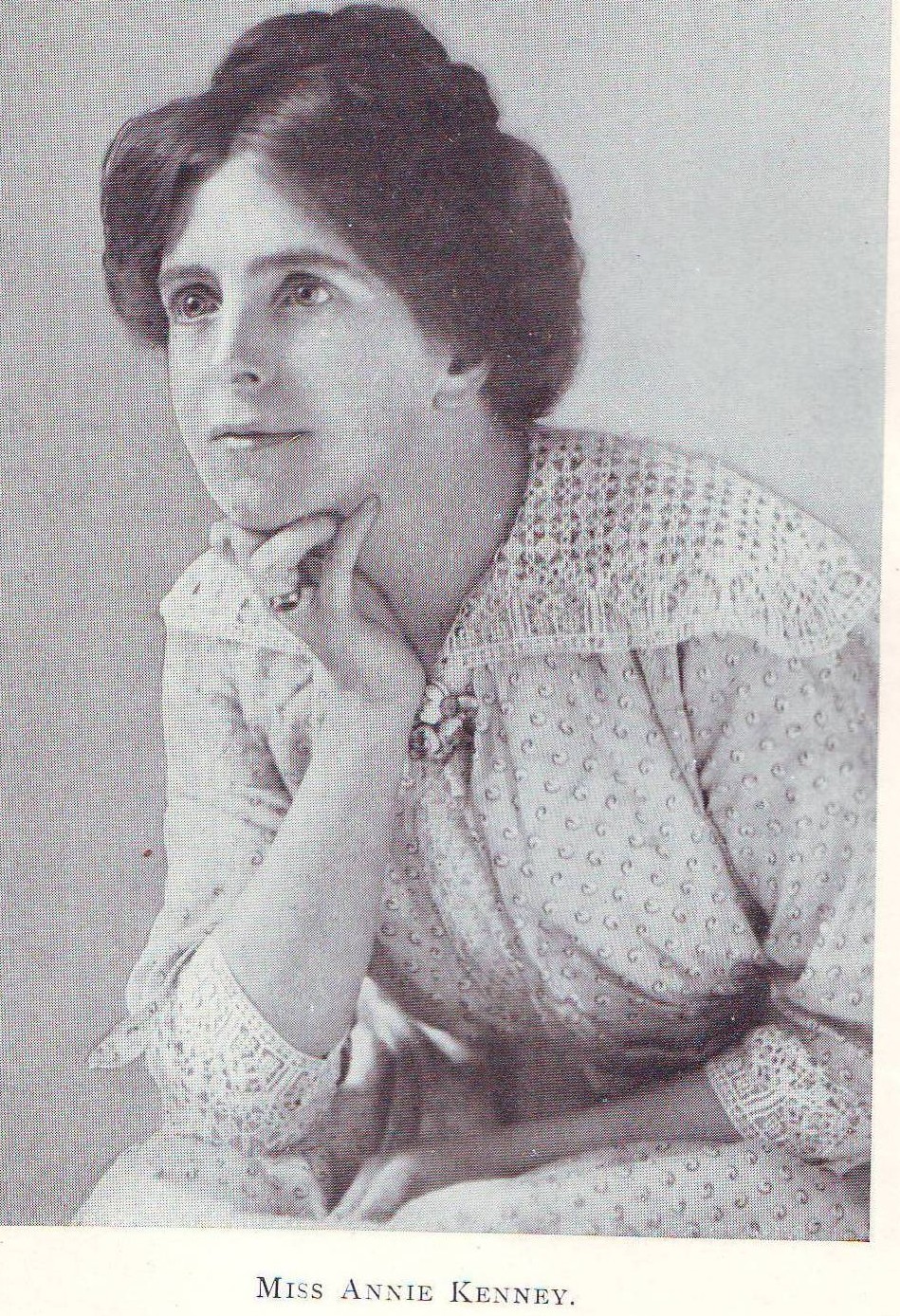
Annie Kenney left school at 13 with no education. She failed at mathematics and geography; wasn’t good at writing but did enjoy poetry. Annie began working full-time in a local mill; she left home at soon after five in the morning and arrived home at after six in the evening. Although Annie didn’t go to night-school she admired those who did. After a day in the mill she had neither the energy or inclination to ‘get on.’ Her friends and workmates attended technical classes, cookery and needlework courses etc. Annie hated dressmaking but liked to cook if her mind was on it. She liked washing and scrubbing floors; which was just as well as she points out in her memories. After 12 hours at work it was likely that there would be plenty of work to do at home as well. This was unfortunate, she added for those who wanted to ‘study’ as well.
Annie hated study but grew into it later. She didn’t blame her parents for her hardship; beginning work at 13 then was normal and necessary. As the years passed so life slipped into a monotonous pattern of work, Sunday school and church.
At seventeen the family moved to a bigger detached house with a large garden which she said ‘was a great source of joy’.
Each Sunday Annie and her brothers and sisters were allow to invite a friend for tea. They would assemble around the table and discuss a current topic. The older children had been reading the likes of Haeckel, Spencer and Darwin; these discussions were beyond her understanding at the time but they did stand her in good stead when she became unwilling to accept statements without proof.
That year she was confirmed but was already having doubts about the holy trinity. During her time preparing for her confirmation Annie questioned the vicar at length about her concerns but they were never resolved adequately. However, she was confirmed, he advised her that ‘her search for the truth would lead to a good understanding of the Gospels’. Singing the closing hymn ‘Oh Jesus I have promised’ Annie still was not convinced that she would be able to keep her promise.
Little did she know that in a few months she would be in the Oldham Library reading the Rational Review in particular a special edition where she read the sayings of Voltaire; that she never forgot. Although she said ‘the ‘Rational Review didn’t change her belief in God, she suggested that Voltaire did start a train of thought which never ceased to vibrate. One thought leads to another and one discovery leads to another.
During this time she remained outwardly happy-go- lucky, but within it was a time of self contemplation. meditation and secret communion with her higher self.’
At 20 Annie became interested in social issues and reading articles by Robert Blatchford in the Clarion she enjoyed reading his weekly writings on nature, philosophy and life. Thousands of men and women in the Lancashire factories owe their education to Robert Blatchford
He was their literary father and introduced them to Walt Whitman, William Morris, Edward Carpenter, Ruskin, Omar Khayyam the Early English Poets , Emerson and Lamb…. To be continued.
Weekly Photo Challenge … Background
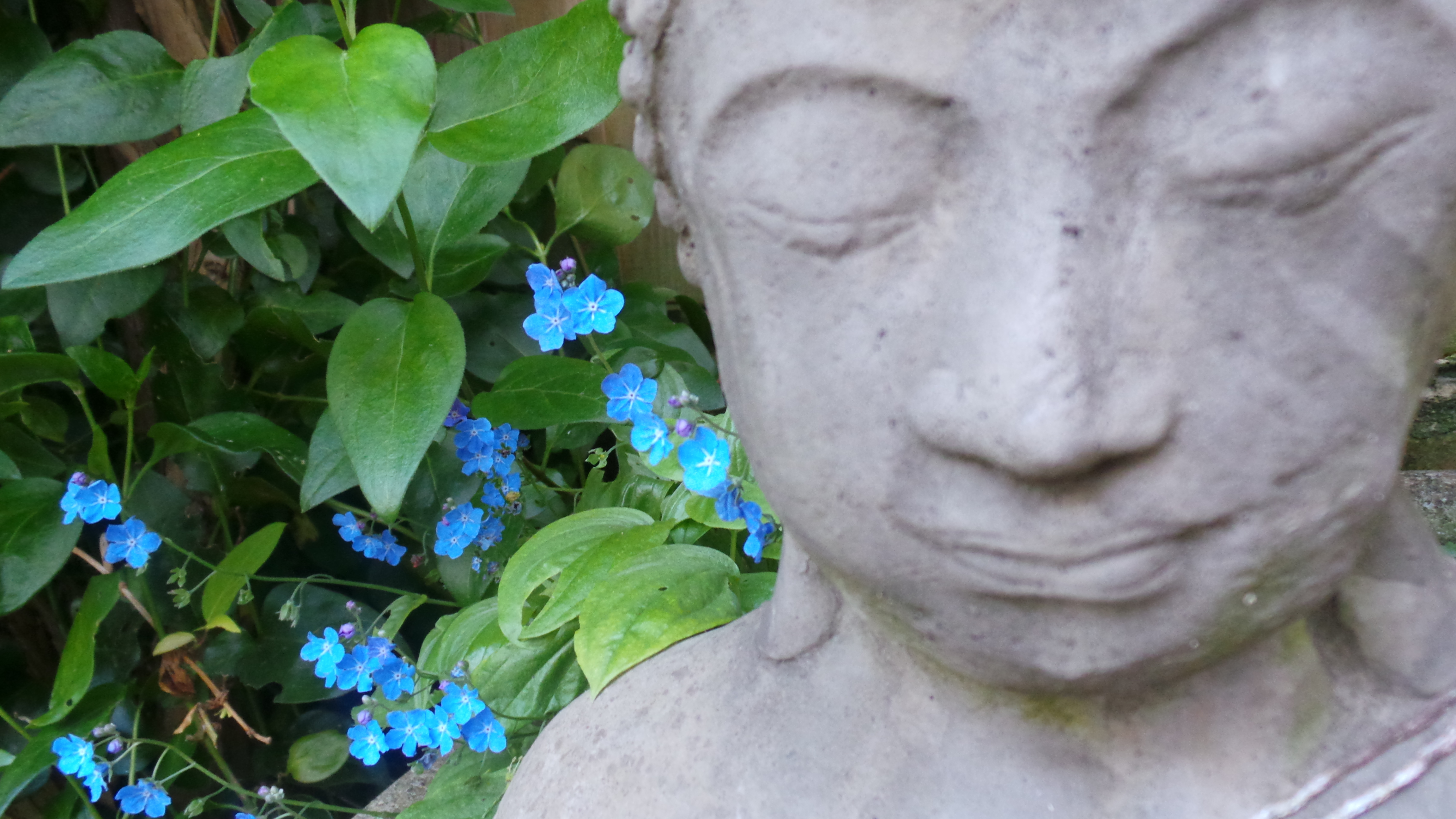
We bought this Buddha statue not only to bring a little alternative culture to our little English cottage garden in the centre of Reading but to hide a an ugly 6ft fence post. Disguising the ‘background’ was our aim and has been for the last 25 years. The garden is a tiny space (4mtrs x12 mtrs) at the back of a row of Victorian terraced houses beyond is another row of identical homes. Although for almost a century these houses were family homes for the workers in the town; it has become mostly student’s rented accommodation and first time buyer land so there is a continual flux of ownership and [dis]-repair. Those of who remain here; ones who are averse to the modern nearby housing estate or unable to afford semi- detached suburbia; have chosen to block out the less desirable aspects of living in a dense population.
So the background can take many forms; like a rambling roses, ivy and some native hedge that serve as a very pleasant perfumed barrier. We are lucky that the garden over the years has become a perfect background to the house in particular the kitchen and this time of year when the tulips are behaving like tarts and then it takes centre stage.
Some plants are not background more ground cover like this very lovely perennial looking like a forget me not but its name I have conveniently forgotten.
This little motif demonstrates well that even Buddha is being overcome by the groundcover who fancies herself as a star!
Last week I learned that … I know nothing!


While attending school in the the 1950s soon after the our ‘winning’ the 2nd World War, my education lacked the depth and breadth that my grandchildren ‘enjoy’ today. The little school was a attached to the local village church, where the Church of England and its religious practices and celebration were honoured by the children. All very valid but it left us all bereft of any social history and culture beyond that of the church and the royal family. To add a bit of dramatic delight and intrigue we learned about the gallant crusaders and their campaigns against the barbarian Moors somewhere across the English Channel! Like little patriots and with the power of rote and propaganda we absorbed the joys of the mighty British Empire and the way in which us Brits had brought civilization and holiness to the world.
Although we partied on the village green around the Maypole. We even had regular English country dancing lessons where we learned to reel and to dosy doe; we had no cultural education. We were pulled up short if were questioned life beyond the church and our glorious new Queen.
Move fast forward; of course I have learned differently about England and its place in the world and fairly certain my grandchildren will be given a more accurate education.
Nonetheless I still know little about life in the United Kingdom before we were ‘invaded’ by the Christians and the Pagans were ethnically cleansed. I believe that at first the Pagans were tolerated and that some of their traditions were embraced by the immigrants and became absorbed to the Christian rituals. I would think that some natives transferred their allegiance to the new ways for various reasons
Sadly there came a time when the old ways were considered dangerous or disruptive to the country’s well being and banishment of Pagan practices began.
I don’t pretend to be a scholar of Paganism, I have only dipped into a few books and begun my research so this may be a work in progress..
I assume that a witch is a representation of Paganism and those watchful of them, and familiar with the Continental witch hunts and trials, would lookout for gatherings of witches; a big gang would be quite formidable. However, there were other clues, ‘she was often am old and weather- beaten crone, with a protruding chin, knobbly knees. She walked with a bent back; leaning heavily on a stick. With hollowed eyed, without teeth, lips trembling with palsy, she might mutter in the streets’ as described by Katherine Briggs in Nine Lives’
Such women at odds with their neighbours, in their loneliness would dote upon their pet dog or cat; it they could afford one. Instead they would perhaps enjoy the company of a rat or a toad.
One story is told that in the early 19th century that old woman was thrown in a pit near Monk Soham in Suffolk because she had a cat ,she must be a witch, another bit of evidence against her was that she went to church in a black silk dress, therefore her means must be ill-gotten.
So the stories go on… and my research into English Folklore and my lack of old English culture!
Further reading
Nine Lives by Katherine Briggs
Everyman’s book of English Folk Tales by Sybil Marshall ; illustrated with wood engravings by John Lawrence
English Folklore by Christina Hole
 Coat Hanger Doll's House