Saturday’s creation …


This week has been for me it bit upsy downsy; a bit of an emotional switch-back ride. Fortunately the blog has remained stable; as I tend to keep a little pattern that is prepared in advance.
Looking back at the posts this week it seems I have featured men and women who have achieved great things in adverse situations seemingly unaffected by emotional disorder.
So I sing their praises and give them well deserved honour.
Meanwhile I give you today’s creation and another I did earlier in the week; that show, not so much I was emotionally discharged more that I know little about this absurd combination; Ginkgo Biloba and the Moon.
However, and I come to the point, both works were a very pleasant way to sit and play in my disrepair. It would seem that play and fun was the only way to bring calm to my recent milady.
So; while it is not great to boast of my ignorance I would like to expound the need for play.
What do you think? … not particularly about the creations.,
More: fun … Do we have enough?
Friday’s Library Snapshot …


Images from:-
Athanasii Kircheri Fuldensis e Soc. Iesu presbyteri Musurgia vniuersalis, siue, Ars magna consoni et dissoni in X libros digesta ; quà vniuersa sonorum doctrina, & philosophia, musicaeque tam theoricae, quam practicae scientia, summa varietate traditur ; admirandae consoni, & dissoni in mundo, adeòque vniuersà naturà vires effectusque, vti noua, ita peregrina variorum speciminum exhibitione ad singulares vsus, tum in omni poenè facultate, tum potissimùm in philologià, mathematicà, physicà, mechanicà, medicinà, politicà, metaphysicà, theologià, aperiuntur & demonstrantur.
published by Romae Ex typographia Haeredum Francisci Corbelletti, 1650 and writtenby Athanasius Kircher (1602-1680)
Kircher was a German Jesuit scholar who wrote extensively on various subjects such as Orientalism, geology and medicine. He was often compared to Leonardo da Vinci as he knowledge and experience was so diverse.
He was regarded by some as the founder of Egyptology and famously made links between ancient Egyptian and modern Coptic languages. Kircher was interested in the Chinese culture and wrote and encyclopedia of China.
While he did study volcanos and fossils it was his interest in microbes and his work with a microscope that brought him recognition. Especially when he suggested that the plague was caused by infectious microorganisms and considered ways in which the spread of the could be prevented.
His fascination in technology and things mechanical didn’t stop there; he invented a magnetic clock, various automatons and a megaphone. Although Kircher did conduct a study of the magic lantern in the above book he did not invent as it sometimes suggested.
While he was considered a ‘giant’ in his day by the end of his life he became ‘outdated’ by the likes of Descartes.
Alphabe Thursday … D is for Dictionary


In particular the Dictionary of the English Language written by Samuel Johnson and published on the 15th April 1755. It is considered among the most influential dictionaries in the history of the English language.
Johnson began this mammoth task in 1746, at at the request of a group of London Booksellers, who were unhappy with dictionaries of the period. He was paid 1,500 guineas (£230,000 in today’s money) and planned to take 3 years. However with only clerical assistance to help with small tasks it took him 9 years to complete. He did go on to publish several revised editions in his lifetime. The copy in our collection would have been among those! Although not its original binding; because dictionaries are so well used they do not always stand the test of time. However, almost 300 years is good enough for me.
Not only was the finished item, printed on the finest paper and very large it was also very expensive at £1600.00 it was more than the author was paid.

Wednesday’s wise women … in the Trade Union
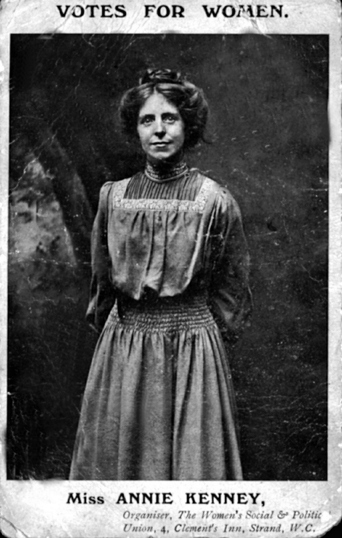
Annie Kenney like Hannah Mitchell became active in the Suffragette movement from the shop floor. Unlike Mrs Pankhurst, her daughter, Christabell and the likes of Emily Wilding Davison who were from the middle classes, able to afford private education and were now able to benefit from further education at University and of course unable to vote and partake in matters of state..
Hannah Mitchell after only two weeks of education fled the repression of home for the drudgery of domestic service and the misery of a clothing sweatshop. She married and had a child, but her commitment to fight against sex and class discrimination remained, as Labour Party campaigner and writer.
Annie Kenney began her campaign a bit sooner. After meeting Mrs Pankhurst and becoming a Trade Unionist she began speaking out for women at Fair grounds and public places around Manchester. Soon she was encouraged to canvas for new members. Before long she was canvassing for herself. It had come to her notice that while there were 96,000 women members of the union there wasn’t a woman official. At a coming election there were two vacant seats and three candidates. After a show of hands on election night Annie was top of the poll. As a committee member she was required to meet with the other members weekly. They would hear cases of injustice and pay ‘out of work’ money. She was paid a shilling for each meeting attended.
Annie wanted to learn more about the history and the aims of Trade Unionism so joined a correspondence course at Ruskin College.
Meanwhile she was mentored by a constitutional Trade unionist, Mr Crinnion, whom she described as a friend to the factory women. He took her to meetings and encouraged her to speak with women and explain the benefits of cooperation.
Annie in her memories suggests that the Trade Unionism then was absolutely genuine; in its objectives to protect the workers against real injustice. The funds were for those out of work.. She went on to say that now (some 10 years later in 1924) the whole movement seemed to be one of mild revolution, and the one word that is used for all purposes was strikes!
She thought that may be Trade Unionism had had its day, that the State may have to undertake the work that undertaken by the movement in the past. Now that there was a Insurance Act, Unemployment Act and the relief work that had been done by the Trade Union has been taken over by the state. Now women had the vote and a legitimate member of the state it should offer the protection that the Union had provided before.
Please note I have missed out the the fight that occurred during this time to enable women to find themselves in the care of the state!
I will return …
Weekly Photo Challenge … Fleeting
Oh Dear!
I don’t do fleeting or should I say they tend not to happen to me. My camera and I are rarely at the same place when a moment might happen. So any fleeting moment is pure happenstance; so lacks that certain ethereal romantic air that others seem to capture.
Mine rather have that ‘ here is one the didn’t happen as it should have … ‘


Last week I learned that …


Last week I learned a bit more about popular literature. While I was in Brazil I discovered folk-popular poetry or so-called string literature (literatura de cordel) of Northeastern Brazil. Which is like our English chapbook; a hybrid literature of ‘popular and folkloric forms’.
The works are small booklets; the cover serves as the title page and it always has a meaningful woodcut image. They are made of poor quality paper and the type is like that of a newspaper. They are sold in plazas, markets and on street corners in many towns and cities of Brazil and are still readily available.
The string literature comes from the oral folk tradition of northeast Brazil. The poet sings the poem in the markets and fairs with a partner in a poetic duel or rival. This was very popular during the 19th and 20th century. Earlier, in the 16th and 17th centuries a type of cordel existed but more like a leaflet of verse; described by Mark J. Curran in Brazil’s folk-popular poetry ‘a literatura de Cordel as a ‘poetic flyer’ brought to Brazil by Portuguese colonizers.
Which ties in with Victor E. Neuburg who writes in the The Penny Histories about ‘eighteenth century writers who looked back with pleasure at the little books [chapbooks] as ‘the old classics of the nursery’. He goes on to say that the story of Faust; and a popular chapbook that was reprinted several times came from Germany. Also Fortunatus , first published in Augsburg in 1509 first appeared in England in 1600. These booklets were not produced for the landed gentry but the ‘ordinary men and their growing interest in books and the spread of literacy in all sections of society including the poorest.
So while it is difficult to say where and when the concept was created; it certainly worked and traveled well.
Silent Sunday


Saturday’s creation …
I struggled this week to be creative in more ways than one. Clearly time is always an issue but when I found the time. Then I found difficulty with subject matter, the effect I wanted and the result;
I have a magnificent Ginkgo Biloba tree in my garden. I say magnificent, it is in a large pot and only stands 3 metres tall; relatively speaking it is a beauty!
While I cannot attempt to transpose a tree on to my my print material; a leaf would be just right!
I wanted to ‘grab’ an image much like I do with my camera these days. So I made some sketches and traced them onto my pencil erasers (6cm x 4cm)
I carefully engraved the image; this way and that and proceeded to print.
I was disappointed with the result; it was pretty but didn’t say what i had wanted it to say and it was too messy … even a cluster of Ginkgo Biloba leaves are too much to take in
So I tried with the shape of the leaf …


This is a work in progress and there are more issues that came out of this week’s exercise that I am going to work on .
I will value comments!
Friday’s Library Snapshot


Images from the
The book of the great sea-dragons, Ichthyosauri and Plesiosauri, gedolim taninim, of Moses : extinct monsters of the ancient earth ; with thirty plates, copied from skeletons in the author’s collection of fossil organic remains. They were deposited in the British Museum by Thomas Hawkins (1810-1809) a fellow of the Geological Society.
He formed two important collections of ichthyosaurs and long-necked plesiosaurs from the Jurassic rocks in the Somerset area (southwest England) where he lived
The frontispiece “Sea-dragons as they lived”, signed; designed and engraved by John Martin, 1840; rest of the plates are printed by Standidge & Lemon, 77, Cornhill and most signed: drawn from nature on stone by H. O’Neill, 2 by B.J. Rossiter and 9 plates signed: G. Scharf, del et lithog.
Alphabe Thursday … C is for Chapbook
Chapbooks or penny histories as they were sometimes called formed an important element of printed popular literature of the 18th century. Although they were produced for the adult reader; it was at a time when childrens works were overtly moral and didactic in tone. It was not surprising that younger readers should be drawn to the attractive little books. In them could be found abridged versions of accounts and stories of knights and maidens, giants, monsters and fairies which had delighted medieval audiences before. Chapbooks were more exciting than the books they had become used to.
It is not clear where the word Chapbook came from; some say it came from the word ‘cheap’ or from the old English word for trade ‘ceap’
Chapbooks measured 6 inches by 4 inches and had 24 pages; some were much smaller They are unbound and the title page serves as a the wrapper on which was always a woodcut illustration.
They were sold by pedlars, hawkers and other itinerant merchants who were known as chapman. During this time there were few shops ‘out of town’; so the chapman was the essential link in the distribution to isolated villages and farms.He didn’t only sell books he supplied other small items required in the household such as needles, pins, ribbon and thread. From the closing of the 17th century an important part of his stock-in-trade was a small bundle of books which he sold for a copper or two.


 Coat Hanger Doll's House