Alphabe Thursday K is for Key
For centuries crude methods have been used against intruders when the premises are occupied. However it was not so easy to seal a dwelling during the occupier’s absence. While there are references to locks in old tales and myths from China and the near east and also mentioned in the Bible and Homer; there is no clue when the lock and its key was first used.
The first lock to be found was a wooden lock discovered on the site of the great palace of Sargon at Khorsabad, north of Nineveh. A similar design was drawn on the frescoes of the Temple of Karnak on the Nile. These findings and other clues prove that the lock found was at least 4000 years old; but more surprising that other locks have been discovered with the same mechanical principle in other places in the world such as Scotland, Japan, Norway and America.
More intriguing is that such locks were still being made and used until recent times.
It would seem that the keys were not the tiny slips of metal we carry today; Greek keys for instance were enormous and a wealthy owner would employ a slave to carry a bunch of them; crooked over his shoulder.
It was not until the Romans came to the fore that locks and their keys attained a fuller development. However Iron Roman keys did not survive completely (the Greek and Egyptian keys made of bronze that didn’t corrode) so historians had to construct replicas.
A favourite device of the time in the safeguarding of possessions was the padlock, used by the Romans, Asians, Chinese and the peoples of the Mediterranean. They were often made of brass and the practice of forming cases in the form of animals was very common.
In Britain when the Romans withdrew in 410 AD and the subsequent invasions of the Anglo Saxons and Jutes etc. so the building work of the Romans crumbled into decay. It was not until 600 AD and the ‘conversion to Christianity’ that led to the building of churches and permanent homes, when the need for security, locks and keys become standard again.
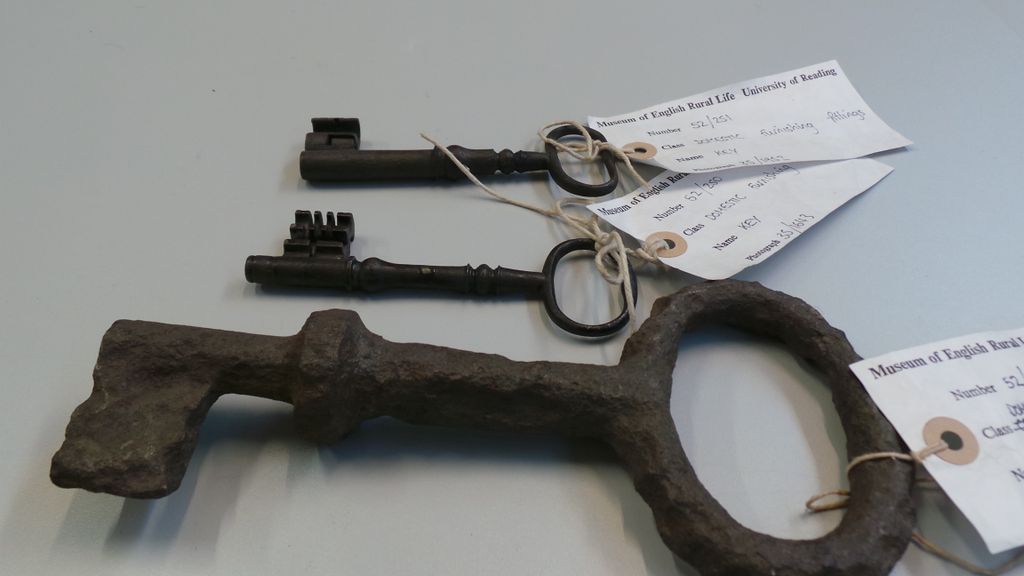
Three keys from the collections of the Museum of English Rural Life (MERL 52/250,52/251, and 52/382) Images copyright Museum of English Rural Life, University of Reading (2013)
Further reading Keys; their history and collection by Eric Monk

 Coat Hanger Doll's House
I am so glad locks and keys are on the whole smaller good post thank you
Thanks for visiting and kind comments _/\_ x
I love a post like this one! The history of everyday objects is so interesting to me.
I too! So rich and relevant. Thank you for visiting and kind comment _/\_ x
I guess people always had prized possessions and needed a way to secure them. All very interesting! I’m amazing at the idea of having your own slave to carry your keys – I guess you had to really trust them… {:-Deb
Thanks for visiting I am glad that we (bloggers) can have an open door! _/\_ xx
I wish I could get someone to carry MY keys around. Perhaps I would lose them less.
ha!
This was a kool link! I enjoyed learning something new.
Thanks for linking.
A+
Yes, we should invest in the local economy … 😉 thanks for kind comments _/\_ x