Wednesday’s wise woman … Chico da Silva
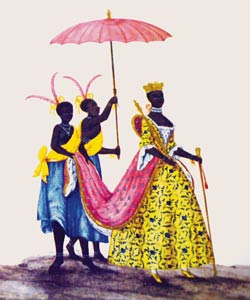
Chico da Silva (Francisca da Silva de Oliveira 1732-1796) became known as the slave who became a queen. She was the daughter of Antonio Caetano de Sa; a Portuguese master and his enslaved lover Maria de Costa
Chica first worked for Sergeant Manuel Pires Sardinha by whom she had two sons; who went to Portugal to study at Coimbra. Her second master Jose da Silva Oliveira was forced to sell her to Joao Fernandes de Oliveira; a diamond mine owner and governor of Arraial do Tijuco, one of the richest men in Brazil.
Chico and Joao became lovers and had thirteen children. In 1777 Joao returned to Portugal with his sons who were granted noble status in the Portuguese court. Their daughters remained in Brazil with Chico and went to the famous Convent Macaúbas. Although they never married during Joao’s absence Chico retained her high status.
Joao and Chica da Silva’s relationship was a scandal in colonial Brazilian society. Chica, a former slave went on to become the most powerful women in colonial Brazil. Chica was banished from her local church that was frequented by whites only. However, unperturbed and to show the locals Chica’s power; Joao built her a church for her personal use.
Chico went to great lengths to fit the status quo by joining threes brotherhoods one for whites, another for Africans and the other for Mulattoes.
Chica became a symbol of Brazil’s so called ‘racial democracy’. Scholars suggest that she used miscegenation and her connections to achieve and keep her higher social status like other African Brazilians at the time. Historians maintain that concubinage and marriage between a white male and a black female in colonial Brazilian society was a way in which slaves could change their social position and not be subject to racism.
Also, manumission (the freedom of slaves) thought to be the beginning for the formation of a positive black identity, was in fact the contrary and the of acceptance of values of the elite, and the assimilation of former slaves and their their descendants in this society
It seems that sex was the key for some females slaves and her children to gain freedom. Concubinage with white men offered advantages to black women because, once free, they reduced the stigma of colour and slavery for them and for their descendants.
Chica, like other freed female slaves, achieved her freedom, loved, had children and ensured they had a good education. So that her offspring could maintain a place in Brazilian high society.
Chica da Silva died in 1796. She was buried at the Church of Sao Francisco de Assis, a privilege that only wealthy whites enjoyed.
 Coat Hanger Doll's House