Last week I learned that … Nothing changes.
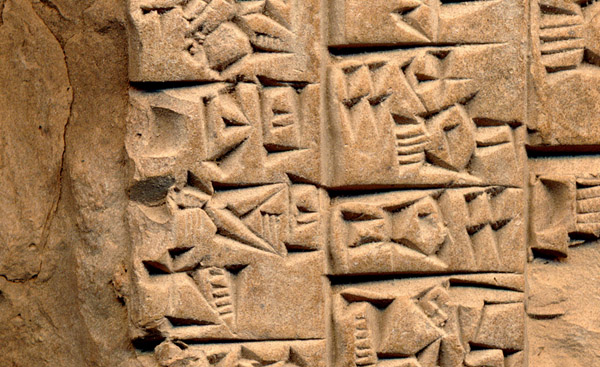
There is evidence to suggest that libraries did exist as long ago as 3000 BC. Inscribed clay tablets were discovered in archaeological remains in Mesopotamia. Although Egyptians were able to write they used perishable materials. The papyrus leaves found along the Nile made the finest quality paper but it was very fragile and evidence of a library was not found.
The Mesopotamians did not have reeds instead they had clay; so while the resulting tablets produced were clumsy, they were durable. They even survived fire. Clay proved to be a cheap and an easy way to produce tablets and became the prefered writing material in Syria, Asia Minor, Persia and for a while in Greece. They remained in use for 2500 years.
The Sumerians devised a style of writing best suited to the tablets using a reed or a wooden stylus; with simple wedge shapes, later called cuneiform after the Latin cunei.
The tablets were used to record numbers of commodities; such as animals, jars, baskets etc., for a a simple form of bookkeeping.
Archaeologists often found the clay tablets in lots; some amounting to thousands . Their contents sometimes more sophisticated; bills, receipts, inventories, contracts; all kept together for easy access.
Sometimes the findings would prove to be different; the subject matter on the tablets was not just facts and figures, but included ideas and creative text. Near Nippur some excavators found a group of tablets dating 2500 BC; on which were listed geographical names, gods , writing exercises and hymns it looked as if may been the remains of library.
In 1980 archaeologists were digging in the remains of a palace in Ancient Ebla in Syria. They came across a room filled with 2000 clay tablets dating between 2300-2250 BC, when invaders set it on fire. The tablets were found in piles on the floor. They would have been kept on wooden shelves; which did not survive the fire.
Thorough research of the tablets show that they were the Palace records and collections of other texts. They had been arranged on the shelves in a room and may have been the working library of the royal scribes.
This collection was relatively small; it could be consulted by browsing along the shelves.
As the libraries grew so did the need for a catalogue. Among the tablets at Nippur, two catalogues were found dated 2000 BC. The second one rather longer than the first; that seemed to relate to the reshuffling of two collections.
It seems that nothing changes … much!
Further reading:- Libraries in the Ancient World by Lionel Casson
 Coat Hanger Doll's House
